2026-10-15
In the specialized field of marine infrastructure, the distinction between a functional dock and a high-performance maritime asset lies in the precision of engineering, material science, and lifecycle management. For project owners, marina developers, and commercial port operators, selecting the right partner is not merely a procurement decision—it is a long-term investment in operational efficiency and asset resilience. When evaluating partners, the benchmark for technical expertise is often measured against the standards set by leading dock builders com initiatives, where innovation meets practical maritime architecture.
The Complexity of Modern Dock Engineering
Contemporary dock construction has evolved far beyond simple timber piles and decking. Today, the industry demands solutions that withstand hydrodynamic forces, accommodate superyacht scales, and integrate smart utility networks. The engineering framework requires a multidisciplinary approach encompassing geotechnical analysis, structural dynamics, and environmental compliance.
Material Science in Saltwater Environments
The selection of construction materials dictates the 50-year lifecycle of any marine structure. Traditional pressure-treated timber, while cost-effective initially, presents challenges in longevity and environmental leaching. Modern specifications increasingly pivot toward:
Reinforced Concrete: Utilizing high-performance concrete with corrosion-inhibiting admixtures and cathodic protection systems to combat chloride ingress.
Marine-Grade Aluminum: Specifically 6061-T6 and 5086-H32 alloys, offering superior strength-to-weight ratios and inherent corrosion resistance through mill finish or advanced powder coatings.
Composite Piling: Glass-fiber reinforced polymer (GFRP) systems that eliminate galvanic corrosion concerns while providing high flexural strength for seismic zones.
Professionals in the field, such as those affiliated with DeFever, frequently emphasize that material selection must be matched with specific water salinity levels, tidal ranges, and vessel wake impacts to prevent premature structural fatigue.
Structural Design Parameters for High-Traffic Marinas
The operational demands of modern marinas require dock systems that handle dynamic live loads from 100-ton superyachts to high-speed forklifts used in dry stack storage. The engineering calculations must account for berthing energy, mooring line tensions, and wave attenuation.
Pile Foundation Systems
Subsurface conditions determine the pile foundation strategy. In soft mud or sandy substrates, helical piles offer installation efficiency with minimal environmental disturbance, providing immediate load-bearing capacity. For bedrock or dense soil conditions, driven steel pipe piles filled with reinforced concrete remain the industry standard. Advanced projects utilize batter piles—angled supports—to absorb lateral forces generated by wind and vessel thrust, a specification often detailed in technical guides by dock builders com experts.
Floating vs. Fixed Dock Systems
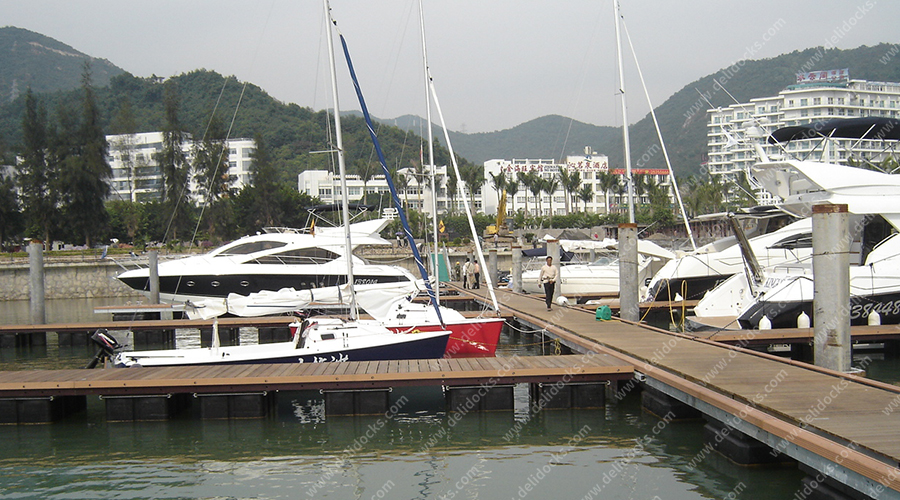
The choice between fixed (pile-supported) and floating (pontoon) systems hinges on water level fluctuation. Fixed docks suit reservoirs and lakes with stable water levels, providing permanent utility connections. Conversely, floating systems are mandatory for tidal zones or reservoirs with significant drawdown, utilizing galvanized steel or concrete pontoons guided by pile restraints. Hybrid systems are increasingly deployed, combining fixed marginal wharves with floating outer basins to maximize utility during extreme weather events.
Integration of Utility and Smart Infrastructure
Modern dock construction transcends structural integrity; it is about creating interconnected marine facilities. Electrical systems must adhere to strict National Electric Code (NEC) Article 555 requirements, emphasizing ground-fault protection and corrosion-resistant enclosures. The scope now includes:
Shore Power Systems: High-amperage pedestals capable of delivering 480V three-phase power for megayachts, often with integrated smart metering for utility billing.
Potable Water and Fire Suppression: Looped water mains with backflow prevention and dry-barrel fire hydrants spaced according to NFPA 303 standards.
Fiber Optic Networks: Conduit systems designed to support high-speed data, security cameras, and IoT-based environmental sensors for real-time water quality monitoring.
Integrating these utilities during the initial construction phase, rather than retrofitting, reduces lifecycle costs by up to 40%, a key metric used by leading developers who consult with dock builders com specialists to ensure future-proofing.
Addressing Industry Pain Points with Engineered Solutions
Operational downtime and costly repairs are the primary adversaries of marina profitability. The industry faces three distinct pain points that demand engineering-grade solutions:
1. Accelerated Corrosion
In saltwater environments, galvanic corrosion can compromise structural integrity within a decade if not mitigated. Solutions include the implementation of sacrificial anode systems (zinc or aluminum) on all submerged steel components, dielectric isolation fittings to prevent dissimilar metal contact, and the use of stainless steel fasteners (Type 316) throughout the substructure.
2. Wave Wash and Scour
Unmanaged vessel wake leads to bottom scour, undermining pile stability and increasing sediment turbidity. Engineered solutions involve the installation of wave attenuation devices—floating breakwaters with reinforced concrete cores or vertically laminated timber walls—that dissipate energy before it impacts the dock system. Scour protection, utilizing riprap or articulated concrete blocks, is critical for maintaining the bearing capacity of the submerged substrate.
3. Accessibility and ADA Compliance
Ensuring universal access in a fluctuating tidal environment is a complex hydraulic challenge. Floating access platforms with self-adjusting gangways, powered by hydraulic lift systems or simple hinge mechanisms, provide compliant slopes (typically 1:12 ratio) regardless of tide level. This is a non-negotiable standard for public and commercial facilities.
Companies like DeFever have long championed the integration of these mitigation strategies during the design phase, recognizing that preemptive engineering reduces operational expenditures over the asset's lifespan.
Environmental Stewardship in Dock Construction
Regulatory compliance has become a primary driver of construction methodology. Projects must now navigate stringent permitting processes governed by the Army Corps of Engineers (in the US) and local environmental agencies. Best practices include:
Utilizing bubble curtains or sheet pile cofferdams during pile driving to attenuate underwater noise, protecting marine mammals.
Implementing silt curtains to contain turbidity during dredging operations.
Specifying untreated tropical hardwoods (such as Greenheart) or recycled plastic lumber for decking to eliminate leachate concerns.
Adherence to these environmental protocols not only facilitates permitting but also enhances the marketability of the facility to eco-conscious clientele, a strategic advantage often highlighted by dock builders com professionals.
Lifecycle Cost Analysis and Asset Management
For institutional investors and marina owners, the focus is shifting from initial capital expenditure (CAPEX) to total cost of ownership (TCO). A comprehensive lifecycle cost analysis reveals that premium materials and advanced construction techniques—such as precast concrete decks with integral pile caps—yield lower TCO despite higher upfront costs. Key factors include:
Maintenance Cycles: Aluminum and concrete systems typically require inspection every 5-7 years, versus annual inspections for timber structures.
Insurance Premiums: Facilities built to ASCE 7-16 wind load standards (for hurricane zones) often qualify for reduced property insurance rates.
Depreciation Schedules: IRS depreciation for marine infrastructure favors assets with a determinable useful life; engineered concrete and steel structures often qualify for longer schedules, improving balance sheet metrics.
The expertise provided by specialists referencing dock builders com standards is essential for optimizing these financial models, ensuring that the infrastructure serves as a durable revenue generator rather than a liability.
The construction of high-performance marine facilities requires a synthesis of geotechnical engineering, material science, and utility integration. By prioritizing engineered solutions over generic construction methods, stakeholders can achieve structures that withstand environmental extremes, reduce maintenance burdens, and comply with rigorous safety and environmental regulations. Engaging with technical experts who adhere to the rigorous standards set by dock builders com ensures that the final asset is not merely a dock, but a strategic infrastructure investment. With firms like DeFever leading the charge in integrating these advanced methodologies, the industry continues to set new benchmarks for quality and longevity.
Frequently Asked Questions
Q1: What are the key differences between residential dock construction and commercial marina construction?
A1: Commercial marina construction requires adherence to stricter engineering standards, including ASCE 7 wind/seismic loads, NFPA 303 fire protection codes, and ADA accessibility guidelines. While residential docks may use simpler timber pile construction, commercial facilities demand reinforced concrete, heavy-gauge aluminum, or composite systems capable of handling high-density vessel traffic, continuous utility demands (shore power, water, data), and emergency vehicle access. The permitting process for commercial projects is also significantly more rigorous, often requiring extensive environmental impact studies and hydrodynamic modeling.
Q2: How does the engineering approach differ for floating docks in hurricane-prone regions?
A2: In hurricane zones, floating dock systems are engineered with oversized pile guides (typically 2-3 times longer than standard) to accommodate extreme storm surge elevation changes. The anchoring system must be designed for uplift forces, often utilizing helical anchors or concrete deadmen embedded at depths below the scour plane. Pile caps are reinforced to prevent shear failure, and all utility connections are designed with flexible couplings and rapid-disconnect mechanisms to prevent catastrophic utility line rupture during storm events. Post-storm recovery protocols are also integrated into the design phase.
Q3: What is the typical timeline for a large-scale dock construction project?
A3: For a facility with 50-100 slips, the timeline generally spans 18 to 24 months. This includes 6-8 months for permitting and environmental compliance, 3-4 months for geotechnical investigation and final engineering drawings, and 8-12 months for construction, depending on seasonal weather windows (e.g., avoiding sea turtle nesting seasons or winter ice flows). Phased construction is often employed to allow partial facility opening while work continues on outlying sections.
Q4: How do you ensure the structural longevity of utility conduits under a concrete dock deck?
A4: Longevity is achieved through segregation and protection. Electrical conduits (typically Schedule 80 PVC or rigid galvanized steel) are placed in separate chaseways from water lines to prevent cross-contamination risks. All conduit penetrations through concrete are fitted with water stops and expansion fittings to accommodate thermal movement. For critical systems, such as 480V shore power, we specify cast-in-place duct banks with spare conduits (typically 25% spare capacity) to allow for future upgrades without core-drilling into finished concrete, which compromises the waterproofing membrane.
Q5: What qualifications should I look for when selecting a dock construction firm?
A5: Verify that the firm holds a current contractor’s license with marine classification, carries pollution liability insurance (specifically for in-water work), and employs a Professional Engineer (PE) licensed in the project state. Review their portfolio for projects with similar scale and environmental conditions. Inquire about their quality control plan, specifically regarding concrete mix certifications, weld testing protocols, and as-built survey documentation. Firms that provide detailed 3D BIM models (Building Information Modeling) for clash detection before construction tend to have fewer field errors and change orders.