2026-10-15
Coastal infrastructure projects face severe environmental pressures, including rising sea levels, strong tidal fluctuations, and extreme weather patterns. Traditional fixed pier systems often fail to cope with these dynamics, leading to structural fatigue, high maintenance demands, and safety hazards for moored vessels. Consequently, marine engineers, port authorities, and commercial marina developers increasingly turn to modern floating solutions to secure marine assets. As a pioneer in maritime engineering, DeFever designs and supplies robust floating infrastructure engineered to withstand these dynamic marine environments.
Integrating heavy-duty floating marine docks into a harbor layout is not merely an aesthetic choice; it is a complex engineering decision. The process demands a deep understanding of hydrodynamics, material science, and soil mechanics. This analysis examines the engineering specifications, structural materials, and anchoring methodologies required to construct high-performance floating marina systems that meet strict international maritime standards.
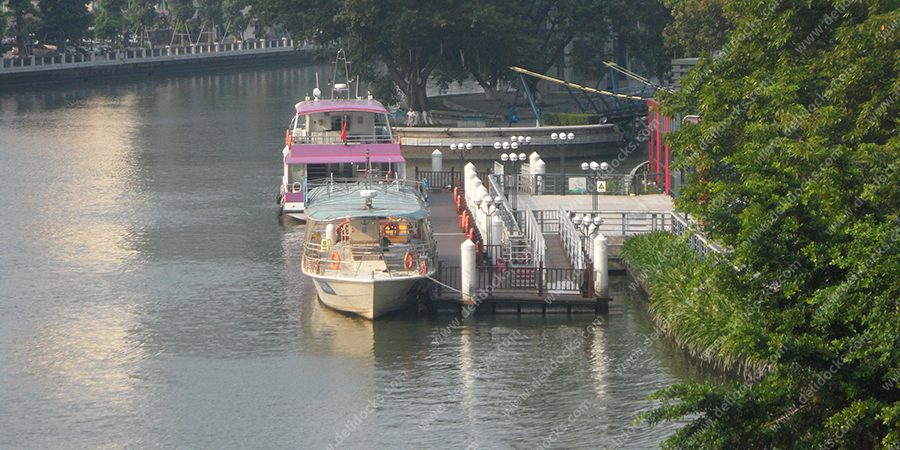
1. Hydrodynamic Principles and Basin Forces
A floating structure must maintain equilibrium while subjected to continuous external forces. Unlike land-based structures that rest on static foundations, a floating system interacts dynamically with the water column. Designing these structures requires precise calculation of hydrostatic and hydrodynamic forces to ensure stability and safety.
Hydrostatic Buoyancy and Draft Calculations
The foundational design of any floating pontoon relies on Archimedes’ principle. The buoyant force acting on the pontoon must equal the total weight of the structure plus its operational live loads. Marine engineers calculate the draft—the depth to which the pontoon sinks into the water—to ensure a consistent freeboard. Freeboard is the distance between the deck surface and the water level. A consistent freeboard is vital for safe passenger boarding and efficient utility connection management.
When calculating buoyancy, engineers must account for:
Structural Dead Load: The weight of the concrete or aluminum frames, internal flotation cores, decking materials, cleats, and utility raceways.
Variable Live Load: The weight of pedestrians, maintenance vehicles, and transient equipment placed on the deck surface.
Environmental Snow and Ice Accumulation: In northern latitudes, the structural calculations must factor in the weight of winter accumulation to prevent excessive draft.
Wave Attenuation and Wave Period Dynamics
Waves transfer significant kinetic energy to floating structures. When planning a commercial marina layout, engineers analyze wave height ($H_s$) and wave period ($T$). If the wave period matches the natural resonant frequency of the floating structure, the resulting movement can cause structural failure and severe discomfort for marina users.
To mitigate wave energy, heavy-duty floating marine docks can be configured as floating breakwaters. These massive structures attenuate waves by reflecting wave energy back into the open water and dissipating the remaining force through internal shear and drag. The efficiency of a floating breakwater depends on its width-to-wavelength ratio; a wider structure is necessary to block longer wave periods effectively.
2. Structural Classifications and Material Science
Choosing the correct structural materials directly determines the lifespan, structural capacity, and maintenance schedules of a floating system. Modern marine engineering primarily utilizes three structural systems: heavy-duty concrete pontoons, marine-grade aluminum alloy frames, and galvanized steel structures.
Concrete Pontoon Systems
For high-energy environments, commercial ports, and mega-yacht moorings, heavy-duty concrete pontoons represent the gold standard. These systems consist of a reinforced concrete outer shell cast over a solid core of Expanded Polystyrene (EPS).
High Mass and Stability: The high dead weight of concrete provides high inertia, reducing motion caused by wind and waves. This provides a solid feel underfoot, comparable to a fixed pier.
EPS Flotation Core: The internal EPS core has a high density and is completely closed-cell. If the outer concrete shell is breached due to an impact, the pontoon retains its buoyancy, preventing submersion.
Reinforcement and Durability: Modern marine concrete utilizes hot-dip galvanized steel rebar, stainless steel, or synthetic fiber reinforcement combined with low-porosity concrete mixes to prevent saltwater intrusion and subsequent internal corrosion.
Aluminum Alloy Frame Systems
For luxury yacht clubs and sheltered basins, aluminum alloy frames offer a highly adaptable, modern, and lightweight alternative. These structures typically utilize marine-grade 6061-T6 or 5086 aluminum extrusions, which provide exceptional structural strength and natural oxidation resistance.
The lightweight nature of aluminum allows for rapid assembly, modular expansion, and reduced shipping weights. Aluminum frames are paired with rotomolded polyethylene (HDPE) floats filled with EPS. These systems are highly modular, allowing marina operators to easily alter slip configurations as vessel size requirements change. When developing high-end waterfronts, specifying floating marine docks constructed from marine-grade aluminum ensures a clean, architectural finish alongside excellent load-bearing capabilities.
Galvanized Structural Steel Systems
In heavy industrial ports or areas prone to impact from commercial vessels, structural steel frames protected by heavy hot-dip galvanizing provide superior yield strength. These systems are designed to handle extreme torsional loads but require systematic inspections to monitor the sacrificial zinc coating and prevent oxidation in highly corrosive saltwater environments.
3. Engineering Load Specifications and Structural Testing
To comply with international standards such as those established by the World Association for Waterborne Transport Infrastructure (PIANC) and the American Society of Civil Engineers (ASCE), floating systems must undergo rigorous structural load testing and finite element analysis (FEA).
Uniformly Distributed Live Loads
Commercial docks must support significant foot traffic, utility carts, and emergency equipment. Engineering standards typically define the required uniform live load capacity based on the classification of the marina:
Light Residential/Recreational: 1.5 kPa to 2.0 kPa (approx. 30 to 40 psf)
Commercial Marinas & Yacht Clubs: 3.0 kPa to 4.0 kPa (approx. 60 to 80 psf)
Heavy Commercial/Industrial Gateways: 5.0 kPa or higher (approx. 100+ psf)
Wind and Current Drag Forces
When vessels are moored to a floating system, they act as sails, transferring immense lateral loads to the dock structure during high winds. The wind drag force ($F_w$) is calculated based on the air density ($\rho$), wind velocity ($V$), drag coefficient of the vessels ($C_d$), and the projected lateral surface area of the moored fleet ($A$):
$$F_w = \frac{1}{2} \rho V^2 C_d A$$
Similarly, tidal currents exert drag forces on both the submerged hulls of moored vessels and the floating pontoons themselves. Engineers must sum these lateral forces to size the structural connection joints, cleats, and mooring systems correctly.
4. Advanced Anchoring and Mooring Methodologies
The structural integrity of floating marine docks is entirely dependent on the anchoring system. The anchoring must secure the docks against lateral forces from wind, waves, and currents while allowing unimpeded vertical movement to accommodate tidal changes.
Selecting the appropriate mooring system requires a detailed geotechnical analysis of the seabed and a bathymetric survey of the basin. The three primary mooring methodologies include:
1. Pile Guide Systems
Pile anchoring is the most common method for commercial marinas. Steel, concrete, or composite piles are driven deep into the seabed substrate. The floating pontoons are attached to these piles using internal or external pile guides equipped with low-friction, wear-resistant polymer rollers or wear blocks.
Pros: Excellent lateral load resistance; ideal for high-current environments and heavy commercial traffic.
Cons: Highly visible, which may conflict with aesthetic preferences; installation requires specialized barge-mounted pile-driving equipment.
2. Elastic Mooring Systems (Seaflex-type)
Elastic mooring utilizes high-strength elastomeric synthetic cables anchored to the seabed via drag-embedment anchors or concrete gravity blocks. These cables are installed under pre-tension, allowing them to stretch and contract smoothly with the tides while keeping the dock in a precise, stable lateral position.
Pros: No visible piles above the water line; excellent shock absorption in swell-prone basins; suitable for deep-water installations where traditional piling is physically impossible.
Cons: Requires regular underwater inspections by commercial divers to assess cable tension and wear.
3. Anchor Chain and Cable Systems
A traditional mooring method that uses heavy-duty galvanized stud-link steel chains connected to heavy concrete sinkers or fluke anchors on the seabed. The chains are crossed under the dock structure to control lateral movement.
Pros: Cost-effective in deep water and suitable for muddy or sandy seabeds where piles cannot achieve sufficient skin friction.
Cons: Chains sweep the seabed as the docks move, which can destroy sensitive benthic ecosystems and marine habitats; requires frequent chain replacement due to accelerated abrasive wear and corrosion.
5. Environmental Durability and Corrosion Prevention
The marine environment is highly corrosive. Steel oxidizes, aluminum can suffer from galvanic corrosion, and concrete can degrade due to sulfate attack and carbonation. Long-term structural durability requires meticulous material specification and active protection strategies.
Mitigating Galvanic Corrosion
Galvanic corrosion occurs when two dissimilar metals—such as aluminum and stainless steel—are in electrical contact in the presence of an electrolyte like seawater. To prevent this, engineers at DeFever utilize non-conductive isolation materials, including neoprene gaskets, nylon bushings, and Delrin isolation washers, at all structural fastening points. Additionally, sacrificial zinc or aluminum anodes are integrated into the underwater steel and aluminum structures to draw corrosive currents away from primary structural elements.
Combating Biofouling and Siltation
Marine growth, such as barnacles, algae, and bivalves, accumulates on the submerged surfaces of pontoons over time. This biofouling increases the overall draft of the floating system and increases hydrodynamic drag. Pontoons must be engineered with smooth, non-porous materials or treated with environmentally safe anti-fouling coatings to minimize marine adhesion and simplify periodic cleaning procedures.
6. Commercial Applications and Utility Integration
Modern marinas are complex municipal projects requiring the seamless integration of water, power, fuel, and communication systems directly into the floating platforms.
Industrial-grade floating marine docks feature dedicated internal utility raceways or service ducts located beneath the deck. These compartments protect pipes and electrical cables from environmental exposure and mechanical impact while allowing easy access for maintenance crews through removable deck hatches. This clean design protects sensitive infrastructure, prevents accidental fuel or sewage spills, and ensures a clean, clutter-free walking surface for marina guests.
Secure Your Waterfront Infrastructure
Designing and constructing a world-class marina requires balancing complex environmental conditions with structural longevity. Using low-quality materials or incorrect anchoring designs can lead to catastrophic failures, costly down-time, and safety hazards during storm events. Working with experienced marine engineering professionals ensures that your floating infrastructure is designed to handle local wind, wave, and soil conditions perfectly.
At DeFever, we specialize in delivering custom, high-durability floating dock systems engineered to the highest international maritime standards. Our team can help you with comprehensive site assessments, hydrodynamic calculations, and custom structural design services.
Ready to discuss your upcoming waterfront engineering project? Contact our technical sales and engineering division today to submit your bathymetric data, request a detailed structural consultation, or obtain a comprehensive project proposal.
Frequently Asked Questions (FAQ)
Q1: What is the average design life of a concrete floating marine dock system?
A1: A professionally engineered concrete floating dock, designed with high-density, low-porosity marine concrete and galvanized or composite reinforcement, typically has a design life of 30 to 50 years. Achieving this lifespan requires adhering to a scheduled maintenance program, including checking sacrificial anodes and inspecting mooring connections.
Q2: How do floating marine docks perform during extreme storms or hurricane surges?
A2: Floating docks generally perform much better than fixed piers during major storm surges because they rise with the rising water levels, preventing the structure from being submerged or lifted off its foundation by upward hydraulic forces. However, their survival depends on the height of the mooring piles or the travel limits of the elastic mooring cables; if the surge height exceeds the pile height, the docks can float off the piles and drift.
Q3: Can aluminum floating docks be used in saltwater environments?
A3: Yes, provided they are constructed using marine-grade aluminum alloys such as 6061-T6 or 5086. These alloys form a natural, protective oxide layer that resists saltwater corrosion. It is critical to ensure that all stainless steel fasteners are completely isolated from the aluminum frame using non-conductive polymer bushings to prevent galvanic corrosion.
Q4: How do you determine whether to use pile guides or an elastic mooring system?
A4: The choice depends on water depth, environmental loads, and soil conditions. Pile guides are highly reliable and offer excellent lateral resistance in shallow to medium water depths (up to 15 meters) with stable soils. Elastic mooring systems are preferred in deeper water, where driving extremely long piles is cost-prohibitive, or in sensitive marine ecosystems where pile driving is restricted due to acoustic disruption to marine life.
Q5: What maintenance is required for the internal EPS flotation cores?
A5: Solid EPS (Expanded Polystyrene) cores require virtually no direct maintenance because they are completely encased within a protective outer shell of concrete or rotomolded polyethylene (HDPE). The primary maintenance task is conducting annual inspections of the outer protective shell to check for mechanical cracks, impacts from vessel collisions, or structural breaches that could expose the inner core to fuel solvents or long-term physical wear.