2026-10-15
For marina developers, resort owners, and civil waterfront planners, the demand for robust, adaptable, and safe recreational platforms has never been higher. A floating patio dock represents a strategic asset—transforming underutilized water edges into premium hospitality zones, crew staging areas, or private club lounges. Unlike traditional fixed piers, these buoyant structures accommodate significant water level fluctuations, making them ideal for reservoirs, tidal zones, and storm-prone basins. This guide provides a high-level examination of engineering parameters, material selection, modular integration, and long-term asset management, drawing from field-proven practices in international marina engineering.
Leading this sector, DeFever supplies heavy-duty modular floating systems that meet ASCE and PIANC guidelines. Our focus remains on delivering zero-defect structural integrity while minimizing environmental footprint—a balance that defines modern B2B waterfront infrastructure.
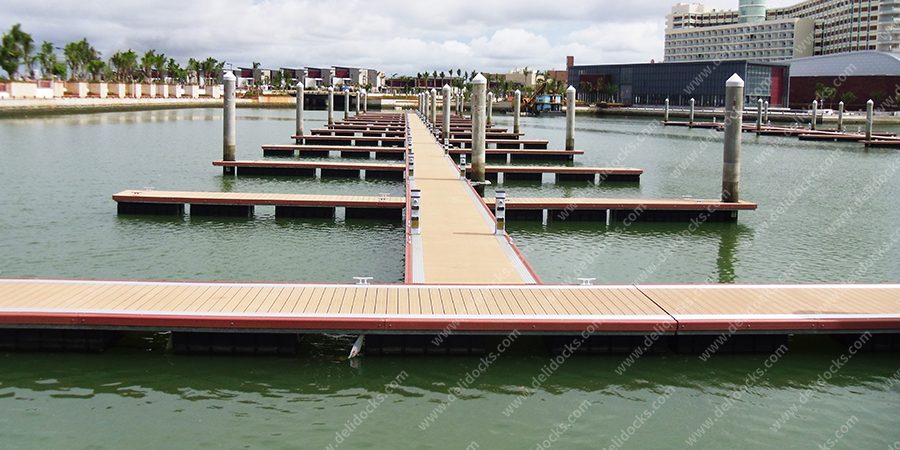
Critical Load Engineering for Patio-Style Floating Platforms
Commercial floating platforms must resist static, live, and dynamic loads that exceed residential specifications. For a floating patio dock intended for group gatherings, outdoor furniture, planter boxes, and portable bars, engineers calculate a uniform live load of 100 to 150 psf (pounds per square foot). In high-occupancy scenarios, such as event decks, safety factors rise to 1.6x. Key load considerations include:
Concentrated point loads: Heavy planters, fire pits, or stage equipment require localized reinforcement via aluminum stringers or thickened HDPE panels.
Dynamic mooring forces: Wave action, wind gusts, and vessel berthing impose lateral stresses—mitigated by resilient dock bumpers and deep-set pile guides.
Buoyancy reserve: A minimum of 35% freeboard reserve ensures the platform stays stable even when fully saturated with water or loaded beyond typical limits.
Structural engineers at DeFever perform finite element analysis for each modular section, guaranteeing deflection below L/250, which preserves deck joint integrity and prevents tripping hazards. For B2B buyers, requesting a certified load chart and floatation redundancy plan is standard due diligence.
Material Science: HDPE, Concrete, and Composite Systems
Selecting the right floating platform material directly impacts life-cycle costs and operational safety. Three dominant technologies exist for commercial floating patio dock construction, each with distinct advantages based on water chemistry and usage intensity.
High-Density Polyethylene (HDPE) Rotomolded Units
HDPE remains the industry benchmark for freshwater and saltwater environments. UV-stabilized, chemical-resistant, and 100% recyclable, these modular blocks incorporate internal foam fill (expanded polystyrene or polyurethane) to guarantee positive buoyancy even if the shell is punctured. Cross-linked HDPE offers superior impact resistance for marinas with frequent boat traffic. Floating patio dock sections manufactured from virgin-grade HDPE also integrate anti-skid embossing and pre-cast utility conduits, simplifying electrical and plumbing runs to shore.
Prestressed Concrete Floatation
For extreme stability in wind-exposed reservoirs or large events, concrete floating patios provide unparalleled mass-damping. Prestressed concrete pontoons with a protective epoxy coating resist abrasion and freeze-thaw cycles. However, these systems require specialized crane installation and reinforced anchoring. Their high inertial mass reduces wave-induced motion, making them suitable for floating restaurants or wedding venues.
Aluminum-Framed Composite Decks
Welded 6061-T6 aluminum frames, topped with co-extruded PVC or capped composite decking, produce lightweight yet torsionally rigid platforms. This configuration permits large-span, column-free surfaces ideal for arranging patio furniture clusters without intrusive cross-members. Galvanic corrosion is prevented using nylon isolation washers and sacrificial anodes.
Key Application Scenarios for Commercial Floating Patio Docks
Understanding the intended usage spectrum allows specifiers to tailor buoyancy, railings, and access gangways effectively. Common B2B installations include:
Resort pool decks and beach clubs: Floating patios extend over shallow water, offering sunbathing zones directly above lagoons. Anti-slip EPDM or teak-style PVC surfaces enhance barefoot safety.
Yacht club lounges and bar platforms: Heavy mooring cleats, retractable awnings, and integrated LED lighting transform a standard floating patio dock into a premium social hub.
Public waterfront parks and fishing piers: ADA-compliant floating patios with wheelchair-accessible gangways and perimeter railings at 42 inches allow municipal compliance while maximizing water access.
Floating event stages for concerts or regattas: Composite decks integrate shore power distribution, sound system anchor points, and crowd-load certifications up to 200 psf.
Each scenario demands consultation with marine engineers to determine mooring patterns, gangway slope limits (max 1:8 for commercial accessibility), and utility routing. DeFever provides site-specific design packages, including wind rose analysis and wave attenuation recommendations.
Solving Industry Pain Points: Stability, Mooring, and Environmental Compliance
Despite their advantages, floating patios face scrutiny regarding lateral movement, biofouling accumulation, and permitting delays. Below we detail how modern engineering mitigates these issues.
Anchor System Engineering for Fluctuating Levels
Conventional deadweight anchors fail in soft bottoms or during drought cycles. Professional installations use either:
Spiral-driven steel piles: Hot-dip galvanized piles driven to competent strata, combined with sliding pile guides that allow vertical motion but restrict lateral shift. This method excels in reservoirs with 15+ foot level swings.
Precast concrete anchor blocks + chain tensioners: For sensitive environments, polyform mooring buoys with adjustable chain lengths reduce bottom disturbance while maintaining position.
Wave Damping and Motion Sickness Prevention
Excessive vertical acceleration (heave) leads to uncomfortable user experience. Installing peripheral wave attenuators—composite skirts or suspended rubber curtains—dissipates short-period wave energy. For high-wake locations, adding a secondary outer ring of floatation sections (extended 4–6 ft beyond the main deck) reduces resonant heave by up to 65%.
Environmental Compliance and Permitting
Modern floating patio dock systems must address shading of submerged aquatic vegetation, fuel spill containment, and stormwater runoff. Using open-grid decking (where local codes allow) promotes light penetration to benthic communities. Additionally, all fasteners and hardware should be 316L stainless steel to prevent heavy metal leaching. Floating patio dock designs now incorporate oil-absorbing boom attachment points and silt curtains for construction-phase compliance.
Modular Advantages and Custom Configurations for B2B Projects
Scalability is the defining benefit of modular floating systems. Rather than fabricating monolithic structures, project managers can assemble hexagonal or rectangular pontoons to create multi-level patios, separated by hinged bridges or integrated planting islands. The modular approach yields faster deployment—typical 200 m² platform installation takes 5–7 days with a four-person crew—and simplifies future expansions.
For specialized configurations, DeFever offers bespoke accessories:
Stainless steel folding cleats and pop-up bollards for temporary vessel tie-ups.
Solar-powered LED bollards with motion sensors (IP68 rated).
Removable swim ladders and kayak launches integrated into the patio edge.
Flush-mount shore power inlets (30A/50A) with weatherproof covers.
Each component is pre-tested for salt spray resistance per ASTM B117 and UV degradation per ASTM G154.
Installation and Long-Term Maintenance Strategies
Professional B2B clients recognize that proper installation accounts for 40% of asset lifespan. Key steps include bathymetric survey, anchor pattern design using DHI MIKE 21 simulation, and precise assembly torque for interlock bolts. After deployment, a routine maintenance schedule should be established:
Quarterly: Inspect all bolts and connection pins for loosening; check sacrificial anodes (zinc/aluminum) in saltwater.
Bi-annually: Pressure wash deck surfaces to remove algae and bird droppings; verify pile guides move freely.
Annually: Perform dry-dock inspection of submerged floatation units (if HDPE, check for cracks; if concrete, inspect for spalling).
With proper care, a commercial-grade floating patio dock exceeds 25 years of service life. DeFever supplies detailed maintenance manuals and remote support for facility managers.
Compliance with International Marina Standards
When specifying a floating patio dock for public or commercial use, adherence to PIANC Guidelines for Design and Construction of Marinas (2018) and ASCE 54-10 (Standard for Structural Design of Floating Docks) is mandatory. Critical metrics include:
Minimum freeboard of 300mm (12 inches) for unsheltered marinas.
Maximum deflection of L/200 under live load.
Fire resistance rating (Class A or B) for deck surfaces per NFPA 303.
DeFever engineers provide stamped structural calculations and compliance certificates for local building departments, streamlining permit acquisition for international clients.
Frequently Asked Questions (B2B Floating Patio Dock Projects)
Q1: What is the typical lead time for a custom 500 m² floating patio
dock system?
A1: After finalizing engineering drawings and obtaining
necessary permits, fabrication takes 8–12 weeks for HDPE modular systems, or
14–18 weeks for prestressed concrete pontoons. DeFever offers expedited
production for repeat configurations; air freight of components is possible for
urgent repairs.
Q2: Can a floating patio dock be winterized for sub-zero
climates?
A2: Yes. For ice-prone environments, specify ice-resistant
perimeter skirts (steel or composite) that deflect ice sheets. Use closed-cell
foam-filled floats rather than air voids. During freeze periods, a perimeter
bubbler or de-icing system prevents ice pressure damage. Annual inspection of
pile guides for ice jacking is recommended.
Q3: Does the deck surface get too hot for barefoot use in tropical
regions?
A3: Standard dark gray HDPE can reach 65°C (150°F) under
direct sun. For resort applications, we recommend light-colored, heat-reflective
PVC decking or tropical-grade cork-infused composite surfaces. These options
stay below 45°C even at peak insolation. Floating patio dock finishes also include cool-roof
rated coatings.
Q4: What anchoring solution is best for a river with strong current
(3 knots+) and 6-meter tidal range?
A4: For high-current and
high-tidal-range sites, a dual system combining vertical steel pile guides
(sliding sleeves) and cross- river tension cables is required. Piles should
penetrate to bedrock or driven to refusal. Additionally, use shock-absorbing
mooring springs to dampen surge loads. A detailed hydrodynamic study is
mandatory prior to design.
Q5: How do I prevent biofouling (mussels, barnacles) on submerged
floatation units?
A5: Commercial clients often utilize non-toxic
silicone-based foul-release coatings approved by EPA under the Vessel General
Permit. Alternatively, installing thin copper-nickel alloy sheathing on critical
submerged surfaces reduces macrofouling by 90%. Periodic freshwater washdown
(where accessible) also limits accumulation. Avoid biocidal paints due to
environmental restrictions in many jurisdictions.
Q6: Can photovoltaic panels be integrated into the floating patio
dock structure?
A6: Absolutely. Elevated aluminum frames can support
solar canopies, providing shade and generating 5–15 kW per 100 m² of deck area.
All cabling must be marine-rated, double-insulated, and secured within
watertight conduits. Tilt mechanisms are available to optimize latitude-based
solar gain while maintaining wind resistance.
Ready to discuss your waterfront development project? Our engineering team at DeFever provides turnkey support—from hydrographic surveys to final commissioning of your commercial floating patio dock. We offer detailed proposals, 3D structural models, and compliance documentation for international procurement. Send your project specifications via our inquiry form to receive a feasibility assessment and budgetary planning within 48 hours. Partner with professionals who deliver durability, safety, and ROI for every marine asset.
Contact DeFever now to engineer your next waterfront advantage.