2026-10-15
Port engineers, logistics terminal operators, and industrial waterfront developers face a persistent challenge: bridging the vertical gap between vessels and shore infrastructure while maintaining safe, continuous cargo flow. A floating pallet dock resolves this by providing a height-adjustable, heavy-capacity interface for forklift and pallet jack operations. Unlike conventional fixed ramps, these buoyant platforms self-adjust with tide, current, and load variations—enabling efficient roll-on/roll-off (Ro-Ro) transfer of palletized goods, drums, and break-bulk cargo. This guide examines engineering parameters, material science, anchoring systems, and operational protocols for industrial-grade floating pallet docks, drawing on practices from marine logistics hubs worldwide.
For more than two decades, DeFever has supplied reinforced floating platforms to ports and inland terminals. Our focus remains on delivering deflection-controlled decks, positive buoyancy reserves, and corrosion-resistant hardware—specifications that define professional cargo-handling floatation.
Structural Engineering for Palletized Cargo Loads
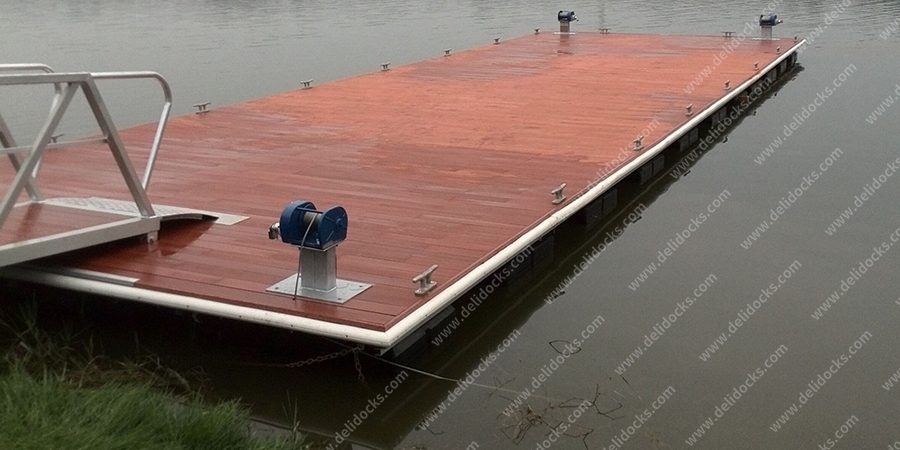
Industrial floating pallet docks must withstand repetitive dynamic loads from forklifts, loaded pallet jacks, and container handlers. Standard live load requirements range from 250 to 400 psf (pounds per square foot) for pedestrian areas; however, for powered industrial truck (PIT) traffic, concentrated wheel loads dominate the design. A typical 5,000 lb capacity counterbalance forklift with a 6 ft wheelbase imposes point loads exceeding 3,000 lbs per front tire. Engineers follow ANSI MH29.1 (design of industrial floating docks) and PIANC guidelines for heavy-duty structures.
Key structural parameters for a floating pallet dock include:
Deflection limits: Maximum vertical deflection under full live load + impact factor (25% for forklift movement) must not exceed L/150, preventing deck warping and tire entrapment.
Buoyancy factor of safety: A minimum 2.0 factor against sinking when the platform is fully loaded and partially flooded. Closed-cell EPS foam (minimum 2 lb/ft³ density) inside sealed pontoons provides redundant flotation.
Edge load reinforcement: Heavy cargo transfers often occur along the dock edge. Steel-reinforced edge beams or aluminum box stringers (6" x 4" x 1/4" wall) distribute concentrated wheel loads from forklifts turning or positioning pallets.
Finite element analysis (FEA) performed by DeFever accounts for fatigue cycles from repeated forklift passes—typically 500,000 cycles over a 20-year service life. Request certified load maps during procurement to validate zone-specific capacities.
Material Selection for Saline, Abrasive, and Chemical Environments
Industrial floating pallet docks operate in harsh conditions: saltwater corrosion, hydraulic oil spills, ultraviolet degradation, and mechanical abrasion from pallet skids. Three principal material systems meet these demands, each with distinct trade-offs.
Heavy-Duty HDPE Rotomolded Pontoons with Steel-Reinforced Decks
High-density polyethylene (HDPE) pontoons (minimum 15 mm wall thickness) resist chemicals, marine borers, and UV radiation. For cargo applications, the deck surface requires either hot-dip galvanized steel grating (5/16" bearing bars) or aluminum checker plate (1/4" 6061-T6). Steel grating allows water drainage and debris wash-through, reducing slip hazards. HDPE pontoons with internal steel reinforcement tubes (2" schedule 40 pipe) increase bending resistance under heavy loads.
Prestressed Concrete Floating Cassions
For permanent installations handling over 10,000 pallets monthly, reinforced concrete cassions (4,000 psi minimum strength, epoxy-coated rebar) provide extreme stiffness and fire resistance. Concrete's mass dampens wave-induced motion, essential for exposed terminals. However, additional buoyancy units (polystyrene blocks) must be integrated to offset the concrete's weight. This system requires precise pre-casting and floating crane placement.
Aluminum-Framed Modular Pallets
Marine-grade aluminum (5086-H116) frames create lightweight yet torsionally rigid sections. Each modular unit (typically 8' x 20') incorporates interlocking fork pockets for relocation using a reach stacker. Co-extruded polyurethane deck surfaces (3/4" thick, 90 Shore A durometer) absorb impact from pallet drops while remaining oil-resistant. This configuration serves seasonal terminals that relocate floating pallet docks between berths.
Application Scenarios for Industrial Floating Pallet Docks
Understanding typical cargo profiles allows proper specification of deck area, ramp angles, and mooring patterns. Primary B2B use cases include:
Barge loading terminals: River barges carrying aggregate, grain, or scrap metal. The floating pallet dock aligns with barge coamings, allowing front-end loaders to transfer bulk materials directly.
Ferry and Ro-Ro ramps: For vessels without built-in ramps, a floating pallet dock with adjustable steel approach ramps (up to 12% slope) accommodates rolling cargo—shipping containers on chassis, heavy machinery, or palletized retail goods.
Shipyard lay berths: temporary cargo loading for vessel provisioning. The floating platform receives stores, spare parts, and consumables on pallets, staged near the ship's deck crane reach.
Inland port cross-dock facilities: Where water level fluctuates seasonally, a floating pallet dock maintains a consistent working height above water, eliminating re-grading of shore ramps.
Each scenario requires assessing vessel freeboard range, max crane outreach, and turnaround frequency. DeFever engineers provide site-specific mooring studies including tidal harmonic analysis and wind fetch mapping.
Solving Operational Pain Points: Motion Control, Load Transfer, and Durability
Industrial floating pallet docks face unique reliability risks: excessive vertical acceleration (heave) during cargo transfer, mooring line failure under wave surge, and deck wear from steel pallet skids. Below we address each with field-proven engineering solutions.
Heave Reduction for Precision Forklift Loading
Vertical motion exceeding 4 inches per second makes forklift alignment dangerous. Installing peripheral wave attenuators—perforated steel skirts extending 24 inches below waterline—dampens short-period waves. For open-water terminals, a secondary floating breakwater (separate anchored structure) placed 50 feet upwind reduces wave height by 60-80%. Pneumatic fenders between the dock and vessel also absorb surge energy.
Heavy-Duty Mooring Systems for Tidal Ranges
Standard pile guides can bind when loaded with heavy cargo. We specify self-lubricating bronze bushings with a 5 mm diametrical clearance. Alternatively, a four-point chain mooring with submerged concrete sinkers (minimum 10,000 lbs each) and D-shackles allows 15 feet of vertical travel while maintaining lateral position within 6 inches. For both systems, use 316 stainless steel wire rope (7x19 construction) for pendants.
Deck Wear and Tire Traction Enhancement
High-frequency pallet movement abrades standard HDPE decking. We specify bonded rubber wear pads (3/8" thick, 60 durometer, vulcanized to aluminum backing) along high-traffic lanes. For forklifts, diamond-pattern steel plate (raised lug height 1/8") provides positive traction even when wet. All deck penetrations (bolts, utility boxes) must be countersunk and capped to prevent pallet damage.
Modular Configurations and Approach Ramp Integration
Scalability enables floating pallet docks to grow with cargo throughput. Standard sections measure 20 ft x 8 ft, joined using pinned connectors with shear capacity of 25,000 lbs per connection. For large terminals, multiple sections create platforms up to 150 ft long, supporting three simultaneous forklifts. Configuration options include:
Straight quay layout: Aligns parallel to the shoreline, best for barges.
L-shaped or T-shaped: Allows end-loading from one side and side-loading from the other, improving vessel access.
Two-tier platform: A lower deck for cargo staging and an upper deck (via fixed stairs) for operator shelter or control room.
Approach ramps require careful design: steel truss ramps (6 ft to 12 ft wide) with a slip-resistant surface and toe plate. Ramp slope must not exceed 1:8 (12.5%) for loaded pallet jacks, per OSHA 1910.30. Hydraulic self-adjusting ramps maintain constant slope regardless of tidal level—powered by solar-charged 12V actuators.
Maintenance Protocols for Extended Service Life
Industrial floating pallet docks operating in demanding environments require structured inspection and maintenance. We recommend the following schedule based on 2,000 operating hours per year:
Monthly: inspect all mooring shackles, chain links, and pile guides for wear. Measure chain link diameter with calipers; replace when worn by 10%.
Quarterly: Verify buoyancy compartment integrity by checking for water ingress (using probe holes in HDPE pontoons). Remove any accumulated debris from deck drains.
Bi-annually: Pressure test welded seams on steel components; recoat any bare steel with coal-tar epoxy (minimum 16 mils dry film thickness). Replace sacrificial anodes if consumed beyond 50%.
Annually: Dry-dock inspection of submerged surfaces. Check for marine growth; high-pressure wash (3,000 psi) without damaging coatings. Verify ramp hinge pins and hydraulic cylinders for leaks.
With proper maintenance, a heavy-duty floating pallet dock exceeds 25 years of continuous service. DeFever supplies maintenance logs and remote consulting for facility teams.
Compliance with International Maritime Cargo Standards
When specifying a floating pallet dock for commercial cargo transfer, adherence to the following standards is mandatory for liability and insurance approval:
ISO 28460: Ship-to-shore interface for roll-on/roll-off cargo.
PIANC Report No. 156: Design of floating terminals for inland waterways.
ANSI MH29.1: Safety requirements for industrial floating docks.
NFPA 307: Construction and fire protection of marine terminals.
DeFever provides stamped engineering certificates and third-party load test reports, streamlining port authority and coast guard approvals.
Frequently Asked Questions (B2B Floating Pallet Dock Projects)
Q1: What is the typical load capacity for a commercial floating
pallet dock designed for forklift traffic?
A1: Standard designs
accommodate forklifts up to 15,000 lbs gross vehicle weight with individual
wheel loads of 4,000 lbs. The deck assembly (steel grating or aluminum plate)
plus pontoon system achieves a uniform distributed load of 400 psf. For heavier
reach stackers (30,000 lbs), we engineer concrete cassions with internal
bulkheads and 2.5 buoyancy factor. Always specify your maximum axle load during
inquiry.
Q2: Can a floating pallet dock be used in freezing environments with
ice formation?
A2: Yes, but require ice-resistant features:
perimeter ice skirts (1/2" HDPE or steel angled at 45 degrees) deflect ice
sheets. All pontoons must be foam-filled (no air voids). For marinas with thick
ice, install a bubbler system (compressed air diffusers) around the dock
perimeter to maintain an ice-free zone. Annual removal of ice ridges by
specialized equipment is advised.
Q3: How does a floating pallet dock handle extreme tidal ranges
exceeding 20 feet?
A3: For ranges above 15 ft, vertical steel pile
guides with extended length (35 ft piles) are necessary. However, the limiting
factor is the approach ramp slope. We recommend a two-section telescoping ramp
with a transfer platform midway. Alternatively, use a floating bridge connection
to shore that articulates with multiple hinges. A detailed site survey using
tidal harmonic data is required before design.
Q4: What deck surface provides the best slip resistance when wet and
oily?
A4: For heavy cargo areas, we specify epoxy aggregate coating
(3 mm crushed quartz broadcast into epoxy) achieving a coefficient of friction
>0.85 wet. For steel grating decks, galvanized bars with serrated edges (ASTM
A325) perform well. Avoid smooth aluminum or painted wood. All ramps must have
transverse slip bars at 12-inch intervals.
Q5: How are utilities (electricity, water, compressed air) routed
through a floating pallet dock?
A5: Utilities run through flexible
galvanized conduits mounted on the dock's underside with drip loops. Shore
connections use stainless steel quick-disconnect fittings and a self-coiling
hose management system. For shore power feeding electric forklift charging
stations, use 600V rated marine cable (type W) with watertight connectors. All
circuits must include ground fault protection (30 mA trip level).
Q6: Does the floating pallet dock require a perimeter guardrail for
forklift operations?
A6: OSHA 1910.29 requires guardrails on
open-sided docks where a fall height of 4 ft or more exists. However, for
forklift loading areas, we install removable steel pipe railings (42" height)
that can be detached during cargo transfer. Load-bearing edges without railing
must have yellow reflective striping and 8" high wheel stops to prevent overrun.
Always consult local occupational safety regulations.
Ready to improve your waterfront cargo handling efficiency? The engineering team at DeFever provides complete project support for floating pallet docks—from hydrographic surveys and FEA modeling to on-site installation supervision. We deliver custom designs that meet your cargo flow, vessel mix, and operational safety targets. Submit your request for quotation (RFQ) with dock dimensions, tidal data, and expected forklift fleet specifications. Our experts will respond with a detailed feasibility study and engineering proposal within five business days. Partner with proven marine infrastructure specialists.
Contact DeFever now to engineer your floating pallet dock solution.