2026-10-15
When evaluating the cost for floating dock installations, project owners and marina developers must consider a range of engineering parameters that extend beyond simple material pricing. The total investment is shaped by site-specific conditions—water depth, tidal range, wave exposure, and seabed composition—which dictate the structural design, mooring system, and anchoring requirements. Floating docks offer advantages over fixed piers in variable water levels, but their cost structure reflects the complexity of maintaining stability and service access under dynamic loading conditions.
Floating dock systems are employed across diverse applications: recreational marinas, commercial ferry terminals, industrial loading platforms, and residential waterfronts. Each application introduces distinct demands for deck strength, load capacity, fendering, and utility integration. As a result, the cost for floating dock projects varies widely—from standardized modular units for small boat harbors to custom-engineered systems for heavy-duty operations. Understanding the cost drivers and their interdependencies supports informed budget planning and specification decisions.
Primary Cost Components in Floating Dock Construction
The material selection forms the largest portion of the initial investment. Polyethylene floats, concrete pontoons, and steel-frame structures each present distinct cost profiles and performance characteristics. High-density polyethylene (HDPE) rotationally molded floats offer corrosion resistance, low maintenance, and ease of assembly, making them popular for recreational facilities. Concrete pontoons provide superior stability and load-bearing capacity, suitable for ferry landings and heavy pedestrian traffic, but require specialized forming and curing processes. Steel-framed docks, often galvanized or aluminum, allow longer spans and integration of utility conduits, though they demand rigorous corrosion protection measures in saltwater environments.
Mooring and anchoring systems constitute another significant cost category. The selection between pile-guided mooring, chain-anchor systems, or spud-pole configurations depends on water depth, tidal amplitude, and bottom conditions. For deep-water sites with soft mud or sand, helical anchors or deadweight anchors may be specified, requiring geotechnical surveys and specialized installation equipment. Pile mooring, which uses vertical guide piles driven into the seabed, offers precise lateral control but involves pile driving costs and potential seabed disturbance. Each mooring approach has implications for the overall project cost, as well as for long-term performance and maintenance requirements.
- Deck surfacing and finishing: Wood, composite decking, or textured coatings each affect both appearance and slip resistance; marine-grade materials with UV stabilizers and fungicidal additives extend service life.
- Fendering and protection: Rubber, foam, or plastic fenders prevent vessel-to-dock impact damage; configuration and density vary with the size and frequency of vessels.
- Utility integration: Electrical conduits, potable water lines, and sewage pump-out systems require careful routing and protection within the dock structure.
Site Conditions and Their Influence on Dock Design
Hydrodynamic and geotechnical conditions at the installation site directly affect both the design and installation cost. Wave height and exposure to prevailing winds determine the required freeboard and the spacing of mooring points. In exposed locations, larger pontoons with increased draft and additional cross-bracing are needed to maintain stability under wave action. Conversely, sheltered basins with limited fetch allow lighter structures and reduced anchoring demands. These differences translate into variations in both material volume and installation complexity, leading to different cost for floating dock specifications between adjacent sites.
Water quality and biological fouling potential influence the choice of coatings and materials. In tropical or nutrient-rich waters, copper-based anti-fouling paints or specially formulated HDPE grades with biocides are specified to reduce marine growth on submerged surfaces. In cold or brackish waters, alternative strategies such as smooth finishes or periodic cleaning schedules may be sufficient. The initial coating or material selection affects the upfront cost, while the maintenance cycle impacts the operational budget over the dock's lifecycle.
- Bathymetric surveys: Required to map the seabed profile and identify any obstacles, such as rocks or debris, that may affect anchoring or pile driving.
- Scour and sediment movement: In tidal rivers or coastal areas with strong currents, erosion around anchors or piles may necessitate additional scour protection measures.
- Environmental permitting: Some jurisdictions require specific materials or construction practices to protect marine habitat, which can influence component selection and cost.
Modular versus Custom-Engineered Floating Dock Systems
The choice between modular systems and custom-engineered designs is a primary determinant of both cost and functionality. Modular floating docks, consisting of standardized sections that can be connected in various configurations, provide predictable pricing and faster delivery. They are well-suited for facilities with straightforward layouts, uniform water depths, and moderate load requirements. Modular systems also allow for future expansion or reconfiguration, as sections can be added or removed without major structural changes.
Custom-engineered floating docks, by contrast, are designed to meet specific site constraints, load demands, and operational workflows. They may incorporate heavier-duty framing, integrated utility distribution, or specialized access features such as hoists or loading ramps. While custom designs tend to have a higher initial investment, they can offer greater durability and functional efficiency for demanding applications. The cost for floating dock in custom projects reflects the engineering time, non-standard fabrication, and potentially more complex installation sequences.
- Modular advantages: Availability of pre-engineered components, reduced design lead times, and simplified replacement of damaged sections.
- Custom engineering: Allows optimization of float volume, frame spacing, and fender arrangement for specific vessel types and mooring patterns.
- Hybrid approaches: Combining modular pontoon sections with custom-built gangways or pile mooring assemblies often provides a balanced solution.
For projects requiring large dock areas or multiple berthing fingers, modular systems typically offer economies of scale. The standardized production processes used by established manufacturers allow for consistent quality and efficient logistics. However, when the dock must interface with existing breakwaters, seawalls, or fixed structures, custom design becomes necessary to ensure proper alignment and load transfer. Evaluating the anticipated longevity of the facility and the flexibility for future modifications helps determine which approach offers the most favorable lifecycle value.
Installation and Logistics: Factors Affecting Project Cost
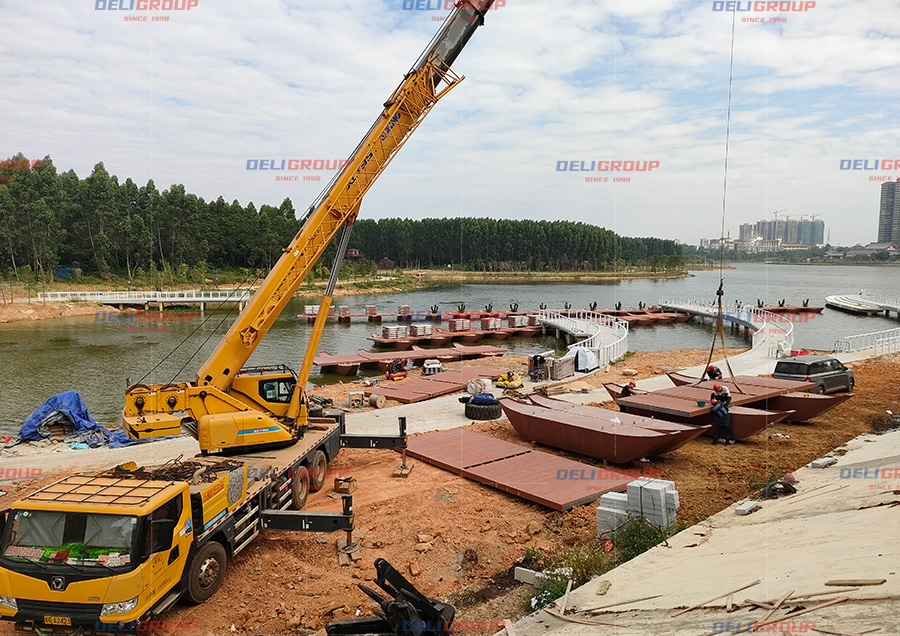
Installation costs vary with site accessibility, water depth, and required equipment. For sites with road access to the water's edge, components can be delivered by truck and assembled using cranes or floating plant. In remote or island locations, transport by barge or landing craft adds significant logistics expenses. Similarly, the method of launching the assembled dock—whether by crane, slipway, or by assembling sections afloat—impacts the time and equipment required.
The installation schedule itself influences cost, particularly when weather windows are constrained. For exposed coastal sites, installation may be limited to calm weather periods, potentially extending the project duration and increasing labor costs. In tidal areas, work must be coordinated with high-water windows for floating components and low-water times for pile driving or anchoring. An experienced contractor will account for these constraints in their bid, ensuring realistic timelines and cost projections.
- Mobilization and demobilization: Transporting cranes, barges, pile drivers, and diving support to the site; particularly significant for projects in remote locations.
- On-site assembly: Bolting, welding, or pinning of deck sections; installation of fendering, cleats, and utility conduits.
- Commissioning and testing: Load testing of mooring points, electrical safety checks, and functional verification of any mechanical or hydraulic components.
Post-installation, the operation and maintenance regime contributes to the overall cost of ownership. Regular inspections of mooring components, replacement of worn fendering, and cleaning of deck surfaces are necessary to maintain safety and performance. In areas with heavy vessel traffic or aggressive marine growth, maintenance intervals may be shorter, increasing annual operating expenses. Selecting materials and coatings that reduce maintenance demands—such as UV-stabilized HDPE, stainless steel hardware, and non-slip deck textures—can lower these recurrent costs.
Long-Term Value and Service Life Considerations
While the initial cost for floating dock construction is a primary decision factor, the service life of the installation significantly affects the total value proposition. HDPE floats, when properly formulated with UV inhibitors, commonly achieve service lives exceeding 25 years in marine environments. Concrete pontoons can last 50 years or more, though they require careful attention to reinforcement corrosion and crack sealing. Steel-framed docks, if hot-dip galvanized or protected with marine-grade coatings, may also provide long service life, but require periodic inspection and touch-up in high-wear areas.
Depreciation of floating dock assets is influenced by both physical deterioration and technological obsolescence. As vessel sizes evolve and operational standards for marinas become more stringent, docks designed 15 to 20 years ago may no longer meet the load or safety requirements of modern users. Modular designs offer an advantage in this respect, as individual sections can be upgraded or replaced to meet changing standards without demolishing the entire facility. This adaptability adds to the overall value of modular systems beyond the initial price point.
- Material durability: Graded HDPE (with antioxidant and UV packages) and high-alumina cement concrete offer improved resistance to environmental degradation.
- Component replacement: Availability of spare parts and the ability to source replacement sections from the original manufacturer.
- Design standards compliance: Adherence to international standards such as ISO 13577 or relevant local codes for structural design and load capacities.
For developers considering a new floating dock investment, engaging an experienced engineering firm early in the planning process helps align the technical specifications with the project budget. The expertise of a company like DeFever can assist in evaluating the cost for floating dock in relation to site-specific conditions, required capacities, and anticipated operational scenarios, ensuring that the final solution meets both functional and financial expectations.
Frequently Asked Questions About Cost for Floating Dock Projects
Q1: What are the main factors that cause the cost for floating dock to vary between projects?
The primary factors include the dock material (polyethylene, concrete, or steel), mooring and anchoring method (pile, chain, or spud), site water depth and wave exposure, required load capacity, and the extent of utility integration. Additionally, installation logistics—such as accessibility, tidal timing, and weather constraints—as well as any environmental permits, contribute to project-specific cost differences. A detailed site assessment is needed to determine which of these factors will have the greatest influence on the total investment.
Q2: Are modular floating docks more cost-effective than custom-engineered systems?
Modular docks generally offer lower initial costs due to standardized production, reduced engineering time, and simpler installation. They are ideal for projects with regular configurations and moderate load requirements. Custom-engineered docks become more cost-effective when site conditions are complex, when specialized load capacities are required, or when the dock must integrate with existing infrastructure. The choice depends on whether the additional functionality of a custom design justifies the higher engineering and fabrication investment.
Q3: How does water depth influence the cost for floating dock installation?
Water depth affects both the mooring system selection and the structural design of the dock. In shallow water (less than 3m), pile mooring is often feasible and relatively cost-effective. In deeper water (over 6m), longer piles or more complex anchoring systems are required, increasing material and installation expenses. Deep-water sites may also necessitate specialized equipment for positioning and securing the dock, which adds to the project cost. The design must also account for tidal variations, with larger tidal ranges requiring longer mooring chains or extended pile lengths to maintain the dock's operating range.
Q4: What utility integration options impact the dock project budget?
Utility integration includes electrical power for lighting, shore-side plugs, and equipment; water supply for hose connections; and waste pump-out systems for marine sanitation. Each service requires protected routing through the dock structure, connection points at the shore interface, and appropriate safety devices such as circuit breakers and backflow preventers. The complexity of these systems—such as the number of power pedestals, the distance of water lines, and the need for sewage holding tanks—directly influences the cost. For marinas with high utilization, the design of utility distribution is a major planning consideration.
Q5: Does the choice of mooring system significantly affect the cost for floating dock?
Yes, the mooring system represents a substantial portion of the total cost, particularly in exposed or deep-water sites. Pile-guided mooring requires driven steel or concrete piles, which involve specialized equipment and potentially extensive seabed preparation. Chain-and-anchor systems are often less expensive in terms of materials but demand careful anchor placement and sufficient scope (chain length) to accommodate water level changes. Spud-pole systems, which lower pins to the seabed, are simpler in concept but may require periodic repositioning. The choice involves balancing initial cost against maintenance accessibility and operational reliability.
Q6: What factors should be considered when comparing quotes for a floating dock project?
Beyond the quoted price, evaluate the scope of supply (whether design, shipping, installation, and commissioning are included), the durability of the materials specified (grade of HDPE, concrete compressive strength, and steel corrosion protection), and the manufacturer's track record in similar environmental conditions. The warranty terms and the availability of technical support for future maintenance are equally important. A lower initial quote may involve compromises in material quality or installation depth, which could lead to higher maintenance costs or reduced service life. A comprehensive comparison should consider the total lifecycle cost, not just the upfront price.
For engineering consultation, specification support, and site-specific assessments related to cost for floating dock installations, DeFever provides technical expertise in marina infrastructure, mooring system design, and material selection. Project documentation, structural calculations, and installation planning are available to support private and municipal waterfront development projects.