2026-10-15
Floating bridges represent a specialized category of marine infrastructure that demands precise engineering, durable materials, and fabrication methods adapted to site-specific conditions. Unlike standard pontoon systems, customized floating bridges must accommodate variable load requirements, tidal fluctuations, current forces, and environmental exposure levels that differ significantly across project locations. A factory of customized floating bridges operates at the intersection of naval architecture, structural engineering, and advanced composites manufacturing, delivering solutions that range from pedestrian walkways to heavy-duty vehicle crossings.
Engineers and project managers frequently encounter challenges when specifying floating bridge systems for unconventional environments. Water depth, seabed composition, wave energy, and ice formation all influence the design parameters. The factory of customized floating bridges addresses these variables through modular design approaches, adjustable buoyancy systems, and connection interfaces that accommodate site-specific anchorage configurations. This engineering flexibility distinguishes purpose-built floating structures from off-the-shelf alternatives that often compromise on performance or longevity.
Engineering Foundations for Floating Bridge Design
The structural integrity of any floating bridge begins with accurate load calculations and buoyancy analysis. Design teams within a factory of customized floating bridges utilize finite element analysis to model stress distribution across the bridge deck, pontoons, and connection points under static and dynamic loading conditions. Live loads from pedestrian traffic, vehicles, or construction equipment produce deflection patterns that must remain within acceptable tolerances to ensure user safety and structural service life.
Hydrodynamic forces impose additional design constraints. Current velocities, wave-induced motions, and wind loads create complex interactions between the floating structure and the surrounding water body. A factory of customized floating bridges accounts for these forces by adjusting pontoon dimensions, draft depth, and mooring system specifications. The relationship between pontoon displacement and deck elevation determines the bridge's response to passing vessels, tidal changes, and storm surge events.
Material selection directly impacts the bridge's durability, maintenance requirements, and environmental footprint. Marine-grade aluminum alloys, galvanized steel, and high-density polyethylene (HDPE) each offer distinct advantages depending on the application environment. Saltwater exposure accelerates corrosion in ferrous materials, while UV radiation degrades certain polymers over time. A factory of customized floating bridges evaluates these material characteristics against project-specific life cycle costs, recommending optimal combinations that balance initial investment with long-term performance.
Customization Capabilities in Floating Bridge Manufacturing
The defining attribute of a factory of customized floating bridges lies in its ability to adapt standard manufacturing processes to unique project requirements. Modular pontoon systems serve as the foundation, but the arrangement, interconnection, and finishing details vary considerably across installations. Deck width, handrail height, surface texture, and access points for utility lines all fall within the scope of customization.
Buoyancy distribution represents a critical customization parameter. Projects with concentrated live loads, such as vehicle crossings or crane access, require pontoons with increased displacement in specific zones. A factory of customized floating bridges achieves this through variable pontoon cross-sections, internal compartmentalization, or supplementary floatation elements positioned along the bridge span. These adjustments ensure that the bridge maintains its designed freeboard under all operational conditions.
Connection systems between floating bridge segments demand particular attention during the customization process. Pin joints, hinge connections, and lockable couplers each offer different degrees of freedom and load transfer characteristics. The factory of customized floating bridges selects connection hardware based on wave exposure, bridge length, and maintenance access constraints. Articulated connections allow the bridge to conform to water surface variations, while rigid connections provide increased lateral stability in sheltered waters.
Anchoring and mooring arrangements complete the customization package. Deadweight anchors, driven piles, or suction anchors may be specified depending on seabed conditions and water depth. A factory of customized floating bridges coordinates the design of anchor points, chain or rope mooring lines, and tension adjustment mechanisms to ensure the bridge remains within its operational envelope throughout tidal cycles and storm events.
Application Scenarios for Custom Floating Bridges
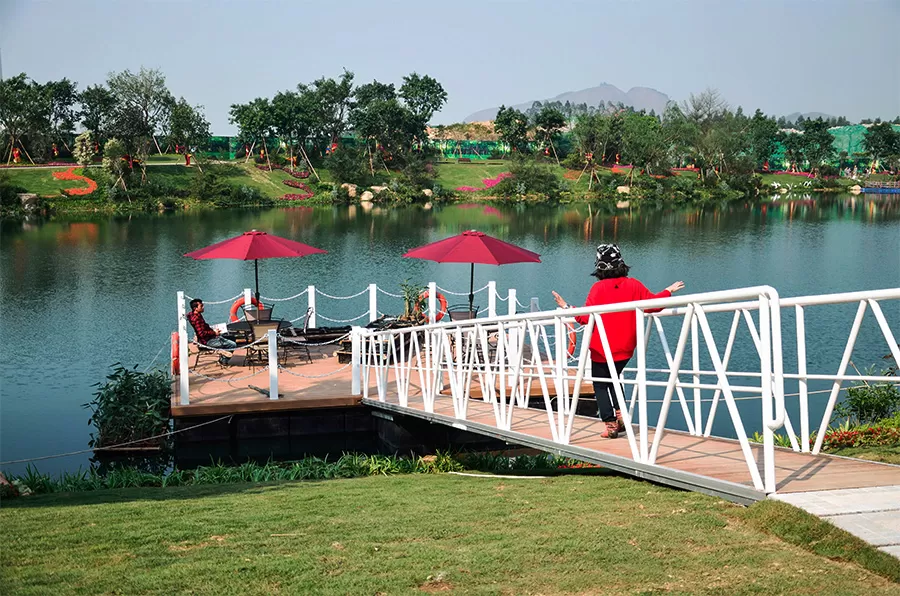
Marinas and recreational boating facilities frequently utilize floating bridges as access walkways between docks, service platforms, and shore facilities. These installations require consistent elevation regardless of tidal stage, allowing boaters to board and disembark safely. A factory of customized floating bridges produces walkway systems with nonslip decking, integrated utility conduits for water and electrical service, and durable handrail systems that meet accessibility standards.
Commercial ferry terminals present more demanding requirements. Passenger loading platforms, vehicle ramps, and baggage handling areas must accommodate high-frequency traffic while maintaining positional stability. The factory of customized floating bridges designs terminal structures with reinforced decks, heavy-duty mooring hardware, and adjustable gangways that compensate for tidal range. These installations often incorporate fender systems and guide piles to facilitate vessel berthing operations.
Military and emergency response applications require floating bridges that deploy rapidly and withstand extreme conditions. Modular systems designed for transport by cargo aircraft or ship container can be assembled on-site with minimal equipment. A factory of customized floating bridges producing military-grade systems prioritizes component interchangeability, rapid connection mechanisms, and redundancy in buoyancy and mooring systems to maintain operational capability under adverse conditions.
Industrial installations, including temporary construction access, pipeline support, and equipment staging areas, benefit from the adaptability of customized floating bridges. These structures provide stable work platforms over water, enabling construction activities in marine environments that would otherwise require extensive dredging or piling operations. The factory of customized floating bridges engineers these platforms with concentrated load capacity, integrated lifting points, and attachment interfaces for specialized equipment.
Quality Assurance and Durability Standards
Manufacturing standards within a factory of customized floating bridges align with international classification society requirements and project-specific specifications. Welding procedures, coating applications, and assembly methods undergo verification through documented quality control processes. Non-destructive testing, including ultrasonic weld inspection and dye penetrant examination, confirms the integrity of critical structural connections before components leave the fabrication facility.
Buoyancy verification tests validate the performance of each pontoon section. Flotation chambers are subjected to pressure testing to confirm watertight integrity, while assembled bridge segments undergo load testing to measure deflection under simulated service conditions. A factory of customized floating bridges maintains comprehensive testing records that support project acceptance and regulatory compliance documentation.
Durability considerations extend beyond initial fabrication to include corrosion protection, UV stabilization, and wear-resistant surface treatments. Coating systems for steel components incorporate multiple layers of epoxy primer, intermediate coat, and polyurethane topcoat to achieve the specified film thickness and adhesion properties. HDPE components receive UV inhibitors and antioxidants to maintain mechanical properties throughout the design service life.
DeFever has established protocols for material traceability, weld qualification, and coating inspection that align with industry best practices. These procedures ensure that each customized floating bridge leaving the factory meets the performance expectations established during the design phase. Documentation packages accompany each shipment, providing the project team with verification records for all critical quality attributes.
Project Workflow from Concept to Delivery
The project lifecycle for a customized floating bridge begins with a site assessment that establishes environmental conditions, load requirements, and operational constraints. A factory of customized floating bridges deploys engineering teams to collect wave data, current measurements, and seabed characterization information that informs the preliminary design. This data-driven approach minimizes uncertainty and establishes a solid foundation for subsequent engineering decisions.
Conceptual design development translates site data into dimensional parameters, material specifications, and connection details. Design reviews with the project team refine these parameters, addressing access requirements, utility integration, and maintenance provisions. The factory of customized floating bridges produces 3D models and structural calculations that support regulatory submissions and permit applications.
Fabrication planning optimizes material procurement, production scheduling, and quality control checkpoints. A factory of customized floating bridges coordinates the manufacturing sequence to ensure that component production aligns with assembly milestones. Subassembly fabrication occurs in parallel with pontoon manufacturing, reducing overall project duration.
Factory assembly and testing confirm that all components integrate correctly before shipment to the project site. This pre-shipment verification identifies and resolves interface issues in the factory environment, reducing field modifications and installation delays. DeFever incorporates this assembly verification step as a standard practice, ensuring that each customized floating bridge arrives at the project site ready for installation.
Transportation and logistics planning addresses the dimensional constraints of road, rail, or water transport. Oversized components may require special transport permits, route surveys, or temporary storage arrangements. A factory of customized floating bridges coordinates these logistics activities, ensuring that components arrive at the installation site according to the construction schedule.
Installation supervision and commissioning support provide the project team with technical assistance during on-site assembly and testing. Factory representatives assist with mooring system installation, bridge alignment, and load testing, confirming that the installed structure meets all performance criteria. This support continues through the commissioning phase, documenting the bridge's response to operational loads and environmental conditions.
Frequently Asked Questions
What distinguishes a factory of customized floating bridges from a standard pontoon manufacturer?
A factory of customized floating bridges applies engineering design to each project, adapting pontoon dimensions, connection systems, and mooring arrangements to site-specific conditions. Standard pontoon manufacturers offer fixed product lines with limited customization options, while the customized approach optimizes structural performance, material selection, and installation methods for each unique application.
What design life can be expected from a customized floating bridge?
Design life depends on material selection, environmental exposure, and maintenance practices. Steel floating bridges with appropriate coating systems typically achieve 25 to 30 years of service life, while aluminum and HDPE structures may exceed 40 years with proper maintenance. A factory of customized floating bridges establishes design life targets during the project definition phase and selects materials and protective systems accordingly.
How are customized floating bridges anchored in deep water locations?
Deep water installations employ mooring systems that transfer horizontal loads to anchors positioned on the seabed. The factory of customized floating bridges specifies anchor types based on seabed conditions, water depth, and load magnitude. Spread mooring arrangements with multiple anchor lines provide redundancy and control bridge position within defined tolerances.
Can customized floating bridges accommodate heavy vehicle traffic?
Vehicle-capable floating bridges require increased pontoon displacement, reinforced deck structures, and heavy-duty connection hardware. A factory of customized floating bridges engineers these systems to support specific vehicle weights, axle configurations, and traffic frequencies. Load testing verifies structural performance under simulated traffic conditions.
What maintenance is required for customized floating bridges?
Maintenance programs include annual inspections of structural components, coating systems, and mooring hardware. Corrosion protection systems require periodic touch-up, while mechanical connections benefit from lubrication and tension adjustment. A factory of customized floating bridges provides maintenance guidelines specific to each installation, addressing the materials and environmental conditions applicable to the project.
How does a factory of customized floating bridges handle site-specific environmental regulations?
Environmental compliance begins with material selection that minimizes toxicity and leaching risk. The factory of customized floating bridges coordinates with environmental consultants to address permit requirements, construction phasing restrictions, and habitat protection measures. Documentation packages include material safety data sheets and compliance declarations for applicable regulations.
What is the typical delivery timeline for a customized floating bridge project?
Project timelines range from 12 to 24 weeks for standard configurations, extending to 36 weeks or more for complex designs with extensive customization. A factory of customized floating bridges develops detailed production schedules that align with project milestones, providing the project team with regular progress updates throughout the fabrication phase.
For project-specific inquiries, design consultations, or to discuss your floating bridge requirements, contact the DeFever engineering team through the official website. Project managers and technical staff are available to review site conditions, load specifications, and installation constraints, providing preliminary design concepts and budget estimates for your consideration. Submit your project details through the online inquiry form to initiate the engineering review process.