2026-10-15
Procuring heavy-duty waterborne access infrastructure requires navigating extreme marine environments. Commercial marina operators, port authorities, offshore energy contractors, and municipal harbor developers often search for a reliable floating bridge manufacturer to supply pontoon assemblies. However, marine infrastructure procurement differs radically from land-based civil engineering. Purchasing structural modules from a basic steel or concrete fabricator without specialized marine engineering capabilities introduces severe operational liabilities.
A floating structure deployed in high-salinity marine environments faces relentless storm surges, cyclical tidal motion, dynamic vehicle or pedestrian live loads, and aggressive electrochemical corrosion. To ensure a 30 to 50-year operational lifespan, asset owners must evaluate partners through a rigorous engineering lens. As an established leader in marine infrastructure, DeFever engineers custom, highly resilient waterborne access systems designed to withstand extreme metocean forces while providing uncompromising operational safety.
The Engineering Reality: Why Floating Bridges Demand Advanced Marine
Engineering
Unlike fixed-span bridges supported by driven deep foundations, a floating bridge relies on displacement physics. The dead weight of the superstructure, combined with variable live loads from pedestrians, vehicles, or industrial cargo, must be dynamically balanced by the submerged pontoon buoyancy reserve. A specialized floating bridge manufacturer treats every pontoon bridge not as a static platform, but as a dynamic floating body reacting to complex sea states.
Hydrodynamic Load Modeling and Finite Element Analysis (FEA)
Standard fabrication yards cut and weld metal according to static structural blueprints. In contrast, an engineering-led floating bridge manufacturer begins every project with numerical hydrodynamic simulations. Utilizing Finite Element Analysis (FEA), marine engineers model multi-directional stress distribution across structural trusses, pontoon hulls, and dynamic connection points.
Wave Fetch and Period Analysis: Engineers calculate the unobstructed distance wind travels across open water (fetch) to determine the significant wave height ($H_s$) and peak wave period ($T_p$) during 50-year and 100-year storm events.
Torsional and Shear Forces: Oblique wave angles subject floating pontoon trains to continuous twisting moments. Articulated elastomeric hinges and high-tensile connection pins must be designed to accommodate rotational degrees of freedom without transferring destructive bending moments into adjacent pontoon hulls.
Fatigue Life Calculations: Cyclical loading from millions of wave interactions induces structural metal fatigue. Weld details and material thickness specifications are selected based on strict stress-range ($S-N$) fatigue curves to prevent premature cracking.
Bathymetric and Metocean Data Integration
Site conditions dictate pontoon geometry and structural anchorage. Pre-engineering feasibility studies incorporate acoustic multibeam bathymetry to construct precise seabed elevation models. Integrating long-term metocean data—such as maximum tidal ranges, surface current velocities, and extreme wind gusts—ensures the floating bridge maintains operational draft levels during extreme low tides without grounding out on hazardous bottom geology.
Material Metallurgy and Corrosion Science in C5-M Marine Environments
Atmospheric salt spray, continuous immersion, and ultraviolet radiation make marine environments uniquely aggressive. Material selection directly determines maintenance overhead and structural longevity.
Marine-Grade Aluminum Alloy (6061-T6 / 5083-H116): Exhibiting an exceptional strength-to-weight ratio, these high-magnesium aluminum alloys form an instant, self-healing oxide layer when exposed to oxygen. Ideal for commercial walkways, gangways, and superyacht access ramps, aluminum drastically reduces top-side weight while resisting severe atmospheric saltwater corrosion.
Structural Steel with C5-M Coating Systems: For heavy-duty roll-on/roll-off (RoRo) ferry terminals and industrial transport piers, structural steel offers required mass displacement and yield strength. Steel pontoon hulls are blast-cleaned to ISO 8501-1 Sa 2.5 standards and coated with multi-layer epoxy-polyurethane or thermal-sprayed aluminum (TSA) systems certified for ISO 12944 C5-M extreme coastal conditions.
Closed-Cell EPS-Filled HDPE Buoyancy Units: Beneath the structural chassis, buoyancy is maintained via High-Density Polyethylene (HDPE) pontoons. Premium units are pressure-filled with high-density, closed-cell Expanded Polystyrene (EPS) foam. Even in the event of an outer shell puncture caused by floating debris impact, closed-cell foam prevents water absorption, preserving total buoyancy.
Mass-Displacement Reinforced Concrete Pontoons: Deep-water harbor installations utilize heavy marine concrete pontoons. Their massive displacement acts as an integrated wave attenuator (breakwater), dissipating incident wave energy to create calm basin conditions for docked vessels.
Dynamic Mooring Systems: Absorbing Environmental Kinetics
A structural platform is only as secure as its seabed restraint mechanism. Anchoring systems must hold the floating bridge within a tightly controlled footprint while freely accommodating vertical tidal displacement.
Steel Guide Piles with UHMWPE Roller Assemblies
For shallow to medium-depth installations with soft sub-bottom geology, heavy-wall steel pipe piles are driven deep into the seabed. The floating bridge framework attaches to these piles via heavy-duty internal or external guide brackets. Fitted with self-lubricating, Ultra-High-Molecular-Weight Polyethylene (UHMWPE) rollers, these brackets glide vertically along the pile shafts with zero mechanical binding, even under heavy lateral wind and current thrust.
Elastic Synthetic Tethers vs. Catenary Anchoring
In deep-water applications, extreme tidal environments, or ecologically sensitive benthic zones (such as seagrass beds and coral reefs), physical pile driving may be impossible or prohibited by environmental regulations.
Seaflex Elastic Mooring Systems: Utilizing high-elongation synthetic elastomeric tethers anchored to seabed weight blocks, these systems expand and contract smoothly with rising and falling tides. They maintain continuous, progressive pre-tension on the floating bridge, absorbing violent kinetic energy without dragging heavy chains across the seabed.
Catenary Stud-Link Chain Systems: Designed for high-capacity industrial platforms, heavy stud-link marine anchor chains connected to high-holding-power (HHP) anchors utilize the submerged weight of the chain cable to provide restorative force against lateral hydrodynamic currents.
Sourcing a Turnkey EPC Partner: The DeFever Advantage
Evaluating an qualified floating bridge manufacturer requires assessing capabilities beyond simple workshop welding. Industrial buyers require end-to-end Engineering, Procurement, and Construction (EPC) services that eliminate multi-vendor friction and technical misalignments.
DeFever operates as a single-source EPC partner for global waterfront developments, port facilities, and luxury commercial marinas. By maintaining total oversight across the project lifecycle, DeFever mitigates critical engineering risks:
Turnkey Marine Engineering & Master Planning: In-house marine infrastructure specialists perform initial hydro-acoustic site surveys, localized environmental impact assessments, and complete structural engineering to international design standards (ISO 19904, ABS, DNV, AWS D1.1).
Precision Automated Fabrication: Structural components are manufactured under strict ISO 9001 and ISO 14001 quality management systems using robotic welding systems, automated CNC plate processing, and rigorous non-destructive testing (NDT), including ultrasonic and radiographic weld inspection.
Complex Logistics & Marine Installation: Modular pontoon components are engineered for standard containerized or heavy-lift sea transportation. DeFever project management teams deploy on-site to direct tugboat positioning, anchor setting, pile driving, and final load testing.
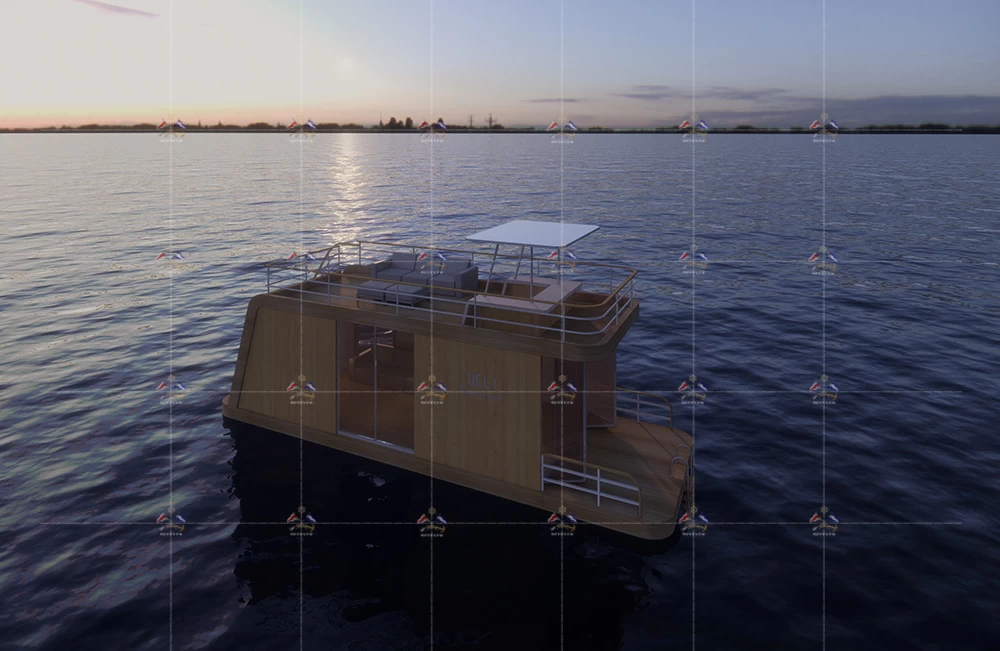
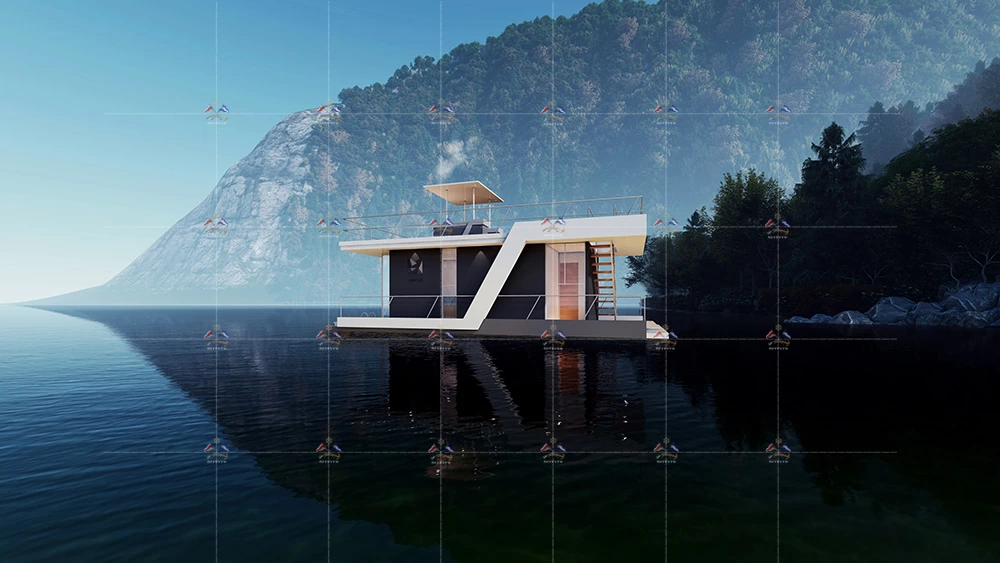
Multi-Sector Adaptability: DeFever infrastructure solutions encompass heavy-load RoRo vehicle transit ramps, modular pontoon bridges, deep-water tourist piers, high-capacity commercial fishing terminals, and custom floating prefabricated waterfront buildings.
Frequently Asked Questions
Q1: How does a floating bridge manufacturer calculate reserve
buoyancy for variable traffic loads?
A1: Reserve
buoyancy is calculated by determining the pontoon displacement volume relative
to the combined weight of the structure (dead load) and maximum anticipated
traffic, vehicles, or equipment (live load). Marine engineers maintain a minimum
freeboard ratio—typically ensuring the pontoon operates at less than 50-60% of
total submergence volume under full design load conditions—to handle dynamic
wave crests without deck wash.
Q2: What dynamic mooring system is best for deep water with sensitive
benthic environments?
A2: Advanced elastic tether
systems (such as Seaflex) are optimal for deep-water installations and
environmentally protected marine zones. Unlike traditional catenary anchor
chains that lie on and drag across the seabed during tidal shifts, elastic
tethers remain suspended under tension between the pontoon dynamic connection
point and fixed seabed anchors, protecting sensitive marine habitats like
seagrass and benthic organisms.
Q3: What engineering standards govern high-capacity floating bridge
fabrication?
A3: Commercial marine infrastructure
manufacturing is governed by international classification standards including
ISO 19904 (Floating offshore structures), AWS D1.1/D1.2 (Structural Welding
Codes for Steel and Aluminum), and design guidelines from major classification
societies such as DNV, ABS (American Bureau of Shipping), and Lloyd’s
Register.
Q4: How does DeFever prevent galvanic corrosion when joining
dissimilar metals?
A4: When joining dissimilar
metals—such as an aluminum superstructure to hot-dip galvanized steel pile
brackets—DeFever marine engineers implement full galvanic isolation. This
involves non-conductive elastomeric isolation pads, neoprene washers, and
sleeved stainless steel fasteners to prevent direct electrical contact,
completely eliminating localized galvanic cell corrosion.
Q5: Can modular floating bridges be disassembled and relocated for
temporary access?
A5: Yes. Engineered modular
pontoon systems utilize standardized, high-strength bolted or pin-connected
joints. This modular architecture allows temporary access bridges—used in
construction zones, commercial logistics, or emergency disaster response—to be
rapidly decoupled, lifted onto transport trucks or cargo vessels, and
reassembled at a new site with minimal specialized tooling.
Realize Your Marine Project with DeFever Engineering Solutions
Developing robust, long-lasting marine infrastructure requires a partner who understands the complex forces of open water. Working with an experienced floating bridge manufacturer transforms technical hydrodynamic challenges into predictable, long-term commercial assets.
DeFever delivers fully customized, end-to-end marine access solutions—from preliminary metocean modeling and custom floating structure design to precision modular fabrication and global on-site deployment. Contact the engineering procurement team at DeFever today to submit your RFP, request a comprehensive site feasibility evaluation, or discuss technical blueprints for your upcoming waterfront development project.