2026-10-15
Personal watercraft (PWC) owners and marina operators face specific challenges when they build a jet ski dock. Unlike conventional boat docks, jet ski docks must accommodate lightweight vessels with shallow drafts, frequent launching, and exposure to propeller wash. A poorly designed dock leads to gelcoat damage, unstable boarding, and accelerated wear on PWC hulls. This technical guide examines the engineering principles behind durable jet ski docks—including flotation systems, mooring pin configurations, decking materials, and wave attenuation methods. DeFever specializes in custom dock engineering for private and commercial marinas, offering solutions that balance structural integrity with low maintenance. Whether you plan to build a jet ski dock for a waterfront home or a rental fleet, understanding load calculations, tidal variations, and material compatibility ensures a safe, long-lasting installation.
1. Why Build a Jet Ski Dock Separately from a Boat Dock?
Many property owners attempt to share a single dock between boats and PWCs. However, jet skis have unique operational requirements. When you build a jet ski dock as a dedicated structure, you address:
Weight distribution – A typical PWC weighs 300–500 kg, far less than a 6-meter runabout. A shared dock may not provide the proper freeboard for easy mounting.
Hull protection – Jet skis have exposed gelcoat below the waterline. Standard dock edges with metal rub rails cause scratches. Dedicated docks use soft bumpers or recessed fenders.
Maneuvering space – PWCs require wider turning radii when approaching. A separate dock allows dedicated approach lanes.
Traffic separation – In commercial rental operations, mixing PWC traffic with boat traffic creates safety hazards.
Field data from marina operators show that installing a purpose-built jet ski dock reduces hull repairs by 70% and increases PWC throughput by 40% compared to shared facilities. Custom dock engineering solutions from DeFever include site-specific layouts that separate PWC slips from boat slips while optimizing shoreline use.
2. Floating vs. Fixed Jet Ski Docks: Engineering Comparison
When you build a jet ski dock, the first structural decision is between floating and fixed pile-supported systems. Each has distinct advantages based on water level fluctuations and seabed conditions.
2.1 Floating Docks
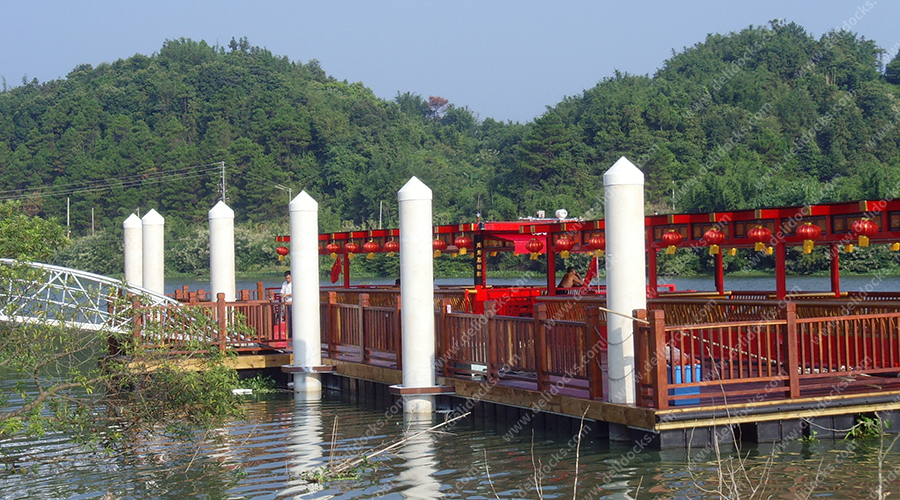
Floating docks rise and fall with tides or reservoir levels, maintaining a constant freeboard (typically 30–40 cm above water). They consist of:
Flotation units – Expanded polystyrene (EPS) encapsulated in polyethylene or concrete. Closed-cell foam prevents waterlogging.
Decking – Marine-grade aluminum, composite lumber, or treated wood.
Guidance piles – Two or four vertical piles that keep the dock in position while allowing vertical movement.
Floating docks are preferred for locations with tidal ranges >1.5 m or fluctuating reservoir levels. They also cause less environmental disturbance because no pile driving is required for the main deck. However, they require anchoring systems (deadweight anchors or screw anchors) to resist lateral forces from waves and PWC thrust. For exposed sites, consider adding wave attenuators to reduce vertical motion.
2.2 Fixed Pile Docks
Fixed docks use timber, concrete, or steel piles driven into the seabed, with a deck constructed at a constant elevation. They are suitable for sites with minimal water level variation (<0.5 m) and firm bottom conditions. Advantages include lower initial material cost (no flotation units) and a solid feel for walking. However, fixed docks present a boarding challenge when water levels drop—the freeboard may exceed 60 cm, making it difficult to mount a PWC from the water. For public rental facilities, fixed docks often require step ladders or floating pontoons alongside.
Most professional marina operators choose floating systems when they build a jet ski dock in tidal or lake environments. DeFever provides floating dock kits with pre-engineered flotation and pile guides, reducing on-site construction time by 50%.
3. Mooring and Securing Systems for Jet Skis
A standard boat cleat does not work well for PWCs. When you build a jet ski dock, incorporate these specialized mooring components:
Jet ski mooring pins (drive-on posts) – Vertical polyethylene or stainless steel posts mounted on the dock edge. The PWC operator drives the bow between two posts, which hold the vessel in position without ropes. Suitable for short-term docking (fueling, loading).
PWC cradle systems – A U-shaped cradle with rollers that lifts the jet ski partially out of the water. Reduces marine growth on the hull and stabilizes the vessel during storms. Requires a larger dock footprint.
Retractable bow lines – Spring-loaded line retractors that keep ropes off the deck, preventing tripping hazards.
Fender strips – Continuous PVC or rubber fenders mounted at the waterline to protect the PWC’s gunwale.
For commercial operations with high turnover (e.g., rental fleets), a combination of drive-on mooring pins and a boarding ladder on each slip reduces boarding time to under 30 seconds. Residential docks may prefer a simple cleat-and-fender arrangement. Regardless of type, ensure that all hardware is 316 stainless steel or marine-grade polymer to resist saltwater corrosion.
4. Decking and Structural Materials Selection
Material choice affects maintenance frequency, slip resistance, and environmental compliance. Below are common options when you build a jet ski dock:
Pressure-treated lumber (southern yellow pine) – Low initial cost, but requires sealing every 2–3 years. Splinters may damage PWC seats. Not recommended for commercial high-traffic docks.
Composite decking (HDPE or PVC-based) – Slip-resistant, no sealing required, and resistant to rot. Higher upfront cost but lower lifetime cost. Choose dark colors to reduce glare.
Aluminum decking (grated or extruded) – Lightweight, non-combustible, and excellent for floating docks. Grated aluminum allows water drainage and reduces wave uplift forces. The preferred choice for commercial marinas. Marina-grade aluminum systems from DeFever feature anti-slip surfaces and modular assembly.
Concrete pontoons – Extremely durable and heavy, providing stability in exposed waters. However, concrete adds significant weight, requiring larger flotation units. Best for large commercial PWC docks with 10+ slips.
For floating docks, aluminum decking combined with polyethylene flotation offers the best balance of weight, durability, and ease of installation. Always verify that decking has a coefficient of friction (wet) ≥0.6 to prevent slips.
5. Wave Protection and Dock Positioning
One of the most overlooked factors when owners build a jet ski dock is wave energy. Jet skis have low freeboard and are easily swamped by waves >0.3 m. Even boat wakes from passing vessels can destabilize a PWC at dock. Mitigation strategies include:
Install a floating wave attenuator – A separate structure placed upwind of the dock that breaks wave energy. Attenuators consist of concrete or plastic modules connected by hinges, reducing wave height by 50–70%.
Orient the dock parallel to prevailing wave direction – Waves approaching the bow/stern cause less rocking than beam seas.
Use a protected cove or inlet – Natural geography (headlands, islands) provides free wave protection. If none exists, consider a breakwater.
Install rubber bumpers on all sides – Not just the mooring edge. PWCs may bounce against adjacent dock sections during rough conditions.
For exposed lakes or coastal bays, a wave attenuator can add 30–50% to the dock project cost but is necessary to prevent damage and improve user safety. DeFever provides site-specific wave modeling to determine required attenuator length and placement.
6. Permitting and Environmental Compliance
Before you build a jet ski dock, verify local regulations. In many jurisdictions, docks require permits from:
State or provincial environmental agency – Review for impacts on aquatic vegetation, fish habitat, and water flow.
Army Corps of Engineers (USA) or similar body – Jurisdiction over navigable waters.
Local zoning board – Setbacks from property lines, maximum dock length, and lighting restrictions.
Floating docks often have less stringent permitting than fixed piles because they do not disturb the seabed. However, anchoring systems (screw anchors or deadweight blocks) may still require approval. Work with a dock engineering firm that handles permit applications—this can reduce approval time from 6 months to 8 weeks. DeFever includes preliminary permit reviews as part of their design service, identifying sensitive areas (eelgrass, shellfish beds) early in the process.
7. Construction Steps for a Floating Jet Ski Dock (6-Slip Example)
For a typical residential or small commercial project, following sequence ensures a robust outcome when you build a jet ski dock:
Site survey – Bathymetric mapping, water level records, wave exposure analysis, soil testing for anchors.
Permit application – Submit drawings, environmental assessment, and construction method statement.
Flotation module assembly – Connect polyethylene floats with galvanized through-bolts; install decking frames.
Pile guide installation – Drive 4–6 vertical piles (or install anchor points) using a barge-mounted pile driver. For floating docks, use steel or concrete piles with guide rings on the dock.
Dock section assembly on land – Build sections (each 2.4 m × 6 m) with decking, fenders, and mooring hardware.
Launch and positioning – Crane or roll sections into water; tow into position; slip over pile guides.
Secure gangway or ramp – Connect floating dock to shoreline using a hinged aluminum ramp with non-skid surface.
Install mooring pins and fenders – Position drive-on posts at each slip (spacing 1.8–2.2 m for a single PWC).
Electrical and lighting – If required for night operation, install low-voltage LED lights and GFCI outlets (marine-rated).
Final inspection and load testing – Verify freeboard (30–40 cm) and stability with two persons on each slip.
Total construction time for a 6-slip floating dock typically ranges from 3 to 5 weeks, excluding permitting. Prefabricated modular systems from DeFever can reduce on-site assembly to 5–7 days.
8. Maintenance Schedule for Jet Ski Docks
To protect your investment, follow this annual maintenance routine:
Monthly – Check for loose bolts, damaged fenders, and debris between flotation units. Clean deck with pressure washer (low pressure to avoid composite damage).
Quarterly – Inspect mooring pins for wear; replace if bent. Verify pile guide rings move freely. Lubricate hinges and ramp joints with marine grease.
Annually – Haul floating sections for inspection of flotation foam (check for water absorption). Re-torque all stainless steel fasteners. Apply anti-fouling paint to submerged aluminum surfaces (if allowed by local regulations).
After storms – Check alignment of pile guides; verify no damage to wave attenuator lines.
A well-maintained floating jet ski dock has a service life of 20–30 years for aluminum/composite construction, and 10–15 years for pressure-treated wood.
9. Frequently Asked Questions (FAQ) – Build a Jet Ski Dock
Q1: How much does it cost to build a jet ski dock for 2
PWCs?
A1: For a small floating dock (2 slips, approximately 3 m × 6
m) with aluminum decking, polyethylene flotation, and two mooring pins, material
costs range from $5,000 to $9,000. Professional installation adds $3,000–$6,000
depending on site access and pile driving requirements. A fixed timber dock may
cost 30% less but offers less tidal flexibility. For a precise quote, build a jet ski dock proposal from DeFever
includes site-specific factors.
Q2: Do I need a building permit to build a jet ski dock on a private
lake?
A2: Most jurisdictions require a permit even on private lakes
if the lake is connected to navigable waters or has public access. For
landlocked private lakes, local zoning often regulates shoreline structures.
Always consult your county planning department. Failing to obtain a permit can
result in fines and forced removal. DeFever assists clients with permit
applications as part of their engineering package.
Q3: What is the ideal freeboard height for a jet ski
dock?
A3: Freeboard (distance from water surface to deck) should be
30–40 cm (12–16 inches). This allows a seated rider to easily swing legs onto
the dock while keeping the PWC’s gunwale above the deck edge. For floating
docks, freeboard is constant regardless of water level. For fixed docks,
freeboard varies; design for average water level, and add a step ladder for
low-water periods.
Q4: Can I build a jet ski dock using plastic drums as
flotation?
A4: Not recommended for permanent installations. Plastic
drums are not designed for long-term UV exposure, can crack, and may absorb
water if punctured. They also lack attachment points for deck framing. Use
commercial flotation units (rotomolded polyethylene or EPS-filled concrete) that
meet ASTM standards for buoyancy and impact resistance. For temporary seasonal
docks, drums may suffice, but they require annual inspection.
Q5: How do I protect a jet ski dock from ice damage in
winter?
A5: In freezing climates, remove floating dock sections
before the water freezes. Store on shore or on cribbing. For fixed docks,
install a bubble system (air diffusers) that keeps water moving around piles to
prevent ice jacking. Alternatively, use a de-icer device near the dock. Never
leave a PWC docked in ice—expanding ice can crush flotation units and damage
decking. Winterization procedures are detailed in
DeFever’s owner manuals.
10. Return on Investment: Commercial Jet Ski Docks
For marina owners or waterfront rental businesses, a well-designed jet ski dock generates significant revenue. A single PWC slip can be rented for $20–$50 per day or $300–$800 per season. A 10-slip dock amortizes its construction cost ($40,000–$70,000) in 2–3 seasons. Adding fueling stations, lockers, and lighting further increases value. When you build a jet ski dock with durable materials, maintenance costs remain below $500 annually per 10 slips. Consulting with an experienced dock engineering firm ensures maximum slip density while maintaining safe access.
To receive a custom engineering package and budget estimate for your waterfront property, contact the dock specialists at DeFever. Provide your shoreline dimensions, average water depth, wave exposure, and desired number of jet ski slips. Our team returns a preliminary design, material list, and installation timeline within 10 business days.
Request
a professional consultation for your jet ski dock project
Submit your site details (photos, water level data, soil type) via the DeFever inquiry portal. Receive a preliminary dock layout, permit checklist, and cost estimate – free for qualified commercial projects. We help you build a jet ski dock that lasts decades with minimal maintenance.
Submit your site details (photos, water level data, soil type) via the DeFever inquiry portal. Receive a preliminary dock layout, permit checklist, and cost estimate – free for qualified commercial projects. We help you build a jet ski dock that lasts decades with minimal maintenance.