2026-10-15
The development of waterfront infrastructure has shifted significantly in recent decades. As coastal environments become more dynamic and water levels fluctuate, the need for adaptable berthing solutions has grown.
A well-engineered floating marina provides the necessary flexibility for both commercial operators and private owners. It ensures that vessels remain safe and accessible regardless of the tide.
Owners of long-range cruisers, such as the robust DeFever yachts, require stable platforms for boarding and provisioning. The stability of the dock directly impacts the experience of the yacht owner.
This article examines the critical aspects of designing and building these complex marine structures. We will look at engineering standards, material selection, and the functional advantages they offer over fixed piers.
The Engineering Principles of a Floating Marina
Designing a floating marina requires a deep understanding of hydrostatics and structural mechanics. Unlike fixed structures, these docks must interact dynamically with the water.
Engineers must calculate the center of buoyancy and the center of gravity. These calculations ensure the dock remains level even when heavy loads are applied to one side.
Load Calculations and Stability
Every project begins with an analysis of the loads the structure must bear. These are categorized into distinct groups to ensure safety margins are met.
Dead Loads: This is the weight of the pontoon itself, including the frame, decking, concrete, and any permanently attached utilities.
Live Loads: This accounts for the weight of people, golf carts, provisions, and temporary equipment moving across the surface.
Environmental Loads: Wind, wave action, and currents exert massive horizontal forces on the system.
For a floating marina to be successful, it must maintain a specific freeboard. This is the height of the deck above the water line. Consistency here is vital for the safety of pedestrians.
Wave Attenuation
In exposed locations, the dock itself often serves as a wave attenuator. Heavy concrete pontoons are designed to absorb and reflect wave energy.
This creates a calm harbor basin behind the dock. Reducing wave agitation is critical for preventing damage to moored boats and reducing fatigue on the dock's connecting hardware.
Types of Floating Marina Systems
There is no "one size fits all" solution in marine construction. The choice of system depends on the location, budget, and intended use of the facility.
Heavy-Duty Concrete Pontoons
Concrete pontoons are the gold standard for high-end marinas and areas with significant wave action. They consist of a reinforced concrete shell filled with expanded polystyrene foam.
These units are extremely heavy, which provides excellent stability. Walking on a concrete floating marina feels very similar to walking on land. They are durable, fire-resistant, and require little maintenance.
Aluminum Frame Systems
Aluminum docks use a metal frame to hold localized float drums. These are lighter and easier to transport than concrete sections.
They are modular, allowing for easy reconfiguration. Aluminum is resistant to corrosion, provided it is isolated from dissimilar metals. These systems are popular in protected lakes and rivers.
Timber Construction
Wood remains a traditional choice, particularly for residential projects or parks with a rustic aesthetic. However, timber requires regular maintenance to prevent rot.
Modern timber docks often use composite decking or tropical hardwoods to extend their lifespan. They are generally less expensive upfront but may have higher long-term costs.
Anchoring Methods for Deep and Shallow Water
A floating marina must be held in position while being allowed to move vertically with the water level. The anchoring system is the invisible backbone of the facility.
Piling Anchors
Piles are the most common method for securing docks in shallow to moderate depths. The dock travels up and down the pile using internal or external guides.
Steel Piles: Strong and durable but require coating or cathodic protection.
Concrete Piles: Extremely long-lasting and aesthetically pleasing.
Timber Piles: Economical but susceptible to marine borers.
Elastic Seaflex and Chain Systems
In very deep water, driving piles becomes cost-prohibitive. In these scenarios, elastic mooring systems like Seaflex or heavy chains are used.
These connect the floating pontoons to concrete blocks (sinkers) on the seabed. Elastic systems are preferred as they dampen the forces and do not damage the ocean floor like dragging chains can.
Advantages and Disadvantages
Choosing between a fixed pier and a floating marina involves weighing various factors. Each has distinct pros and cons depending on the environment.
The Benefits of Floating Systems
The primary advantage is the constant freeboard. Regardless of whether the tide is high or low, the distance from the boat to the dock remains the same.
This is crucial for accessibility. It prevents steep gangway angles that can make boarding difficult for the elderly or for loading heavy supplies.
They also reduce the need to constantly adjust mooring lines. Since the boat and the dock move together, the lines stay at the correct tension.
Potential Drawbacks
Floating systems are generally more expensive to manufacture than light-duty fixed piers. They also involve moving parts, such as hinges and rollers, which require inspection.
In areas with massive ice movement, floating docks can be vulnerable. Bubbler systems must be installed to prevent ice from crushing the floats.
Commercial vs. Residential Applications
The scale of the project dictates the engineering requirements. A private dock has different safety standards compared to a commercial facility.
Commercial Standards
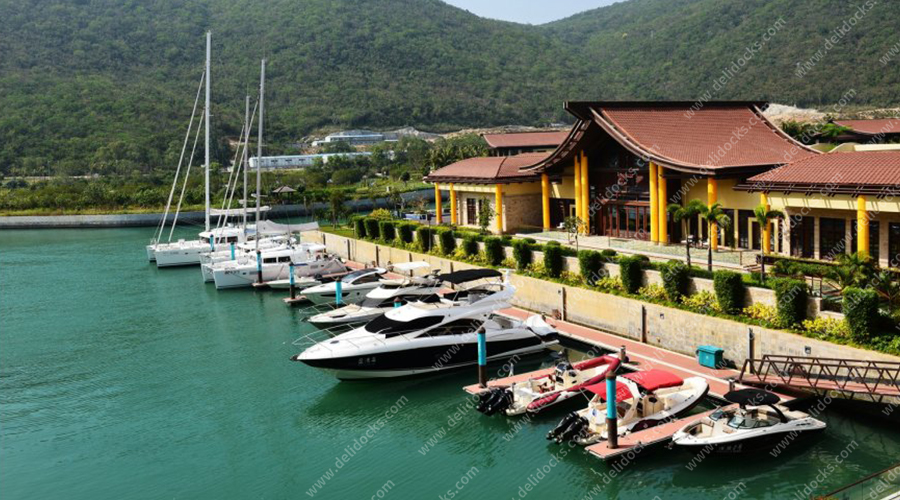
Commercial marinas must adhere to strict codes regarding fire safety and electrical systems. A modern floating marina often includes integrated service channels.
These channels house high-voltage cables, water pipes, and even vacuum sewage pump-out lines. Access panels allow maintenance crews to service utilities without disrupting boat owners.
Residential Preferences
For private homeowners, aesthetics often drive the design. The choice of decking material is paramount. Options range from synthetic composites to exotic hardwoods like Ipe.
Private docks often integrate recreational features. Swim ladders, kayak launches, and lower-profile sections for small watercraft are common additions.
Designing for Yacht Compatibility
The layout of the marina must accommodate the specific types of vessels that will visit. The turning basin width and fairway dimensions are critical.
For example, a trawler yacht like a DeFever has a specific beam and draft. The slip must be wide enough to accommodate fenders while allowing safe entry.
Large yachts require substantial shore power. The electrical infrastructure must be able to deliver 50-amp or 100-amp service without voltage drops. This requires heavy cabling running through the floating structure.
The structural frame must also withstand the wind load of these large vessels. A tall yacht acts like a sail, transferring significant force to the cleats and the main walkway during storms.
Maintenance and Longevity
The harsh marine environment attacks all man-made structures. Saltwater corrosion, UV radiation, and biological growth are constant threats.
Routine Inspections
To ensure the longevity of a floating marina, regular inspections are mandatory. Connections between modules are high-stress points.
Flexible connectors, often made of rubber and steel, absorb the energy of wave movement. If these fail, the structural integrity of the entire arm can be compromised.
Material Care
Concrete requires very little care, though cracks should be sealed immediately to prevent water intrusion. Aluminum frames should be checked for galvanic corrosion, especially near stainless steel fasteners.
Wood decking requires cleaning and sealing. Composite decking is low maintenance but can be stained by oils or solvents if not cleaned promptly.
Environmental Impact and Permitting
Modern engineering places a high priority on environmental stewardship. Regulatory bodies often require light-penetrating decking on a floating marina.
This allows sunlight to reach the seabed, sustaining seagrass and marine life below. Grated surfaces or glass-reinforced plastic (GRP) mesh are often used for this purpose.
The flow of water is another consideration. Pontoons should not stagnate the water in a basin. Proper spacing and alignment ensure that tidal flushing continues to keep the water clean.
The Future of Marina Technology
The industry is moving toward "smart marinas." These facilities integrate technology directly into the floating infrastructure.
Power pedestals now feature Wi-Fi monitoring. Operators can track electricity usage in real-time and detect stray currents that could cause corrosion or safety hazards.
New materials are also emerging. Fiber-reinforced polymers (FRP) are being used to create piles and frames that are impervious to rust and rot, promising a lifespan that exceeds traditional materials.
The construction of a floating marina is a complex feat of engineering. It combines structural strength with the flexibility needed to survive in a fluid environment.
From the heavy concrete breakwaters that protect the harbor to the precise electrical systems powering a DeFever yacht, every component matters. The right design ensures safety, convenience, and longevity.
As materials improve and designs evolve, these floating systems will continue to serve as the vital link between the land and the water. Investing in quality engineering today prevents costly repairs and failures tomorrow.
Frequently Asked Questions
Q1: What is the average lifespan of a floating marina?
A1: The lifespan depends on the materials used. A well-built concrete floating dock can last upwards of 50 years. Aluminum and timber systems generally have a lifespan of 25 to 35 years, provided regular maintenance is performed.
Q2: How do floating marinas handle hurricanes or severe storms?
A2: Engineers design these structures to withstand specific wind and wave loads based on the location's history. Piles are driven deep into the substrate to resist uplift, and flexible connections allow the dock to ride out the surge without breaking.
Q3: Can I install a boat lift on a floating dock?
A3: Yes, but it requires careful calculation. The weight of the lift and the boat will push the dock further into the water. Additional flotation modules are usually added under the lift area to maintain a level deck.
Q4: Why is concrete preferred over wood for large commercial marinas?
A4: Concrete offers superior mass, which dampens wave movement and provides a more stable walking surface. It is also fire-resistant, does not rot, and can support heavier utility infrastructure required for large vessels.
Q5: What is the difference between freeboard and draft?
A5: Freeboard is the distance from the water's surface to the top of the dock deck. Draft is the distance from the water's surface to the bottom of the float. Maintaining a consistent freeboard is essential for safe boarding.