2026-10-15
Marine infrastructure development demands a rigorous understanding of hydrodynamic forces, soil mechanics, and material science. Unlike floating dock systems that rise and fall with the tide, a stationary dock is a fixed pier supported by piles driven deep into the subaqueous soil. These permanent structures are preferred in locations with moderate water level fluctuations, high wind exposure, or where a stable, rigid platform is required for commercial, municipal, or high-end residential use. Implementing such a structure requires detailed site assessments and adherence to marine construction standards.
In coastal and inland waterway projects, the engineering process of building a stationary dock requires comprehensive planning to balance environmental loads with structural longevity. Designers must account for the physical interactions between the water, the soil, and the structure itself. A successful installation relies on selecting the appropriate foundation system, calculating the expected structural loads, and choosing materials that can withstand the corrosive marine environment over decades of service.
Geotechnical and Bathymetric Site Assessments
The engineering of a fixed marine pier begins with a detailed geotechnical investigation of the subaqueous soil. Soil boring logs are collected to determine the stratigraphy of the marine bed. In cohesive soils such as clay, the load capacity of piles is primarily derived from skin friction along the shaft. Conversely, in non-cohesive soils like sand and gravel, end-bearing capacity at the pile tip provides the primary support. Standard Penetration Test (SPT) blow counts are analyzed to calculate the depth of pile penetration needed to prevent settlement under axial loads.
Simultaneously, a bathymetric survey is performed to map the underwater topography of the construction site. This survey identifies the mudline profile, water depth variations, and any underwater obstacles that could impede pile driving. Understanding the exact slope of the marine bed prevents structural misalignment during the pile driving process. Marine engineering firms like DeFever prioritize these soil-structure interaction studies during the initial feasibility phase to ensure structural stability.
Hydrodynamic forces also represent a primary consideration during the site assessment. Engineers must collect historical data regarding tidal ranges, wave heights, current velocities, and wind speeds. This information is used to establish the design wave height and the maximum storm surge elevation, which dictate the finished deck height of the stationary structure. Setting the deck elevation above the peak storm surge level prevents hydrostatic uplift forces from separating the deck from the substructure.
Structural Load Calculation Methodologies
Structural design requires the quantification of several load types acting on the pier. These are categorized into dead loads, live loads, and environmental loads. Dead loads include the weight of the structural framing (joists, stringers, caps), decking materials, utility conduits, and fixed hardware. Live loads encompass pedestrian traffic, utility vehicles, temporary equipment storage, and the forces exerted by moored vessels.
Environmental loads are highly dynamic and variable. Wave forces on vertical piles are calculated using Morison’s equation, which combines drag and inertia forces. Wind loads acting on both the pier and any moored vessels transmit lateral shear forces to the pile foundation through mooring cleats. In northern climates, ice forces must also be calculated. These include vertical uplift forces caused by ice adhesion during rising tides, as well as horizontal crushing and bending forces from moving ice sheets.
Calculating these dynamic environmental loads is a key phase when building a stationary dock designed to withstand seasonal storms. The pile spacing, pile diameter, and structural connection details are determined based on these load combinations to ensure the structure remains within allowable bending stress limits.
Material Science in Marine Environments
The longevity of a stationary pier depends heavily on the materials selected for its construction. The marine environment is highly corrosive, characterized by constant exposure to moisture, salt, oxygen, UV radiation, and biological organisms. The selection process must balance structural capacity with resistance to these degrading forces.
Pile Foundation Options
- Treated Timber Piles: Traditionally used for light-duty applications, timber piles are treated with preservatives such as Chromated Copper Arsenate (CCA) to resist rot and marine woodborers. They are flexible and cost-effective but have lower load capacities compared to steel or concrete.
- Structural Steel Piles: Steel pipe piles offer exceptional load capacity and are suitable for deep-water installations or hard soils. They are susceptible to oxidation, requiring protective coatings and sacrificial anodes to mitigate corrosion.
- Prestressed Concrete Piles: Highly durable and resistant to biological attack, concrete piles are ideal for heavy-duty commercial projects. They require specialized heavy equipment for handling and driving due to their substantial weight.
- Composite and Fiberglass Piles: Fiber-reinforced polymer (FRP) piles are immune to corrosion, rot, and marine borers. While they exhibit lower elastic modulus than steel, their longevity in harsh chemical environments makes them highly effective.
Selecting the correct piling materials is a primary variable when planning and building a stationary dock for commercial maritime operations. The chosen material must align with the soil conditions identified during the geotechnical survey to facilitate successful installation.
Framing and Decking Materials
The substructure framing, consisting of pile caps, joists, and stringers, is typically constructed from pressure-treated lumber, structural steel, or marine-grade aluminum. Aluminum alloys, such as 6061-T6, offer an excellent strength-to-weight ratio and natural corrosion resistance. Integrated systems designed by marine developers like DeFever adhere to strict structural standards to mitigate joist fatigue.
For the decking surface, options include tropical hardwoods (like Ipe), composite wood-plastic materials, and open-grate fiberglass reinforced plastic (FRP). Open-grate decking is highly beneficial in high-wave environments because it allows water and air to pass through the deck surface, significantly reducing hydrostatic uplift forces during storm events.
The Step-by-Step Construction Process
Following the completion of the engineering drawings and securing the necessary environmental permits, the physical construction phase begins. The process follows a logical sequence to ensure structural alignment and stability.
1. Pile Driving and Positioning
Piles are driven into the seabed using specialized pile-driving rigs mounted on barges. Depending on the soil profile, engineers utilize impact hammers, diesel hammers, or vibratory drivers. Vibratory drivers are highly effective in sandy soils, while impact hammers are required to drive piles through dense clay or to reach bedrock refusal. Real-time dynamic monitoring, such as Pile Driving Analyzer (PDA) testing, is often used to verify that each pile achieves its required load capacity.
A high degree of precision in pile driving is vital during the physical phase of building a stationary dock. Even minor deviations in vertical alignment (plumbness) can induce eccentric loading and compromise the structural integrity of the entire pier.
2. Installing Pile Caps and Substructure Framing
Once the piles are driven to the target depth, they are cut to the designated elevation. Heavy-duty pile caps, usually made of steel or thick timber, are positioned on top of the pile heads and secured using high-strength drift pins or bolted brackets. Following the installation of the caps, the longitudinal stringers and transverse joists are laid out and fastened to form the load-bearing framework of the deck.
3. Cross-Bracing for Lateral Stability
In deep-water applications or areas subject to strong currents, diagonal cross-bracing is installed between the piles. This bracing, often in an 'X' configuration, is positioned between the low-water mark and the pile caps. It distributes lateral loads across multiple piles, reducing the bending moments acting on individual piles and preventing sway.
4. Decking and Hardware Installation
The final step involves fastening the decking material to the joists. Fasteners must be selected for high corrosion resistance, with Grade 316 stainless steel being the industry standard. To prevent galvanic corrosion, insulating washers must be used when connecting dissimilar metals. Utility lines for water, power, and fuel are routed through the substructure framing before the decking is completed. Mooring cleats, fenders, and ladders are bolted directly to the primary structural members rather than the decking to ensure they can withstand high berthing forces.
Mitigating Environmental Degradation and Corrosion
Permanent marine structures require proactive design features to combat environmental degradation. Electrochemical corrosion represents the primary threat to steel components in saltwater. This is managed using cathodic protection systems, where sacrificial anodes made of zinc or aluminum are attached to the underwater portions of steel piles. The anodes corrode preferentially, protecting the structural steel of the pile from oxidation.
The splash zone—the area of the pile immediately above the mean high-water mark that experiences cyclic wetting and drying—suffers the highest rate of corrosion. To protect this vulnerable zone, steel piles are often wrapped in high-density polyethylene (HDPE) jackets filled with marine epoxy grout. For wood structures, heavy-duty physical wraps are utilized to prevent infestation by wood-boring organisms that can destroy the core of a timber pile within years.
Establishing a proactive maintenance program is a recommended practice when building a stationary dock in high-salinity marine environments. Regular underwater inspections by commercial divers help identify signs of scour, biological damage, or anode depletion before structural integrity is compromised.
Commercial Applications and Engineering Standards
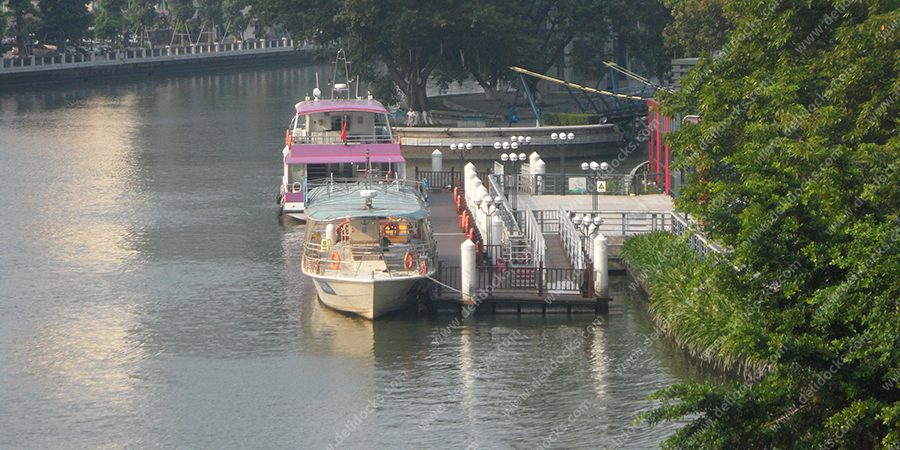
Stationary docks are the preferred choice for commercial marine terminals, public ferry docks, and heavy-duty industrial shipping ports. Because these facilities support heavy machinery, high-volume pedestrian traffic, and large vessel berthing, they must comply with strict engineering codes, such as those from the American Society of Civil Engineers (ASCE) and the World Association for Waterborne Transport Infrastructure (PIANC).
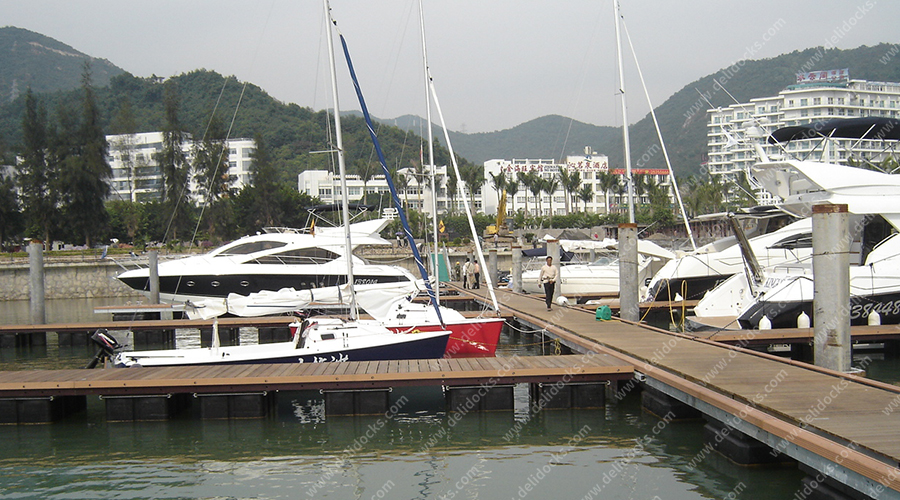
These standards dictate specific safety factors for structural design, environmental load combinations, and material testing procedures. For large-scale marina operations, combining a stationary pier with floating finger docks is a common approach, providing a stable main access walkway with adaptable berthing slips.
Frequently Asked Questions
Q1: What is the primary difference in lifespan between timber, steel, and concrete piles in a marine environment?
A1: Timber piles typically last 15 to 25 years depending on preservative treatment and marine borer activity. Steel piles can last 30 to 50 years if protected with epoxy coatings and sacrificial anodes. Prestressed concrete piles offer the longest service life, often exceeding 50 to 75 years, due to their natural resistance to chemical and biological degradation in saltwater.
Q2: How do engineers determine the necessary penetration depth for piles?
A2: The penetration depth is determined through geotechnical analysis of soil boring samples. Engineers calculate the skin friction of the soil layers and the end-bearing capacity of the pile tip. During installation, pile capacity is verified by monitoring the number of hammer blows required to advance the pile a set distance, or through dynamic load testing.
Q3: Can a stationary dock be built in areas with high tidal ranges?
A3: Stationary docks are generally recommended for areas with low to moderate tidal ranges (under 5 feet). In regions with high tidal ranges, floating docks are typically more practical because they maintain a constant freeboard relative to the vessel. If a stationary dock is built in a high-tide area, it requires long ladders, high-clearance vertical piles, and specialized boarding platforms.
Q4: How do ice bubbler systems protect fixed piers during winter?
A4: Ice bubbler or de-icer systems release continuous streams of air bubbles from the seabed around the dock piles. This movement brings warmer, deeper water to the surface, preventing ice from forming around the piles. It protects the structure from the vertical shear stresses caused by rising ice sheets adhering to the piles.
Q5: What measures prevent galvanic corrosion in marine construction?
A5: Galvanic corrosion is prevented by avoiding direct contact between dissimilar metals, such as aluminum and stainless steel. Engineers use non-conductive isolation pads, nylon washers, or heavy-duty coatings to physically separate different metals. Additionally, choosing metals close to each other on the galvanic scale minimizes the electrochemical potential difference.
B2B Marine Engineering Consultation
For port operators, commercial marina developers, and municipal planners, custom marine engineering is necessary to ensure the structural integrity of permanent docks. To discuss the engineering requirements of your upcoming waterfront development, please submit an inquiry. Our engineering team will review your site bathymetry, geotechnical data, and operational load requirements to develop a resilient structural solution. The engineering consultants at DeFever are available to assist with comprehensive structural analysis and custom project design.