2026-10-15
Waterfront development and marina expansion demand reliable docking solutions. Personal Watercraft (PWC) usage has grown substantially, requiring commercial facilities to establish designated, secure mooring systems. To handle this demand, operators frequently choose to invest in specialized docking solutions. When marina managers prepare to buy jet ski dock infrastructure, they must assess several factors including structural durability, wave tolerance, and material integrity.
Implementing a dedicated floating platform protects both the watercraft and the main dock infrastructure. Traditional mooring methods, such as tying a PWC to a standard dock slip, often lead to hull abrasion from continuous wave action. Modern dry-docking platforms address this issue by elevating the watercraft completely out of the water, preventing marine growth accumulation and salt-water exposure when the craft is idle. Understanding the engineering behind these platforms is necessary for securing a high-return, long-term asset.
Structural Engineering and Material Selection for Floating PWC Ports
High-Density Polyethylene (HDPE) Properties
The selection of raw materials determines the longevity of a floating dock. Industrial-grade marine platforms rely heavily on High-Density Polyethylene (HDPE) due to its high strength-to-density ratio and resistance to chemical corrosion. Standard polyethylene often degrades when exposed to continuous marine environments. To mitigate this, advanced manufacturers like DeFever employ high-density polyethylene compounded with specific UV inhibitors to resist solar radiation damage over decades of use.
The manufacturing process itself influences structural integrity. Rotational molding is the preferred industry standard for these platforms. This process creates a one-piece, seamless hollow part with uniform wall thickness, eliminating the weak points often found in welded or blow-molded alternatives. A seamless construction prevents water ingress, ensuring that the dock retains its design buoyancy over its lifetime.
Buoyancy Calculations and Load-Bearing Capacity
A stable PWC dock must support the deadweight of the watercraft alongside the active weight of the operator. Modern multi-passenger PWCs can weigh up to 500 kilograms when fully loaded with fuel and gear. A reliable docking system must distribute this localized load across a broad surface area to prevent tilting or submerging during boarding.
Engineers calculate buoyancy based on displaced water volume. A high-quality modular platform provides a draft depth that keeps the craft dry while maintaining a stable surface for users to walk on. The internal chamber design often includes structural columns or webbed supports that prevent the top surface from flexing under concentrated foot traffic or when a watercraft drives onto the platform.
Key Factors to Consider When You Buy a Jet Ski Dock
Selecting the right configuration requires analyzing the physical demands of your specific waterfront. When decision-makers evaluate options to buy jet ski dock units for public or private facilities, they need to examine the roller system design, entry dynamics, and connection methods.
- Roller Systems and Entry Dynamics: The ease with which a watercraft transitions from water to dock is determined by the roller placement and design. Adjustable polyurethane rollers allow the dock to accommodate different hull shapes, minimizing friction and avoiding gelcoat wear during launching and docking.
- Connecting Mechanisms and Modular Adaptability: Marinas frequently need to adjust their layout to accommodate changing slip demands. Modular connection kits allow multiple PWC ports to be linked side-by-side or inline, utilizing durable rubber couplers that absorb wave energy without fatiguing the primary structural walls.
- Tidal Fluctuations and Anchoring Compatibility: Dock designs must adapt to local tidal ranges. Whether utilizing piling brackets, deadweight anchors, or stiff-arm systems, the docking platform must slide smoothly or pivot to match water level variations without stressing the anchoring points.
The entry throat of the platform should feature a gradual incline. This design reduces the thrust required to drive the PWC onto the dock, which lowers the risk of accidental overshooting and protects the overall structural interface.
Environmental Adaptation and Anchorage Systems
Pile Guides vs. Deadweight Anchorages
Anchoring is the foundation of any marine installation. In deep-water environments with significant tidal ranges, pile guides are the standard solution. These guides encircle steel, concrete, or timber piles, allowing the PWC dock to glide vertically. The tolerance within these guides must accommodate slight angular misalignments caused by wind and current forces without binding.
In shallower waters or locations where driving piles is not feasible, deadweight anchorage systems are utilized. This method relies on heavy concrete blocks resting on the seabed, connected to the floating platform via marine-grade chains or tensioned synthetic ropes. The length of the chain must be calculated precisely to prevent the dock from shifting excessively during high winds while ensuring it does not submerge during high tides.
UV Degradation and Chemical Resistance
The marine environment exposes equipment to harsh conditions, including fuel spills, saltwater, and organic growth. HDPE is naturally resistant to petroleum products, meaning accidental fuel spills during refueling will not compromise the polymer structure. Furthermore, algae and barnacles cannot easily bond to the smooth, non-porous surface of rotationally molded HDPE, making cleaning a straightforward process.
Solar radiation remains a primary factor in polymer degradation. High-quality docks incorporate UV stabilizers (such as UV8 or higher) directly into the raw resin before molding. This integration ensures that the material retains its tensile strength and impact resistance even after years of direct exposure to intense sunlight, preventing the cracking and chalking associated with low-grade plastics.
Integrating PWC Docks into Commercial Yacht Marinas
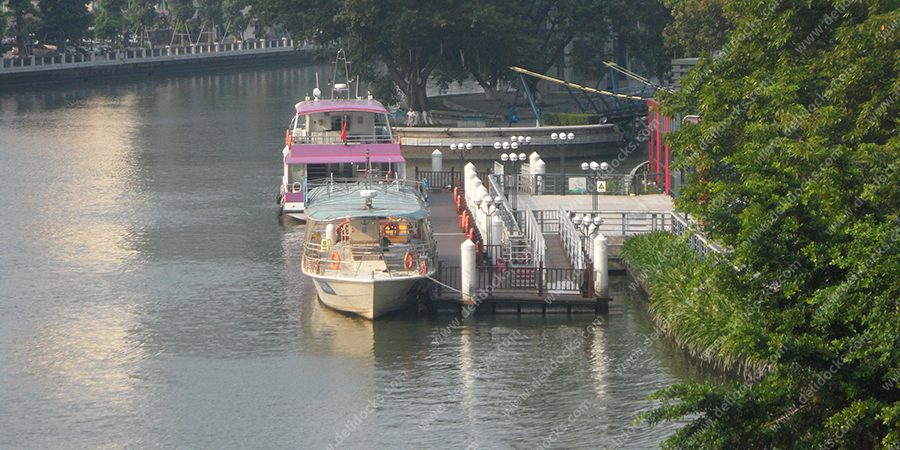
Integrating personal watercraft docking systems into an existing yacht marina requires careful planning. Commercial operators must maximize dock space without restricting the fairways used by larger vessels. Because PWCs are compact, modular floating docks can be installed in underutilized corners of a marina, such as the space behind wave attenuators or in shallow areas unsuitable for deep-draft yachts.
Using modular PWC ports from DeFever allows marina operators to configure custom docking arrays. These arrays can be attached directly to concrete, timber, or aluminum floating docks. The resulting layout maintains a uniform aesthetic and provides safe, stable access for slip holders, which enhances the commercial appeal of the marina facility.
When planning to buy jet ski dock configurations for commercial use, consider how the transition from the main walkway to the PWC dock is managed. Hinge kits and heavy-duty transition plates prevent tripping hazards and accommodate the differing motion patterns of a large floating dock and a smaller, more responsive PWC port.
Operational Efficiencies and Maintenance Protocols
Anti-Slip Texturing and User Safety
Safety is a key concern in wet marine environments. The deck surface of a high-performance PWC port must feature molded-in, anti-slip patterns that provide traction even when wet or covered in marine film. These patterns are engineered to be non-abrasive to bare feet while still providing sufficient grip for footwear.
Water drainage is another design element that affects safety. Channels molded into the surface of the dock direct water away from the walking paths, preventing pooling and reducing the growth of slippery biofilm. This design detail keeps the platform clean and dry shortly after a watercraft is launched.
Structural Integrity Inspections
While HDPE modular docks require very little upkeep compared to timber or concrete structures, regular inspections are still recommended. Maintenance teams should verify the integrity of the connecting couplers twice a year. These couplers, often made from specialized composite rubber, bear the brunt of wave energy and must be checked for signs of wear or loosening.
The roller assemblies should also be inspected periodically to ensure they spin freely. Salt, sand, or debris can sometimes lodge in the roller shafts, which increases rolling resistance. Flushing the rollers with fresh water and verifying the security of the retaining pins is generally all that is needed to maintain smooth launching performance. This systematic approach ensures that when you buy jet ski dock systems for high-traffic environments, they perform reliably over their projected service life.
Strategic Sourcing and Commercial Specifications
For engineering procurement teams looking to buy jet ski dock configurations, writing clear specifications is a necessary step. Requesting detailed material sheets that verify the use of virgin HDPE with UV protection ensures that the products delivered will meet long-term durability goals. Recycled plastics, while suitable for some land-based applications, often lack the consistent molecular weight needed to survive continuous wave action and freeze-thaw cycles in northern climates.
Engineering teams at DeFever provide detailed structural drawings and load calculations to streamline municipal approval and permitting processes. Having access to these documents accelerates the development timeline, allowing marinas to install their new PWC docks ahead of the active boating season.
Frequently Asked Questions
Q1: What is the typical lifespan of a commercial-grade HDPE jet ski dock?
A1: High-density polyethylene floating docks designed with appropriate UV stabilizers generally have a service life exceeding 15 to 20 years. Because the material is highly resistant to saltwater corrosion, rot, and marine organisms, it does not degrade in the manner of wood or steel under typical environmental conditions.
Q2: How do modular PWC docks handle extreme tidal changes?
A2: These platforms adapt to tidal changes through specialized anchoring systems. Pile guides allow the dock to slide vertically along fixed piles, while slide tracks or deadweight anchor chains adjust dynamically to rising and falling water levels, maintaining a consistent relative height to the water surface.
Q3: Can these PWC ports be integrated with existing timber or concrete floating docks?
A3: Yes. Modular PWC ports are designed with universal connection points. Heavy-duty brackets and flexible hinge kits allow them to attach to concrete, aluminum, or timber floating docks, ensuring compatibility with existing marina infrastructure.
Q4: What maintenance is required for the roller assemblies?
A4: Maintenance is minimal. It involves periodically checking the roller shafts for debris, sand, or salt buildup and flushing them with fresh water. Verifying that the retaining pins are secure ensures that the rollers spin freely and protect the PWC hull during docking and launching.
Q5: How does the entry angle of the dock prevent hull damage on larger PWC models?
A5: The entry throat of a professionally engineered dock features a gentle, flared incline and initial rollers positioned low to the water line. This design guides the bow of the PWC upward smoothly, distributing the weight and reducing the impact force as the craft transitions onto the platform.
Contact Our Engineering Team for Custom Specifications
For detailed structural specifications, CAD drawings, or custom configuration proposals for your commercial waterfront, please submit an inquiry to our technical sales office. Our engineering representatives are available to assist with site-specific dock design, buoyancy calculations, and anchorage planning to ensure your project meets all local marine standards.