2026-10-15
Modern marine infrastructure demands structures capable of enduring harsh offshore environments while providing stable, reliable service for commercial vessels and luxury yachts. As coastal development expands into deep-water zones and areas subject to severe weather, traditional fixed piers often prove inadequate or structurally unfeasible. This shift has positioned the caisson floating dock as a primary choice for harbor designers, municipal authorities, and private developers seeking robust marine installations.
The engineering philosophy behind these structures relies on hydrostatic displacement, heavy-duty material integration, and flexible anchoring systems. Unlike lightweight pontoon designs, these heavy-mass structures offer the inertia needed to damp wave action, providing a platform that mimics the stability of a solid stone pier while adapting to significant tidal variations. Understanding the structural properties, manufacturing standards, and application parameters of these installations is necessary for successful modern marina development.
As a leading name in marine engineering and waterfront fabrication, DeFever specializes in designing, manufacturing, and installing high-performance concrete floating structures. By integrating advanced concrete formulations with precise structural design, the company delivers solutions that meet international maritime standards, ensuring longevity and minimal operational disruption in diverse marine environments.
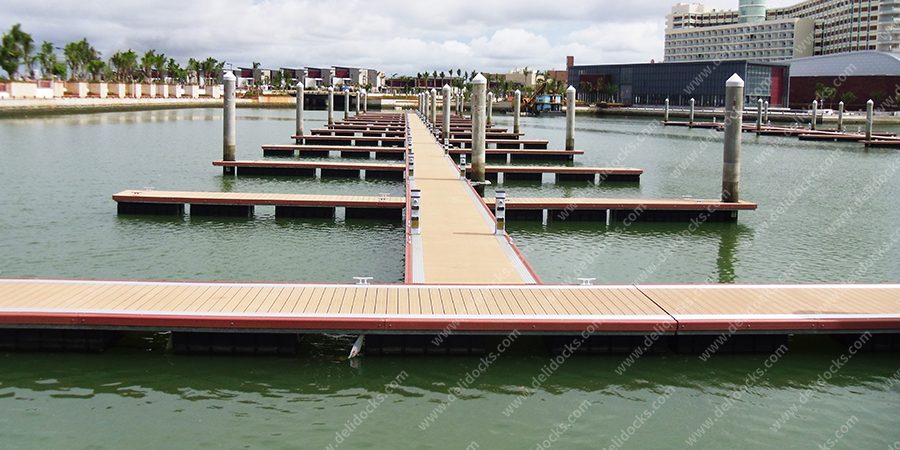
Structural Anatomy of Concrete Caissons
A high-performance caisson floating dock relies on a multi-layered design where material quality and geometric precision determine structural longevity. The primary structure consists of a reinforced concrete outer shell, an internal buoyancy core, and integrated utility chases.
High-Performance Concrete Shell
The outer barrier is typically cast using high-strength, low-permeability concrete, often specified at grade C50/60 or higher. This concrete mix design incorporates silica fume, fly ash, and specific plasticizers to achieve water-resistance and mitigate chloride ion penetration, which causes internal rebar corrosion. Synthetic micro-fibers are frequently added to the wet mix to control micro-cracking during the curing process. The reinforcing steel cage inside the concrete is either hot-dip galvanized or composed of epoxy-coated rebar, placed with a minimum concrete cover of 50 millimeters to satisfy BS 6349 marine exposure standards.
Core Buoyancy Architecture
Internal buoyancy is provided by blocks of Expanded Polystyrene (EPS), characterized by a high density of 15 to 20 kilograms per cubic meter. These EPS blocks are non-water-absorbent and serve as a secondary defense; even in the highly unlikely event of an impact breaching the concrete outer wall, the dock retains its buoyancy and structural integrity. The EPS cores are cast directly inside the concrete structure during a monolithic pour, eliminating cold joints and ensuring a seamless, watertight outer skin.
Utility Integration and Service Chases
To support modern marina operations, the structural design incorporates dedicated utility channels. These chases run longitudinally beneath the deck surface, allowing for the hidden installation of water supply lines, electrical conduits, fiber-optic internet cables, and fire-suppression systems. Removable composite or aluminum trench covers facilitate maintenance access without compromising the structural load-bearing capacity of the deck surface.
Hydrodynamic Performance and Load Calculations
The primary advantage of choosing a heavy-duty concrete caisson floating dock lies in its exceptional hydrodynamic stability. This stability is directly related to the mass of the structure, which provides the necessary inertia to resist external forces.
- Dead Load and Freeboard Maintenance: The dead load of a standard concrete caisson provides a low center of gravity. This self-weight is calculated to establish a consistent freeboard, usually between 500 millimeters and 1000 millimeters above the water level, depending on the targeted vessel draft and boarding requirements.
- Live Load Capacity: Standard configurations are engineered to support uniform live loads ranging from 2.5 kN/m² to over 5.0 kN/m² for commercial and industrial applications. This capacity allows for the safe operation of maintenance vehicles, heavy pedestrian traffic, and utility carts.
- Wave Attenuation Properties: Due to their deep draft and significant mass, these structures function effectively as floating breakwaters. When a wave train encounters the vertical face of a caisson, a large portion of the kinetic energy is reflected or dissipated beneath the structure, creating a calm basin on the leeward side.
By optimizing these three parameters during the engineering phase, designers ensure that the floating pontoons maintain horizontal alignment and minimal roll, even when subjected to asymmetrical loads during peak berthing hours.
Strategic Applications in Marine Infrastructure
Because of their load-bearing capacity and resilience, concrete caissons are utilized across several sectors where lightweight dock systems are structurally insufficient.
Commercial Mega-Yacht Marinas
Superyachts require substantial mooring structures capable of handling high windage loads and deep drafts. A concrete caisson floating dock provides the structural rigidity needed to install high-capacity mooring bollards (rated from 50 kN to over 150 kN) directly into the concrete deck without risking structural shear failure.
Public Transit and Ferry Terminals
Ferry terminals experience continuous passenger traffic and repetitive docking impacts. The wear-resistant concrete deck of a caisson provides a non-slip, level surface that complies with accessibility standards, while the robust structure absorbs the regular berthing energy of commercial vessels without accumulating fatigue damage.
Industrial and Utility Platforms
In industrial harbors, floating platforms must support heavy equipment, fuel bunkering systems, and pump stations. The modular design of concrete caissons allows for the creation of wide, stable work areas that can support localized crane loads and high-capacity storage tanks, maintaining stable positioning near industrial shorelines.
Mooring Systems and Site-Specific Anchoring
A floating structure is only as secure as its anchoring system. Selecting the appropriate mooring method requires an analysis of local bathymetry, soil composition, wave climate, and extreme tidal ranges.
For applications with deep water or soft seabed geology, heavy-duty chain and anchor systems are utilized, combined with high-tension marine elastic mooring lines. These systems damp shock loads during storm surges, minimizing stress on both the concrete caisson and the seabed anchor points. Under the guidance of experienced manufacturers like DeFever, engineers perform finite element analysis (FEA) to determine the exact sizing of tension members, ensuring the system can handle environmental forces during extreme weather events.
In environments with shallow to medium water depths and significant lateral forces, steel or concrete guide piles are preferred. The caisson is connected to the piles using heavy-duty guide collars equipped with low-friction, wear-resistant polyurethane rollers. This arrangement allows the dock to rise and fall smoothly with tidal variations while maintaining precise lateral alignment. Internal pile guides can also be cast directly within the caisson body, presenting a clean exterior profile that maximizes usable berthing space.
Advanced Manufacturing and Quality Control Standards
The fabrication of concrete caissons demands precise quality control protocols. Because these units are designed for continuous submersion in saltwater, manufacturing errors can lead to premature structural decay within a few years.
The casting process is conducted in controlled dry-dock facilities or specialized casting beds. The molds must be structurally rigid to prevent deformation during concrete placement. High-frequency external and internal vibrators are deployed during the pour to eliminate air voids and honeycombing around the dense reinforcement steel. Following the pour, the concrete undergoes a wet-curing cycle, maintaining optimal moisture levels for at least 7 days to maximize compressive strength and minimize shrinkage cracks.
Post-cure inspections include ultrasonic testing to verify concrete density, cover-depth measurements to confirm rebar protection, and hydro-testing of internal compartments. These measures ensure that every manufactured pontoon exhibits the necessary durability to withstand decades of continuous exposure to marine organisms, freeze-thaw cycles, and chemical attacks from saltwater.
Engineering Consultation and Customized Inquiry
Developing resilient waterfront infrastructure requires a balance of structural analysis, material science, and hydrodynamic modeling. A standard, off-the-shelf solution rarely suffices when confronting unique tidal dynamics, soil profiles, and operational parameters. Partnering with a specialized marine contractor ensures that every variable—from concrete mix design to anchoring mechanics—is tailored to the specific demands of your project site.
If you are planning a commercial marina development, a public transit terminal, or an industrial port upgrade, contact DeFever today. Our engineering team provides comprehensive support, including site evaluations, custom structural drawings, and precise manufacturing specifications, to deliver a durable, long-term marine installation. Reach out to discuss your project requirements and receive a comprehensive engineering inquiry package tailored to your commercial development goals.
Frequently Asked Questions
Q1: What is the expected design life of a concrete caisson floating dock?
A1: A properly engineered concrete caisson floating dock, manufactured using high-performance C50/60 concrete and protected reinforcement, has a design life exceeding 50 years. This longevity is achieved through low-permeability concrete mixes, adequate concrete cover, and high-density EPS cores that do not degrade when exposed to seawater or marine organisms.
Q2: How do caisson floating docks perform in freezing climates?
A2: These structures are designed to withstand freeze-thaw cycles. The concrete mixes incorporate air-entraining agents that create microscopic air voids, allowing water within the concrete to expand upon freezing without causing structural cracking. Additionally, the vertical walls of the heavy caisson are engineered to resist lateral ice pressure.
Q3: Can utility systems be retrofitted after the concrete caisson is installed?
A3: It is recommended to integrate utility chases during the initial design and casting phase. However, secondary utility runs can be accommodated via external bracket systems or by utilizing pre-cast internal conduit networks. Major structural modifications to the concrete shell should be avoided post-installation to preserve watertight integrity.
Q4: What maintenance is required for a concrete caisson floating dock?
A4: Compared to timber or steel systems, concrete caissons require minimal maintenance. Routine inspections should focus on the connection hinges between modules, the wear pads on pile guides, and the tension of mooring lines. The concrete surface should be periodically checked for impact damage or localized spalling, which can be repaired with marine-grade epoxy mortars.
Q5: How does a caisson floating dock act as a breakwater?
A5: The deep draft and substantial mass of a caisson floating dock allow it to intercept incoming wave energy. As waves strike the vertical concrete face, a portion of the energy is reflected, and another portion is dissipated through friction and turbulence beneath the draft of the structure, significantly reducing wave action in the protected harbor basin.