2026-10-15
Marine civil engineering projects increasingly encounter geographical and geological settings where traditional bottom-fixed pile structures prove economically prohibitive or environmentally unacceptable. Deep-water crossings, reservoirs with radical seasonal water-level fluctuations, soft silt seabeds, and sensitive marine conservation zones demand flexible structural solutions. Partnering with a specialized floating bridge manufacturer enables municipal authorities, commercial marina operators, and industrial contractors to deploy continuous over-water access systems capable of riding hydrodynamic fluctuations without sacrificing load-bearing integrity.
Modern pontoon-based transit corridors demand an exact balance between buoyancy mechanics, material longevity, dynamic wave response, and articulation joint physics. Navigating these parameters requires an exhaustive evaluation of fabrication capabilities, geotechnical mooring design, and lifecycle maintenance metrics.
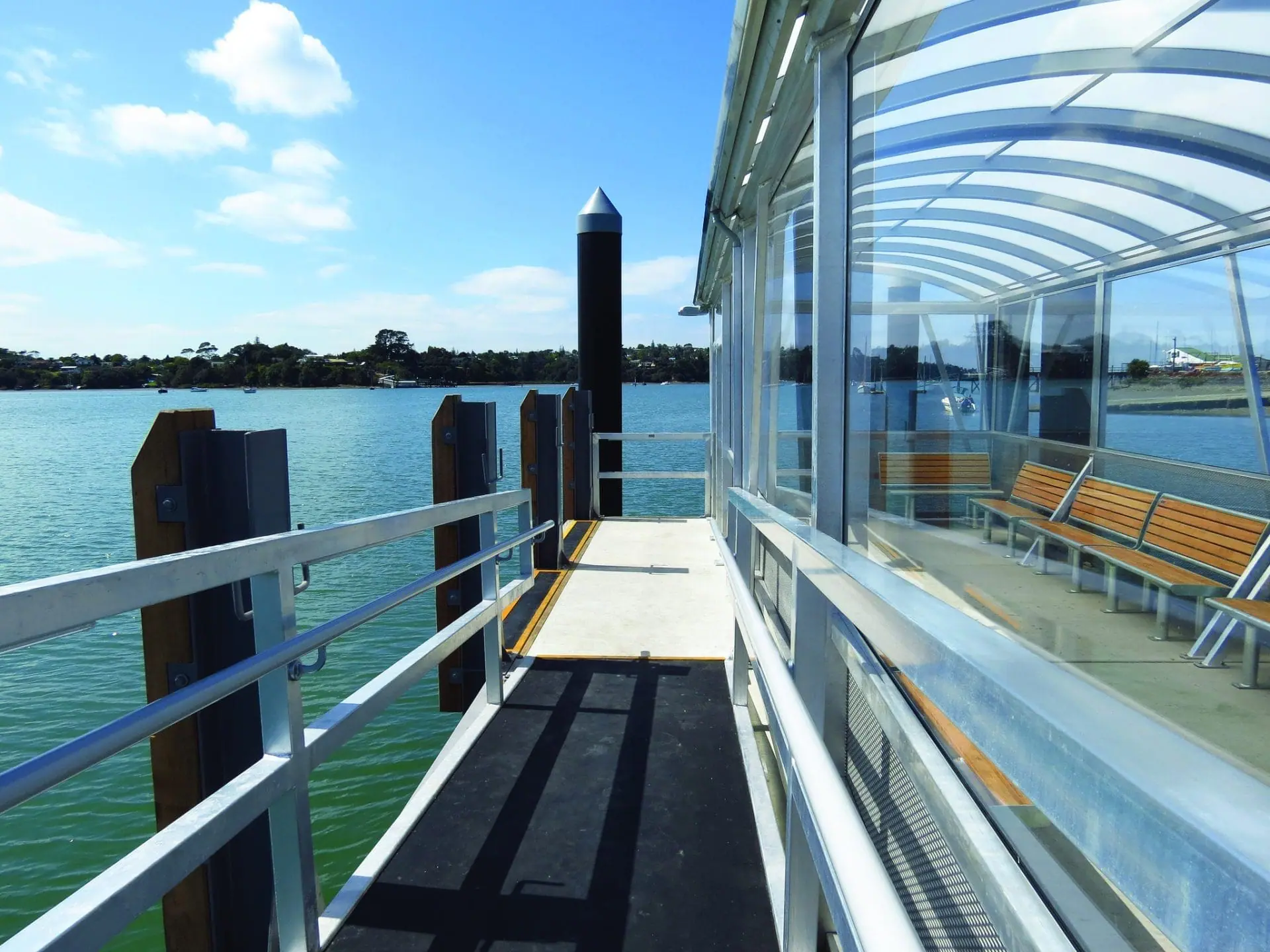
Pontoon Material Science and Core Flotation Engineering
A floating structure derives its performance directly from the chemistry and structural design of its buoyant units. Selecting the appropriate pontoon matrix dictates structural stability, total dead-weight capacity, and service life within saline or brackish environments.
Prestressed Maritime Concrete Pontoons
For heavy vehicular crossings and long-span pedestrian access corridors subject to persistent wave action, heavy-duty concrete pontoons represent the industry standard. Structural characteristics include:
Concrete Formulation: High-density C45/55 or C50/60 concrete infused with silica fume, slag, or fly ash to reduce permeability and prevent chloride ion ingress to the internal rebar.
Reinforcement: Hot-dip galvanized or epoxy-coated prestressed steel rebar, combined with synthetic micro-fibers to arrest micro-cracking caused by cyclic hydrodynamic wave flexing.
Internal Core: Solid blocks of 100% virgin expanded polystyrene (EPS) with a minimum density of 15 to 20 kg/m³, molded directly into the concrete shell to guarantee continuous reserve buoyancy even under catastrophic outer wall penetration.
Marine-Grade Aluminum and Composite Structures
Where total dead-load must remain low to facilitate shallow draft operation or swift deployment, structural frames fabricated from extruded 6061-T6 or 6082-T6 marine-grade aluminum alloy provide superior strength-to-weight ratios. The structural framing supports rotomolded heavy-wall high-density polyethylene (HDPE) pontoons or seamless aluminum chambers. HDPE pontoons integrate high carbon black concentrations or specialized UV stabilizers to prevent polymer chain degradation under prolonged solar exposure.
Hydrodynamic Loads, Reserve Buoyancy, and Torsional Articulation
Pontoon spans do not behave as static land bridges; they operate within continuous multi-axis hydro-mechanical environments. Hydrodynamic displacement must be calculated against a spectrum of live loads, environmental actions, and static weights.
Buoyancy-to-Load Ratios and Metacentric Height
A reliable floating bridge design maintains a conservative freeboard height under maximum allowable live load conditions. Engineers compute the metacentric height ($GM$) to prevent vessel or pedestrian induced listing:
Uniform Distributed Loads (UDL): Pedestrian spans typically require ratings between 3.0 kN/m² to 5.0 kN/m², whereas commercial vehicular spans require ratings matching local heavy transport regulations (such as AASHTO HS-20 or Eurocode LM1 classifications).
Point Load Distribution: The pontoon array must dissipate concentrated wheel or axle loads across multiple adjacent modules through continuous longitudinal structural beams.
Reserve Freeboard: Design parameters demand a minimum safety margin of 40% to 50% reserve buoyancy above the combined dead and design live loads, ensuring the top decking remains clear of surface splashing and green water wash.
Modular Articulation and Elastic Hinge Design
Rigid, monolithic connections across prolonged water surfaces inevitably experience early structural failure from wave-induced shear, yaw, roll, and pitching moments. Structural longevity depends on specialized bridge articulation:
Clevis-and-Pin Heavy Hinge Units: Fabricated from duplex stainless steel (such as 2205 grade) to resist localized shearing forces while providing controlled single-axis rotational freedom.
Elastomeric Shear Bushings: High-durometer polyurethane or vulcanized rubber compression blocks integrated into connection nodes to absorb torsional energy, damp vibrational shock, and isolate dynamic cyclic loads between individual pontoons.
Continuously Flexible Cable Links: Pre-tensioned structural steel or synthetic hawser tendons running internally through modular ducts to offer elastic restorative forces across high-current spans.
Engineering departments at specialized production entities like DeFever calculate these articulating interfaces using finite element analysis (FEA) and hydrodynamic simulation software to ensure that cyclic bending stress remains well below the fatigue threshold of each structural alloy.
Mooring Geometry and Dynamic Displacement Control
A continuous floating bridge must be held strictly on alignment to support safe traversal while allowing unrestricted vertical movement across the site-specific astronomical tidal range or seasonal reservoir drawdowns. Specifying the anchoring scheme is a foundational responsibility of any accomplished floating bridge manufacturer.
Vertical Guide Piles and Internal Sliders
In ports, marinas, and protected inland waterways where geotechnical seabed conditions allow driving steel tubular piles, vertical guide piles provide precise lateral restraint. The floating structure integrates low-friction pile guide collars lined with self-lubricating ultra-high-molecular-weight polyethylene (UHMW-PE) wear plates. This mechanical interface delivers silent, low-maintenance vertical tracking without applying moment loads directly to the pile shafts.
Elastic Hawser and Pre-Tensioned Seafloor Anchoring
When working in deep channels, lakes exceeding practical pile-driving depths, or rock beds that prohibit pile penetration, diagonal mooring configurations become mandatory:
Seagreen and Elastic Mooring Lines: High-durability synthetic elastomeric moorings under constant pre-tension, which extend and contract with water level shifts to provide progressive lateral resistance without slack-line snap loading.
Stud-Link Anchor Chains with Sinkers: Heavy steel ground chains matched with modular concrete sinker blocks or drag-embedment high-holding-power (HHP) anchors, using catenary curve weight to absorb horizontal wave impacts.
Seafloor Helical Screws: Grouted or torqued earth anchors embedded deep into marine sub-strata, offering high pull-out resistance without disturbing adjacent sensitive marine flora.
Fabrication Standards, Quality Assurance, and Corrosion Protection
Constructing multi-decade infrastructure in dynamic marine conditions calls for rigorous quality assurance protocols during factory assembly. Substandard welding or deficient protective treatments will quickly manifest as accelerated structural degradation under atmospheric salinity.
Experienced marine fabricators apply comprehensive anti-corrosion and quality assurance protocols:
Welding Certifications: Aluminum and steel structural components are joined by certified welders in compliance with standards such as AWS D1.1 (Structural Welding - Steel) and AWS D1.2 (Structural Welding - Aluminum), or international equivalents (ISO 9606).
Cathodic Protection Systems: Sacrificial anode arrays (zinc or aluminum-indium alloys) positioned across all submerged metallic components to suppress galvanic corrosion caused by dissimilar metal proximity.
Protective Surface Finishes: Hot-dip galvanization according to ASTM A123/ISO 1461 for carbon steel structures, or high-build marine epoxy coatings applied in controlled climatic environments over abrasive blast-cleaned substrates (SSPC-SP 10 / NACE No. 2).
Industrial, Municipal, and Commercial Application Scenarios
The versatility of modular water-spanning engineering solves access obstacles across a broad spectrum of commercial, public, and private waterfront developments.
Municipal Pedestrian and Cycle Links
Urban waterfronts frequently separate districts via navigable channels or bays. A floating pontoon bridge provides high-capacity pedestrian and cycling mobility without the sprawling approach ramps and massive vertical clearances demanded by high-level fixed bridges. Modular spans can feature motorized swing or retracting pontoon sections to accommodate maritime vessel traffic through defined navigation channels.
Heavy Industrial and Extraction Access Corridors
Mining operations, tailings ponds, and offshore aggregate facilities need stable industrial platforms to transport heavy hauling units, slurry pipelines, and heavy dredging equipment. Heavy concrete floating spans distribute massive localized weights uniformly across large surface displacement volumes, bypassing unstable shoreline soils.
Marina Hubs and Commercial Waterfront Masterplans
Commercial marine operators, such as those working alongside marine developers like DeFever, deploy wide floating bridge causeways to integrate offshore mega-yacht berths, fuel docks, and waterfront retail promenades into cohesive facilities. The infrastructure adjusts organically to seasonal traffic swells and extreme weather events.
Key Criteria for Evaluating a Floating Bridge Manufacturer
Selecting an engineering and manufacturing partner for an over-water access asset requires evaluating operational proficiencies beyond raw fabrication costs.
In-House Hydrodynamic and Structural Modeling: The manufacturer should demonstrate proficiency in running computational fluid dynamics (CFD) tests to calculate wave diffraction, current drag, and dynamic wave-structure interactions specific to the local bathymetric profile.
Full-Traceability Material Sourcing: Verification that all aluminum extrusions, steel profiles, concrete constituents, and EPS cores arrive with certified mill test reports ensuring composition adherence.
Turnkey Marine Logistics: The capability to pre-assemble, modularize, transport via specialized flat-rack or break-bulk vessels, and supervise site installation using experienced marine civil engineers.
Standardized Modular Interoperability: Systems built on modular footprints that permit future structural extensions, layout reconfigurations, or targeted element replacements without disrupting the entire span.
Frequently Asked Questions
What is the expected structural service life of a commercial floating bridge?
A professionally engineered floating bridge constructed with marine-grade concrete pontoons, 6061-T6 aluminum structural framework, and cathodic corrosion protection offers an operational design life of 30 to 50 years. Routine maintenance focuses predominantly on replacing sacrificial anodes, inspecting elastomeric articulation bushings every 5 to 7 years, and checking pre-tension values on mooring chains or cables.
How does a floating bridge maintain stability during extreme storm surges or tidal changes?
Vertical stability is maintained through purpose-designed mooring systems—either vertical telescoping guide piles or elastomeric continuous-tension tether arrays. These systems allow uninhibited vertical travel over the entire water surface fluctuation envelope while resisting lateral displacement from heavy cross-currents and high-velocity wind loads.
Can a floating bridge accommodate heavy commercial vehicular traffic?
Yes. By sizing pontoon displacement volumes, increasing prestressed concrete wall thickness, and integrating continuous load-spreading longitudinal structural girders, a floating bridge manufacturer can design modular causeways capable of supporting heavy commercial vehicles, emergency apparatus, and construction machinery exceeding 40-tonne axle limits.
How are floating bridge segments connected to prevent fatigue damage?
Segments are joined using heavy-duty articulating hinges paired with high-performance elastomeric shock-absorbing dampers or internal pre-tensioned structural tendons. This engineered elasticity permits controlled rotational movement along designated axes, dissipating the dynamic energy imparted by waves and reducing localized shear stresses on the connection hardware.
What environmental advantages does a floating bridge offer over a traditional pile-supported bridge?
Floating bridges minimize permanent disruption to the benthic ecosystem because they do not require extensive seabed drilling, continuous pile grids, or heavy hydraulic hammering that disrupts marine life. Water circulation and fish migration paths remain largely unobstructed, and the entire structure can be completely decommissioned or relocated with near-zero ecological footprint.
Initiate Your Marine Engineering Project
Over-water infrastructure requires deep mechanical precision, durable material formulation, and dynamic hydrodynamic calculation. Whether you are developing an urban pedestrian causeway, expanding a commercial superyacht harbor, or requiring industrial heavy-load water crossings, partnering with an experienced floating bridge manufacturer guarantees your installation performs reliably across decades of exposure to demanding marine environments.
Contact the engineering and design specialists at DeFever to submit your site bathymetry, design load specifications, and environmental parameters. Our marine civil engineering team is available to review your tender drawings, run preliminary buoyancy and mooring assessments, and deliver a comprehensive structural proposal tailored to your waterfront development.