2026-10-15
For marina developers, port authorities, and private stakeholders, understanding dock construction costs is far more complex than comparing initial bids. A floating dock system in a sheltered freshwater lake bears little resemblance to a heavy-duty commercial pier exposed to tidal surges and saltwater corrosion. This article dissects the technical drivers behind these expenses—from subsurface conditions to material science—and explains why experienced firms like DeFever prioritize lifecycle value over upfront pricing. We will explore how geotechnical surveys, concrete mix designs, and regulatory navigation collectively define the true cost of a durable, safe dock structure.
1. Key Variables Influencing Dock Construction Costs
No two waterfront projects are identical. The variance in dock construction costs is primarily driven by site-specific parameters and performance requirements. Below are the non-negotiable factors that professional estimators evaluate during the feasibility stage.
1.1 Water Depth and Bathymetry
Shallow water (< 3m): Typically allows for bottom-founded fixed piers or simple pile systems. Costs are driven by excavation and pile-driving access.
Deep water (> 6m): Requires longer piles, floating dock systems with robust mooring anchors, or specialized articulated gangways. Increased material and equipment expenses.
Fluctuating water levels (reservoirs/tidal): Necessitates floating docks or adjustable piles, adding complexity to anchoring and utility connections.
1.2 Geotechnical Conditions and Substrate Analysis
Rock or hardpan: Requires pre-drilling or spudding, significantly increasing pile installation time and cost. May need rock sockets.
Soft silt/clay: Requires longer friction piles to achieve bearing capacity. Potential for liquefaction in seismic zones demands advanced engineering.
Contaminated sediments: If dredging is needed for access, disposal costs can skyrocket due to environmental handling protocols.
1.3 Environmental Loads: Waves, Currents, and Ice
Wave height and fetch: Open-water sites need heavy-duty floating dock systems with wave attenuation features. Breakwaters may be required.
Current velocity: High-flow rivers demand stronger mooring systems (e.g., helical anchors or dolphin piles) to prevent drift.
Ice formation: In northern climates, docks must withstand ice thrust. Options include ice-resistant piles or removable floating sections.
2. Material Selection and Its Impact on Lifecycle Costs
Material choice directly dictates both initial capital outlay and decades of maintenance. Cutting corners here almost always inflates total ownership cost. Below is a technical comparison of primary dock building materials.
2.1 Marine-Grade Concrete
Mix design: High-performance concrete with low water-cement ratio, air entrainment for freeze-thaw resistance, and corrosion inhibitors.
Reinforcement: Epoxy-coated rebar or stainless steel mesh to combat chloride ingress. Prestressed concrete elements offer longer spans and fewer piles.
Typical application: Heavy-use commercial docks, ferry terminals, and areas with high vessel impact.
Cost implication: Higher initial pour and forming costs, but 50+ year service life with minimal repairs.
2.2 Structural Steel and Aluminum
Steel piling: Offers high strength for exposed locations. Must include sacrificial anodes (cathodic protection) and heavy-duty coatings. Lifecycle cost sensitive to corrosion monitoring.
Aluminum framing: Lightweight, corrosion-resistant in saltwater, ideal for floating dock superstructures. Higher material cost per pound but reduces floatation needs and installation labor.
Hybrid systems: Steel piles with aluminum deck frames – balancing strength and longevity.
2.3 Treated Timber and Composites
Pressure-treated wood: Lowest initial cost, but susceptible to marine borers (teredo worms) in warm saltwater. Regular replacement of decking and members required.
Fiber-reinforced polymers (FRP): Emerging alternative for decking and piles. High strength-to-weight ratio, impervious to corrosion, but significant upfront premium.
Lifecycle note: While timber may halve initial dock construction costs, a 30-year analysis often shows FRP or concrete being more economical due to zero maintenance.
3. Site-Specific Challenges: Geotechnical and Environmental Factors
Professional marine contractors know that what lies beneath the waterline is the largest unknown. A thorough geotechnical investigation (boreholes, CPT testing) typically costs 0.5–1% of the total project but can prevent 20% overruns.
3.1 Pile Driving Dynamics
Wave equation analysis is used to determine drivability. Refusal on dense layers or damage to piles during driving adds mobilization costs for specialized hammers.
In urban waterways, vibration monitoring and noise mitigation (bubble curtains) may be mandated to protect marine life, adding to daily operational costs.
3.2 Dredging and Bottom Preparation
If vessel draft requires deepening the access channel or berthing area, disposal of spoils (especially if contaminated) is a major cost center. De-watering and upland transport can exceed dredging itself.
Alternatives like floating docks with shallower draft may eliminate dredging needs entirely.
3.3 Corrosion Protection Strategies
In saltwater, the corrosion rate of steel is 0.1–0.2 mm per year without protection. Impressed current cathodic protection systems require engineering design and ongoing monitoring, adding to both capital and operational budgets.
For reinforced concrete, limiting crack widths and adequate cover (75–100 mm) are critical to preventing spalling.
4. Engineering Design: Balancing Functionality and Cost Efficiency
Optimizing dock construction costs without compromising safety or lifespan requires sophisticated design trade-offs. Engineering firms employ advanced modeling to test load scenarios.
4.1 Load Criteria and Vessel Impact
Live loads: Commercial docks often require 5–10 kN/m² (500–1000 kg/m²) for forklifts, cranes, or storage.
Berthing and mooring loads: Fender systems must absorb kinetic energy from vessels. Under-designed fenders lead to dock damage and high repair costs.
Seismic design: In active zones, ductile connections and pile flexibility are essential, adding complexity but preventing catastrophic failure.
4.2 Utility Integration
Fuel lines, potable water, shore power, and data cables all require dedicated chases and conduits. Accessibility for future repairs must be factored in.
Advanced marinas incorporate sewage pump-out systems, which involve below-dock piping and holding tank connections—adding 5–15% to mechanical budgets.
4.3 Modular vs. Custom Fabrication
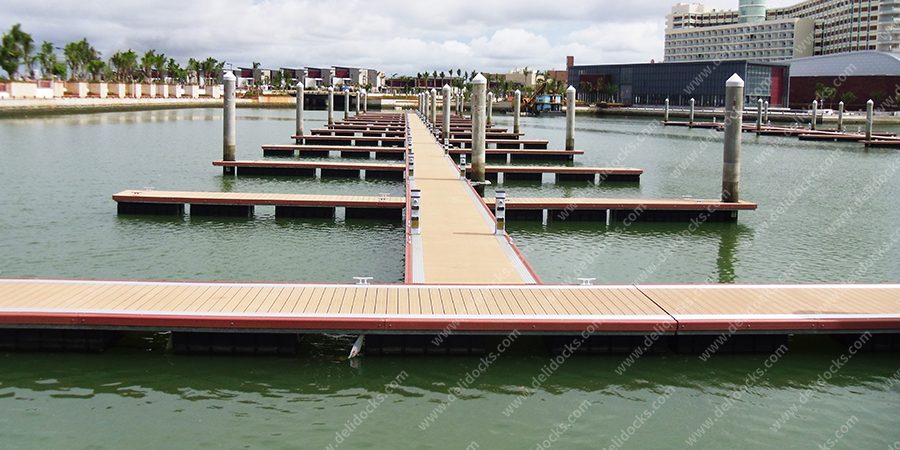
Modular floating dock systems (pre-cast concrete pontoons with interlocking connections) can reduce on-site labor and speed installation. Custom steel or timber layouts offer flexibility for odd shapes but increase engineering hours.
Firms like DeFever often blend modular components with custom-designed transition pieces to optimize both budget and site fit.
5. Case Study: How DeFever Optimizes Dock Construction Costs
With decades of experience in heavy marine construction, the engineering team at DeFever approaches cost management through the lens of durability and operational efficiency. For a recent commercial fishing port expansion in the Pacific Northwest, the initial client estimate for a steel pile-and-deck system was USD 4.2 million. dock construction costs were scrutinized across three alternatives:
Alternative A (Traditional steel): Lower upfront, but required anode replacement every 8 years and recoating after 15 years.
Alternative B (Reinforced concrete on steel piles): 18% higher initial cost, but zero planned maintenance for 30 years.
Alternative C (Hybrid: concrete decks on FRP piles): Highest first cost but eliminated corrosion entirely and reduced pile count due to lighter weight.
DeFever’s lifecycle analysis demonstrated that Alternative B delivered the lowest net present cost over a 40-year concession period. By adjusting pile spacing and optimizing precast yard fabrication, they brought the initial cost within 5% of the steel option, securing the project. This exemplifies why experienced owners look beyond the initial sticker price.
6. Regulatory Compliance and Hidden Costs
Permitting and environmental compliance often account for 10–20% of total project duration and a notable portion of soft costs. These are frequently underestimated by developers.
6.1 Federal and State Permits
In the U.S., Section 404 (Clean Water Act) and Section 10 (Rivers and Harbors Act) permits require extensive documentation, including alternative analysis and public interest review.
Mitigation measures (e.g., creating artificial reefs or wetlands) can add direct costs.
6.2 Protected Species and Seasonal Windows
In-water work windows are often restricted to avoid fish spawning or migration. Missing these windows extends construction schedules, increasing equipment standby costs.
Presence of eelgrass or other habitats may force dock realignment or pile-driving method changes (e.g., using vibratory instead of impact hammers).
6.3 Insurance and Bonding
Marine contractors must carry high-lifetime warranties and pollution liability insurance, which are factored into bids. Owners should verify that subcontractors have adequate coverage.
7. Future-Proofing Your Investment: Smart Technology Integration
Modern dock infrastructure increasingly incorporates sensors and automation. While this raises initial dock construction costs, it provides long-term savings through predictive maintenance and operational intelligence.
Structural health monitoring: Strain gauges, inclinometers, and corrosion potential sensors embedded in concrete or attached to piles transmit real-time data, enabling condition-based repairs rather than scheduled ones.
Automated mooring and shore power: Reduces vessel idle time and improves safety; requires robust power distribution and control systems integrated into the dock structure.
Environmental sensors: Water quality monitors and current meters assist with compliance and operational planning.
8. Frequently Asked Questions (FAQ) about Dock Construction Costs
Q1: What is the average cost per linear foot for a commercial
dock?
A1: It varies widely by type and location. A basic floating
dock in protected water might range from USD 300–600 per linear foot, while a
heavy-duty concrete pier in an exposed coastal environment can exceed USD 2,500
per linear foot. These figures include piles, decking, and basic utilities but
exclude site-specific factors like dredging or elaborate fendering.
Q2: How much should I budget for engineering and permits relative to
construction?
A2: For complex marine projects, professional fees
(engineering, geotech, surveying) and permitting typically run 10–18% of total
construction costs. Simpler projects in non-sensitive areas may be 6–10%. It is
wise to allocate a contingency of 10–15% for unforeseen site conditions revealed
during design.
Q3: Can using recycled or composite materials reduce dock
construction costs?
A3: Recycled plastics and composite decking can
lower maintenance expenses, but they are generally not structural. For primary
structure, they may not replace steel or concrete. In some cases, FRP
(fiber-reinforced polymer) piles, though higher initial cost, eliminate future
replacement, proving cost-effective in aggressive environments. A full lifecycle
assessment is recommended.
Q4: Why do contractor bids for the same dock design vary so
much?
A4: Bid variance often reflects differences in assumed
productivity, equipment mobilization methods, subcontractor quotes for pile
driving, and risk contingencies. Experienced marine contractors like DeFever base their numbers on
local knowledge and actual crew availability. Always scrutinize bids for
exclusions (e.g., dewatering, environmental monitoring) that may appear later as
change orders.
Q5: How does water depth affect dock construction costs
exponentially?
A5: Deeper water requires longer piles, which are
more expensive to transport and drive. Additionally, if depths exceed 10–12
meters, floating dock systems with heavy anchors and chains might become more
economical than fixed piles. Each depth range (0–5m, 5–10m, 10m+) has its own
construction methodology with distinct cost curves.
Q6: What are the hidden operational costs after dock
completion?
A6: Owners must budget for periodic inspection (every 5
years for commercial docks), underwater repair of corrosion or spalling, fender
replacement, utility line maintenance, and sediment accumulation around piles. A
well-designed dock with cathodic protection and quality concrete can keep these
below 1% of initial cost annually.
Q7: Does the choice between a fixed pier and a floating dock affect
total ownership cost?
A7: Yes. Fixed piers generally have lower
maintenance if built with durable materials, but they are susceptible to damage
from vessel impact and are less adaptable to sea-level rise. Floating docks move
with water levels, reducing strain on piles, but require more complex utility
connections and periodic floatation inspection. The choice depends on tidal
range, ice conditions, and vessel types.
Understanding the multifaceted nature of dock construction costs is essential for making informed capital decisions. By prioritizing site investigation, robust materials, and engineering expertise—such as that offered by DeFever—stakeholders can ensure their waterfront infrastructure remains safe, functional, and economically viable for decades.