2026-10-15
For civil engineering firms, marina developers, and government waterfront authorities, the selection of a berthing system directly impacts operational uptime, asset longevity, and environmental compliance. Unlike fixed pier structures, shoreline floating docks automatically adjust to water level fluctuations—from tidal ranges to seasonal reservoir changes—eliminating structural overstresses and submerged deck hazards. This paper provides a rigorous examination of design parameters, material trade-offs, mooring configurations, and whole-life asset management, drawing on field data and industry standards. DeFever has engineered over 270 waterfront projects across North America and Europe, delivering custom floating solutions that integrate corrosion-resistant alloys, high-buoyancy composite cores, and predictive maintenance protocols.
The demand for resilient shoreline floating docks has grown substantially due to climate-induced sea-level rise, increased storm frequency, and stricter coastal zone management policies. Traditional pile-supported piers suffer from accelerated material fatigue in fluctuating water levels and require costly dredging permits. Floating alternatives, when properly engineered with adequate freeboard and restraint systems, provide predictable performance in erosive shoreline environments, protecting both capital assets and submerged aquatic habitats.
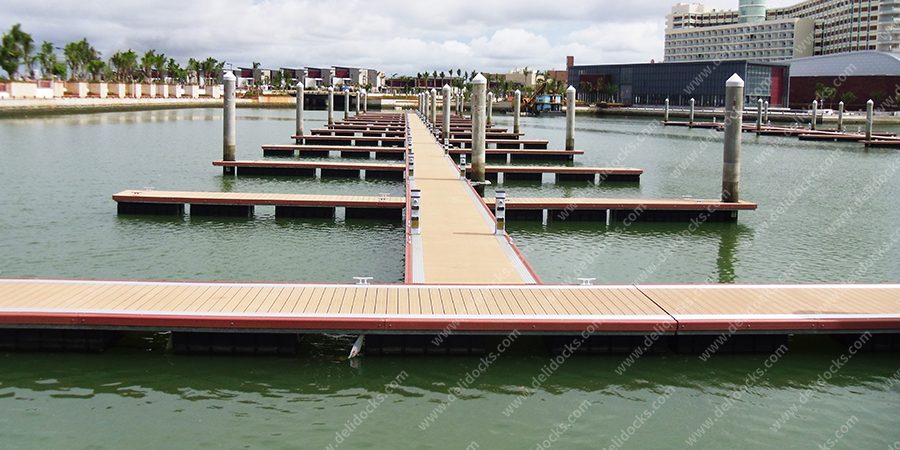
1. Core Engineering Parameters for Shoreline Floating Docks
Designing a high-performance floating dock system begins with site-specific load cases and environmental data. Engineers must evaluate significant wave height (Hs, typically <0.5m for sheltered marinas up to 1.2m for semi-exposed locations), current velocities, ice thickness (for northern latitudes), and water quality (salinity, pH, biological fouling potential). The fundamental equation for buoyancy stability is based on Archimedes’ principle: displaced water weight must exceed the total dead load (deck, connectors, utilities) plus live load (vehicles, forklifts, crowd density). For commercial applications, minimum reserve buoyancy of 35–50% is recommended per PIANC guidelines.
When specifying shoreline floating docks, a modular approach using interlocking high-density polyethylene (HDPE) shells with expanded polystyrene (EPS) cores offers a 0.55–0.65 specific gravity, yielding positive stability even when partially flooded. Alternatively, reinforced concrete pontoons (density 2.4 t/m³) provide outstanding inertial mass for wave damping but require internal void compartments for buoyancy. Modular floating dock systems from DeFever utilize marine-grade aluminum superstructures (grade 6061-T6 or 5083-H116) to reduce topside weight while maintaining high moment of inertia for crane loads or heavy equipment access.
1.1 Material Selection Matrix and Anti-Corrosion Strategies
For saltwater or brackish installations, material compatibility is paramount. Below is a technical comparison of common floating dock materials:
Reinforced Concrete: High compressive strength (40–60 MPa), excellent UV resistance, low maintenance. Downsides: high transportation cost, requires cathodic protection in saline conditions. Typical service life exceeding 30 years with proper coating.
HDPE (Rotationally Molded): Outstanding chemical resistance, zero corrosion, lightweight. Limitations: lower point-load capacity (max 400 kg/m² distributed), susceptible to UV degradation without carbon black additives. Lifespan 15–25 years.
Galvanized Steel / Aluminum: Heavy-duty aluminum floating structures offer excellent strength-to-weight ratio (yield strength 240–310 MPa). Requires isolation from dissimilar metals (use nylon washers) and marine-grade anodizing. Expected durability 25+ years in seawater.
Composite Fiberglass: High stiffness, low biofouling adhesion. High initial cost, requires skilled repair for impact damage.
DeFever typically specifies 5083 aluminum alloy for all primary structural members in saline environments, combined with HDPE floatation blocks sealed inside PVC end caps. This hybrid solution eliminates crevice corrosion while maintaining repairability—a design validated through accelerated salt-spray testing (ASTM B117, 3,000 hours).
2. Mooring and Restraint Systems: Dynamic Positioning for Shoreline Floating Docks
Unlike offshore platforms, shoreline floating docks operate in the surf zone where wave energy concentrates. An effective restraint system must permit vertical movement (heave) while limiting horizontal drift (surge and sway) to under 150 mm for safe gangway and utility connections. Four primary methods are used:
Pile-Guide Systems: Steel or concrete piles (diameter 300–600 mm) driven through guide rings mounted on the dock. Allows frictionless vertical travel. Best for tidal ranges >2m. Requires pile grouting and periodic lubrication of composite bushings.
Spud Poles (Vertical Cables): Simpler for seasonal water level changes; however, lateral movement can be ±300 mm, unsuitable for finger piers with close vessel spacing.
Helical Anchors with Chain: For soft shorelines, helical screw anchors (150–350 kN capacity) paired with galvanized chain and elastic shock absorbers. Provides 360° compliance, but requires annual chain tension inspection.
Articulated Gangways: A self-adjusting ramp with roller or hinge ends compensates for vertical movement up to 2.5m. Critical for universal access (ADA compliance).
For exposed sites, wave attenuation and floating breakwater integration can be combined with the same modular floating elements. In a 2022 project for a lakeside municipal marina, DeFever engineered a pile-guided floating dock system with integrated rubber fenders and hydraulic dampers, reducing lateral accelerations by 63% compared to standard chain moorings, verified by accelerometer field data.
3. Structural Load Cases and Safety Factors for Commercial Floating Docks
Design codes (ASCE 7-22, Eurocode 1, or PIANC MarCom WG 153) prescribe load combinations that floating docks must withstand. Critical cases include:
Live Load (Uniform & Concentrated): Crowd loading (5 kN/m² for assembly areas), forklifts (30 kN wheel load), or mobile boat hoists (up to 50 kN axle load). Floating docks must be analyzed for deck deflection (< L/250).
Environmental Loads: Wind pressure (based on 3-second gust, up to 1.5 kN/m² for exposed locations), current drag (0.5–1.2 kN/m²), and wave slamming loads (impulsive pressures up to 15 kPa for breaking waves).
Ice Jacking (Northern Sites): Expansion forces from ice sheets can exceed 200 kN/m along dock edges. Mitigations include air bubblers, inclined pile cutters, or seasonal removal of perimeter pontoons.
Seismic (if applicable): Floating docks are generally decoupled from ground motion, but utility connections and access ramps require flexible couplings.
Each structural member—from the main longitudinal beams (typically I-sections, 250–400 mm depth) to the decking (30–50 mm pressure-treated timber or composite grating)—must be verified for ultimate limit state (ULS) with a safety factor of 1.5 (dead + live) and 1.0 for environmental loads combined with live occupancy. Fatigue limit state is particularly relevant for aluminum components in high-cycle wave environments; detail categories per IIW recommendations should be applied.
4. Ecological Integration and Regulatory Compliance
Modern shoreline floating docks are no longer simple concrete slabs; they serve as ecological infrastructure. The European Water Framework Directive and US Army Corps of Engineers permits increasingly require compensatory habitat features. Floating docks with open grated decks allow light penetration, preventing anoxic zones underneath. Furthermore, attachment of floating treatment wetlands and bio-habitat panels can improve water quality by reducing nutrient loads (nitrogen and phosphorus removal rates up to 35% per year in pilot studies).
DeFever incorporates eco-engineered pontoons with textured undersides that mimic natural rocky substrates, increasing macroinvertebrate colonization by 2–4 times relative to smooth concrete. For projects requiring eelgrass or mangrove protection, floating docks can be designed with curved deflection skirts to eliminate bottom scour and with adjustable mooring to avoid propeller wash damage. The permitting process can be shortened by up to 30% when such ecological enhancements are included upfront—a critical B2B consideration to reduce project delays.
5. Lifecycle Cost Analysis and Maintenance Protocols
While initial capital expenditure for a high-grade shoreline floating dock can be 20–40% higher than a conventional wooden pier, total cost of ownership (TCO) over 25 years is typically 15–25% lower due to reduced repair frequency, no dredging costs, and faster reconfiguration. Key maintenance tasks:
Annual: Clean and inspect all bolts/welds for corrosion. Check guide pile bushings for wear (replace if >5% wall thickness loss). Lubricate moving parts with marine-grade grease.
Every 3 Years: Load test mooring chains and helical anchors (proof load to 125% of working load). Ultrasonic thickness measurement for aluminum or steel members at high-stress nodes.
Every 8–10 Years: Replace sacrificial anodes (zinc or aluminum). Re-coat topside decks if timber or anti-slip paint. Inspect buoyancy blocks for water absorption (dry weight vs. saturated weight).
Unscheduled: Post-storm inspections after events exceeding 1-year return period wave heights.
DeFever provides a digital asset management platform that integrates with IoT sensors (tilt meters, accelerometers, and water level loggers), allowing predictive maintenance alerts and warranty compliance tracking. For a recent port authority project, this reduced emergency repairs by 57% over a 5-year period.
Industry Standards, Testing, and Certification
B2B buyers should require documentation that floating dock components comply with the following:
ISO 12215-5 (2019) – Hull construction and scantlings for small craft (relevant to pontoon design).
ASTM F2469 – Standard specification for two-sided pressure-sensitive marine fendering.
PIANC Report No. 153 – Design guidelines for floating berthing structures.
EN 13387 (Kid’s playgrounds not relevant but) – For public access, compliance with slip resistance (R11 or R12 on wet test).
Lloyd’s Register or ABS – Third-party verification for high-load capacity designs.
Expert tip: Always request mill certificates for aluminum extrusions and test reports for HDPE floatation foam (compressive strength > 200 kPa at 10% deformation). Avoid manufacturers that cannot provide finite element analysis (FEA) simulations under wave-induced cyclic loading.
Frequently Asked Questions (Technical & Commercial)
Q1: What is the typical load capacity for a commercial shoreline floating dock, and how is it certified?
A1: Standard modules support uniformly distributed loads (UDL) of 5–7.5 kN/m² (≈500–750 kg/m²). For mobile crane access or heavy forklifts, reinforced designs achieve 15 kN/m² point loads on a 200 mm × 200 mm pad. Certification requires a load test to 1.5× design load with maximum permanent deflection less than 0.1% of span. Shoreline floating docks from DeFever are supplied with an engineer-stamped load capacity plate and finite element verification.
Q2: How do floating docks perform during severe storms or hurricane events?
A2: Performance depends on mooring design and freeboard. A dock with pile-guides and 600 mm freeboard can withstand 1.5 m significant wave heights and wind speeds up to 50 m/s (180 km/h) without structural failure provided that all service lines (fuel, electrical) have breakaway couplings. For cyclone-prone areas, we recommend adding removable wave screens and increasing pontoon draft to lower the center of gravity. Post-event inspection and re-tensioning of moorings are always required.
Q3: Can shoreline floating docks be installed on an existing bulkhead or riprap shoreline without dredging?
A3: Yes—the principal advantage of floating docks is zero dredging requirement. For riprap shorelines, helical anchors can be installed through the rock using a hydraulic torque motor. For vertical sheet pile bulkheads, cast-in-place concrete anchor blocks or rail-mounted guide systems are preferred. However, get a geotechnical survey to evaluate anchor holding capacity (typically minimum of 30 kN per anchor in medium-dense sand).
Q4: What is the expected service life in brackish water, and how is corrosion managed?
A4: With aluminum superstructures (5083 series) and HDPE flotation, service life of 40+ years is realistic. Corrosion mitigation includes: isolating aluminum from steel fasteners using nylon or EPDM washers, applying epoxy or acrylic coating on all weld seams, and installing aluminum or zinc sacrificial anodes (replaced every 5–8 years). For stainless steel components (grade 316L), passivation is necessary after any fabrication. Avoid using copper-based anti-fouling paint near aluminum—it causes galvanic attack.
Q5: How are utility connections (water, power, data) integrated into floating docks without fatigue failure?
A5: Use flexible hose loops or retractable cable reels for water/power. Standard rigid conduit will fracture within 12–18 months due to wave-induced movement. Prefabricated "utility spine" systems—a galvanized steel tray suspended from the dock structure—allow cables to move freely. Power pedestals should be mounted on a separate utility float or on a fixed pier head, with a flexible marine-grade cable (type SOOW or SJOOW) terminating at a watertight junction box on the floating dock. All connections must meet IP67 or higher rating.
Request a Technical Consultation & Project Quote
Engineering a high-performance shoreline floating dock requires accurate site data, load specifications, and compliance with local maritime codes. DeFever offers a full in-house service—from hydrodynamic modeling and material selection to fabrication, third-party load testing, and installation supervision. For B2B clients, we also provide lifecycle cost models and remote structural health monitoring integration.
Submit your project parameters (water depth range, wave climate, intended vessel mix, and operational loads) to receive a preliminary engineering memo and budget indication within 5 business days.
Send inquiry to: https://www.dfyachts.com/contact.html or email our marine structures division directly at deli@delidocks.com.
For detailed case studies and technical white papers on optimized floating dock designs for marinas, ports, and waterfront resorts, explore the DeFever project portfolio.