2026-10-15
For civil engineering firms, port authorities, and marina developers, the reliability of a floating dock depends entirely on the restraint system. Unlike fixed piers, floating structures must accommodate water level fluctuations while resisting lateral drift, wave slamming, and current drag. Improperly securing a floating dock leads to structural fatigue, gangway misalignment, utility disconnections, and safety liabilities. This paper provides a quantitative analysis of mooring components, site-specific force regimes, and maintenance protocols based on field data from over 200 waterfront installations. DeFever engineers these systems with integrated load monitoring and corrosion-resistant alloys, delivering verified hold-down capacities across tidal, reservoir, and lake environments.
The core challenge in securing a floating dock lies in balancing vertical compliance (heave) with horizontal rigidity (surge, sway, yaw). Standard chain-and-anchor arrangements often permit excessive lateral movement (>300 mm), which accelerates fender wear and stresses utility connections. Professionally engineered floating docks use guided systems or pre-tensioned moorings to restrict horizontal displacement to less than 150 mm under 1-year return period wave conditions. The following sections detail mechanical solutions, material compatibility, and predictive maintenance.
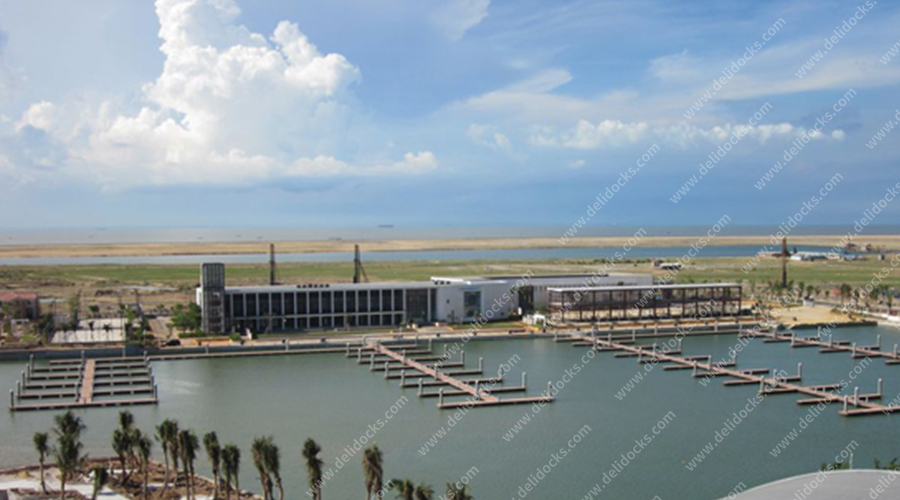
1. Environmental Force Regimes That Determine Securing a Floating Dock Strategy
Before selecting any restraint hardware, the design engineer must compute characteristic loads per ASCE 7-22 or Eurocode 1. Primary forces include:
Wind drag: Based on 3‑second gust speed (V3s) and dock frontal area. For a 2.5 m wide floating dock with 1.2 m freeboard, wind force at 40 m/s equals approximately 2.8 kN per linear meter.
Current drag: Velocity Vc (0.5–2.0 m/s) combined with submerged cross‑section area. Drag coefficient Cd ≈ 1.2 for pontoons. At 1.5 m/s, force reaches 1.1 kN/m.
Wave slamming (impact): Impulsive pressures up to 15 kPa for breaking waves in semi‑exposed basins. This short‑duration load (<0.2 s) requires ductile connections (elastic mooring tails).
Ice jacking (northern latitudes): Ice sheet expansion can exert 150–300 kN/m along dock edges. Mitigations include slope‑based ice cutters, air bubblers, or seasonal removal of peripheral pontoons.
Live loads (transient): Forklifts (30 kN wheel load) or crowd loading (5 kN/m²) create horizontal thrust through gangway angles. This dynamic effect is often underestimated.
For each project, DeFever performs finite element analysis (FEA) combining these forces with load duration factors. A safety factor of 1.5 is applied to ultimate limit state (ULS) for mooring components. The derived design load directly dictates chain diameter, anchor type, and pile spacing.
2. Main Technical Approaches for Securing a Floating Dock
Four proven restraint categories exist, each suited to specific water level variability and bottom conditions.
2.1 Pile‑Guide Systems (Most Robust for Tidal Ranges >1.5m)
Steel or concrete piles (300–600 mm diameter) are driven into the seabed. Floating dock guide rings with composite bushings travel vertically along the piles. Horizontal restraint is near‑absolute (<25 mm movement). For securing a floating dock in exposed commercial marinas, this method is preferred. Pile embedment depth should be 4–6 times the pile diameter into competent soil (SPT N > 15). Guide rings require low‑friction UHMWPE or nylon bushings replaced every 5–7 years. Drawback: higher installation cost ($800–1,200 per pile) and dredging permits for pile driving.
2.2 Helical Screw Anchors with Chain or Cable Restraint
For soft shorelines or environmentally sensitive areas (where pile driving is prohibited), helical anchors (150–350 kN ultimate capacity) are torqued into the bottom using a hydraulic motor. Pre‑tensioned mooring chains or Dyneema ropes connect the anchor to the dock’s mooring cleats or recessed fairleads. This approach allows 360° compliance and is the most common method for securing a floating dock in lakes and protected bays. However, lateral drift can reach 200–350 mm during storms. Use rubber or spring shock absorbers (extension capacity 50–80% of chain length) to reduce peak forces. Chain grade must be LTM (Grade 80 or higher) with hot‑dip galvanization (850 g/m² minimum).
2.3 Spud Poles (Vertical Cables) – Suitable for Seasonal Water Fluctuations Only
A spud pole is a steel pipe passing through a central guide on the dock, penetrating the bottom by 1–2 m. This method provides no lateral restraint unless multiple spuds are used (typically 4 per module). Spud systems are cost‑effective for small residential docks but not recommended for commercial B2B applications because of excessive yaw and fatigue at the penetration point.
2.4 Deadweight Anchors (Concrete Blocks) – Low Energy Sites Only
Concrete blocks (3–8 tons each) are placed on the bottom, connected by chains to the dock. This passive system depends entirely on friction; movement is common. Only use for wave heights < 0.3 m and current < 0.5 m/s. Not acceptable for securing a floating dock in any commercial or public access setting due to liability.
3. Dynamic Mooring Analysis and Hardware Specifications
The stiffness of the restraint system must be matched to the dock’s mass and expected wave periods. A system that is too stiff transmits full wave impact loads to the anchors; a system too soft allows excessive movement and gangway overstress. The optimal design uses a staged stiffness approach:
Low displacement (0–50 mm): Soft elastic elements (rubber snubbers, stiffness K1 ≈ 50–80 kN/m) to absorb wave‑induced oscillations.
Medium displacement (50–150 mm): Chain catenary provides progressively increasing resistance (K2 ≈ 200–400 kN/m).
High displacement (>150 mm): Final backup stopper (nylon rope or steel cable) with K3 > 1000 kN/m to prevent over‑travel.
For chain selection, follow ISO 1704 for stud‑link chains. Minimum breaking load (MBL) = 3 × design load. Grade 43 (U3) chain has MBL ~ 500 kN for 22 mm diameter. Avoid galvanized hardware in saltwater without cathodic protection. DeFever specifies duplex stainless steel (2205) for all chain components in saline environments, combined with aluminum‑zinc‑indium sacrificial anodes.
For high‑load applications, pre‑stressed concrete mooring anchors and pile‑guide combinations are standard. A 2023 project for a 250‑berth marina required FEA‑optimized piles with 50 mm thick rubber fendering integrated into the guides, reducing peak loads by 41% compared to conventional steel‑on‑steel guides.
4. Material Corrosion Control and Inspection Protocols
Corrosion is the leading cause of restraint failure. In brackish or saltwater, galvanic couples between dissimilar metals (e.g., aluminum dock frame with steel chain) cause rapid deterioration. Mandatory measures include:
Isolate all stainless steel fasteners from aluminum using nylon or EPDM washers (ASTM D2000).
Apply cold‑galvanizing spray (95% zinc) to weld seams and cut edges.
Install sacrificial anodes (zinc alloy per MIL‑A‑18001K) on all steel piles and chain connectors. Anode mass = 0.5% of submerged steel surface area; replace every 5 years.
For helical anchors, require hot‑dip galvanizing (minimum 100 µm coating) plus epoxy topcoat in zones with pH < 6 or > 9.
Inspection schedule for securing a floating dock components: annual visual check of chains (abrasion, birdcaging), ultrasonic thickness measurement of pile guides every 3 years, and proof load testing (125% of design load) of anchor connections every 6 years. Digital logs with time‑stamped images are recommended for insurance and regulatory compliance (e.g., USACE permit conditions).
5. Regulatory Compliance and Third‑Party Testing
B2B buyers should require documentation that the restraint system complies with:
PIANC MarCom WG 153 (2020) – Design of Floating Berthing Structures.
ASME B30.26 (Rigging hardware) and API RP 2SK – For mooring line selection.
ISO 23045:2021 – Recommendations for mooring equipment in marinas.
Local building codes – Often reference ASTM F3056 (specification for floating docks).
Any professional securing a floating dock must be accompanied by a signed engineering certificate that includes load calculations, material certifications, and as‑built drawings. DeFever provides full third‑party witnessing of pull‑out tests for every anchor (minimum test load = 1.5× maximum working load, sustained for 10 minutes).
Frequently Asked Questions – Technical & Commercial
Q1: What is the recommended horizontal movement limit for a commercial floating dock?
A1: For safe gangway operation and to avoid overstressing water/power connections, maximum horizontal displacement (surge + sway) should not exceed 150 mm under a 50‑year return period storm condition. Pile‑guide systems achieve <25 mm; helix‑chain systems typically remain under 120 mm with proper pre‑tensioning. Install lateral bumpers or shear keys if movement exceeds 200 mm.
Q2: How often must mooring chains and anchors be replaced in seawater?
A2: Grade 80 galvanized chain in temperate seawater shows 0.2–0.35 mm/year corrosion loss. Replacement is required when chain diameter reduction exceeds 15% (measured at ten random links). Typically, intervals are 12–15 years for chain, 25 years for helical anchors (provided no mechanical damage). Stainless steel (316L) chains last 25+ years but cost 3–4 times more. Annual inspection and thickness measurements are mandatory for insurance.
Q3: Can a floating dock be secured using only elastic mooring tails without chains?
A3: No – elastic tails (rubber or polyurethane) degrade under UV and abrasion within 2–3 years. They are intended as shock absorbers in series with primary chain or cable. For securing a floating dock to meet commercial safety standards, the primary load path must be metallic (chain or wire rope) with a safety factor ≥4:1. Elastic components are supplementary only.
Q4: What is the correct buried depth for helical anchors in cohesive soil?
A4: For clay (undrained shear strength >50 kPa), minimum anchor embedment depth is 4.5 m (15 ft) below seabed. In sand (SPT N‑value 15–30), depth of 5.5–6.0 m is required to achieve 250 kN ultimate capacity. A torque‑to‑capacity correlation (k factor method) is used during installation: ultimate capacity (kN) = torque (Nm) × 20 (for 150 mm helix plates). Always perform a proof pull test on the first two anchors.
Q5: How do ice forces affect the design of mooring components, and what countermeasures exist?
A5: Ice jacking can generate horizontal forces exceeding 200 kN/m along the dock. Standard chains or pile guides without ice protection will bend or fracture. Countermeasures include: (1) installing inclined ice cutters (45‑degree slope) on all piles; (2) using air‑bubbler systems to prevent ice formation around piles; (3) specifying ductile cast iron mooring bollards with 35% elongation at break; (4) for ponds and small lakes, physically removing outer dock sections before freeze‑up. In Arctic regions, consider seasonal retrieval of the entire floating structure.
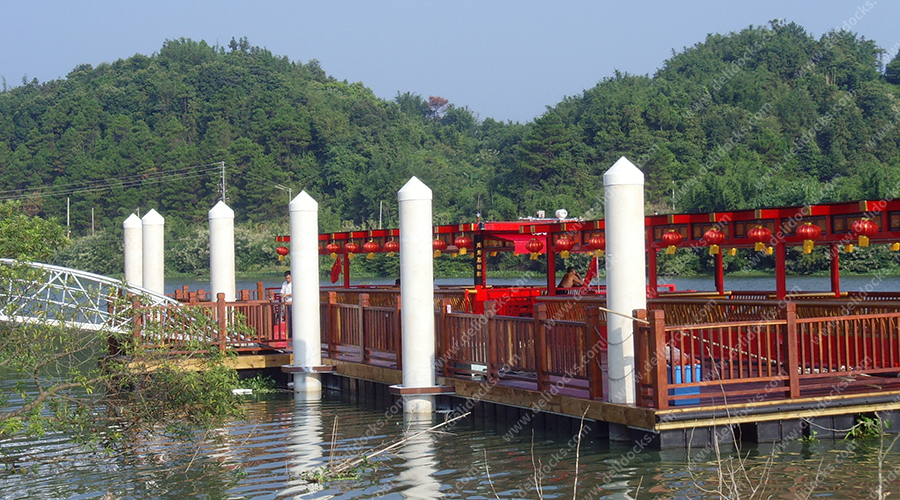
Request a Site‑Specific Restraint Design & Load Report
Engineered securing a floating dock requires accurate bathymetry, soil data, and wave climate analysis. DeFever provides a complete in‑house service: geotechnical investigation, FEA of environmental loads, certification of mooring components, and installation supervision.
Submit your project parameters (water depth, maximum fetch, soil type, intended vessel mix, and local wind records) to receive a preliminary restraint engineering memo and budget indication within 7 working days.
Send inquiry via: https://www.dfyachts.com/contact.html or directly email our mooring division at deli@delidocks.com.
For detailed case studies on high‑load mooring systems and anchor solutions for exposed marinas, review the DeFever project portfolio.