Building a private dock is more than adding a structure to the shoreline—it is a complex marine engineering project that demands expertise in hydrodynamics, material science, and environmental compliance. For property owners, architects, and developers, understanding the intricacies of residential dock construction ensures long-term safety, functionality, and return on investment. With over five decades of shipbuilding and marine structure experience, DeFever has set the benchmark for resilient, code-compliant dock systems worldwide. This article dissects the technical layers of modern dock projects, from geotechnical surveys to smart utility integration, while avoiding generic advice—only data-driven, field-tested knowledge.
1. Site-Specific Design: Hydrodynamic & Geotechnical Foundations
Every successful residential dock construction begins with a thorough site assessment. Factors such as tidal range, wave fetch, soil bearing capacity, and ice scour dictate the structural system. A professional hydrographic survey measures water depth variability and bottom composition—critical for selecting pile depths or anchoring systems. For soft mud or sandy bottoms, friction piles may need to reach depths of 15–25 m to achieve adequate load capacity, while rocky substrates require rock-socketed steel piles. At DeFever, engineers utilize FEA (finite element analysis) to model extreme storm surges and vessel impact, ensuring the dock remains operational for decades.
Wave attenuation studies – quantifying potential dock overtopping and designing energy dissipation features.
Bathymetric mapping – identifying navigation channels to avoid future dredging conflicts.
Geotechnical borings – determining pile driveability and corrosion potential (sulfate attack on concrete).
2. Material Science: Balancing Longevity, Aesthetics & Ecological Footprint
Selecting materials for a residential dock is a trade-off between first cost, maintenance intervals, and environmental compatibility. While traditional treated wood remains common, its lifespan in brackish water rarely exceeds 12–15 years without significant upkeep. Modern residential dock construction increasingly relies on:
Reinforced concrete floats – extremely durable in saltwater, with 50+ year service life; used in high-traffic marinas.
Marine-grade aluminum – lightweight, 100% recyclable, and immune to rot; ideal for gangways and pile guides.
High-density polyethylene (HDPE) composites – low maintenance, splinter-free, and resistant to UV degradation.
Galvanized or stainless steel hardware – ASTM A153 compliant fasteners prevent galvanic corrosion when connecting dissimilar metals.
DeFever’s specifications often combine aluminum substructures with composite decking to reduce weight and maximize corrosion resistance—a solution validated by hurricane-force wind tunnel tests.
3. Structural Integrity: Pile Design, Flotation & Load Calculations
Docks must withstand live loads (people, equipment, boats), environmental loads (current, wind, waves), and accidental impacts. For fixed piers, pile embedment depth is calculated using API RP 2A methodologies adapted for nearshore soils. In areas with soft sediments, engineers may specify helical piles or driven pipe piles with internal reinforcement. Floating docks require robust flotation units—typically encapsulated EPS foam or rotationally molded polyethylene pontoons—engineered to support dead load plus a minimum freeboard of 300 mm even under maximum live load. Structural engineers at DeFever employ limit-state design (LRFD) to verify that connections and hardware can resist fatigue from constant wave action, a leading cause of dock failure.
Key engineering outputs include:
• Pile spacing (typically 3–4 m centers)
• Dock width (minimum 1.5 m for residential, but 2.4 m if boat lifts are planned)
• Connection detailing for finger piers and utility conduits.
4. Navigating Permits & Environmental Regulations
Delays in residential dock construction often stem from non-compliance with wetland protection, coastal zone management, or endangered species habitat rules. In the U.S., projects affecting navigable waters require Section 404/10 permits from the USACE, plus state water quality certifications. Modern best practices incorporate:
Ribbon-style decks – to allow sunlight penetration to submerged aquatic vegetation.
Open-grating systems – reduce shading and current deflection, preserving littoral zones.
Spill containment plans – for fueling stations or hydraulic boat lifts.
International projects face similar frameworks (e.g., EU Water Framework Directive). Partnering with marine consultants who have established relationships with regulatory bodies is essential—DeFever’s project managers routinely conduct pre-application meetings with agencies to streamline approvals, cutting permitting time by 30% in sensitive areas.
5. Utility Integration: Shore Power, Water, Data & Smart Systems
Today’s residential docks are floating smart hubs. Owners expect 50A/240V shore power, potable water, high-speed data, and even electric vehicle charging for tenders. Designing these systems requires corrosion-resistant panels, GFCI protection, and conduit sealed against immersion. For marinas with multiple slips, load calculations must account for simultaneous air-conditioning and battery charging. Additionally, many jurisdictions now require dark-sky compliant LED lighting and motion sensors to minimize light pollution. DeFever’s dock packages include integrated cable trays and stainless steel junction boxes, future-proofed for 5G antennas and security cameras. A hidden but vital aspect is grounding—docks must have equipotential bonding to prevent stray-current corrosion on nearby vessels.
6. Construction Phasing: Precision On and Over the Water
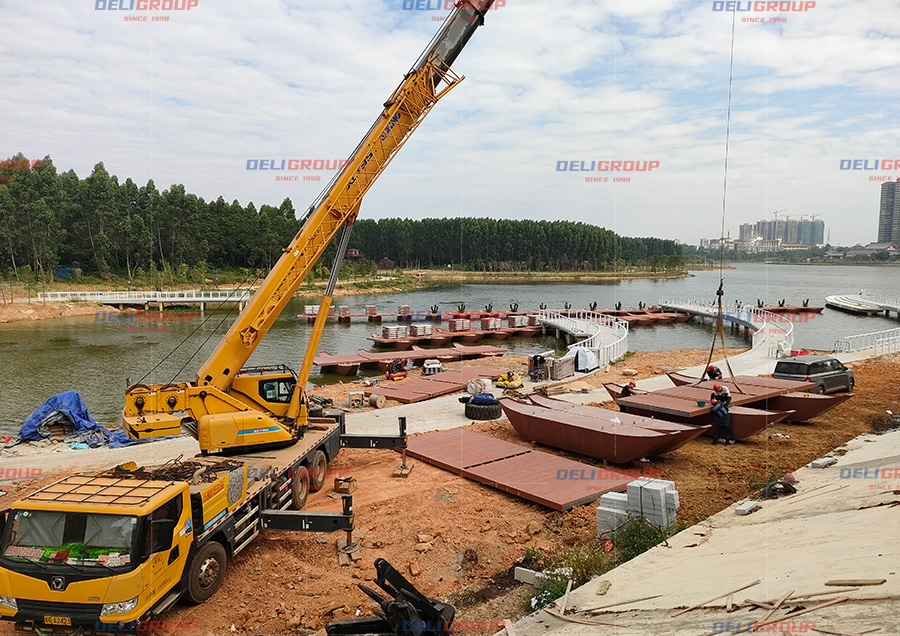
Executing a dock project involves overlapping phases: mobilization, pile driving, deck installation, utility rough-in, and final finishing. Over-water work is weather-dependent; professionals schedule pile driving during “weather windows” using specialized barges or spudded equipment. Tolerances are tight: pile batter must be within 1° of vertical, and deck elevation differences should not exceed 6 mm over 10 m. Quality control includes:
Dynamic pile monitoring (PDA testing) to verify capacity.
Torque checks on every bolted connection.
Pressure testing of water lines before decking installation.
DeFever’s construction supervisors hold maritime certifications (e.g., ABS or Lloyd’s Register) and enforce strict safety protocols for crews working over water—a non-negotiable in professional residential dock construction.
7. Cost Analysis & Lifecycle Value
While the initial outlay for a high-end engineered dock may be 20–30% higher than a basic timber structure, the total cost of ownership over 30 years is significantly lower. Composite/aluminum systems require no painting, fewer fastener replacements, and minimal board replacement. Insurance premiums can also be reduced due to better fire resistance and structural reliability. A typical breakdown for a 40 m residential dock (with 10 m finger piers) ranges from $150,000 to $450,000 depending on soil conditions, water depth, and amenities. Investing in professional engineering and premium materials—such as those specified by DeFever—yields a waterfront asset that enhances property value and withstands extreme weather events.
8. Case Study: DeFever’s Approach to High-Current Residential Dock Construction
On a recent project in the Pacific Northwest, the client required a dock capable of handling 4‑knot tidal currents and accommodating a 22 m motoryacht. DeFever engineered a floating dock system using reinforced concrete floats with integral fendering and a steel pile-guide system. The design utilized 406 mm diameter steel pipe piles driven 18 m into the seabed, with four vertical guides per float to restrict lateral movement while allowing vertical tide adjustment. Utilities were preinstalled in utility trenches inside the concrete floats, eliminating exposed conduit. Post-construction monitoring over two years showed zero maintenance issues, and the dock withstood a 1-in-50‑year storm surge without damage. This exemplifies why integrated engineering is the cornerstone of premium residential dock construction.
Frequently Asked Questions (FAQ) About Residential Dock Construction
Q1: How long does the entire residential dock construction process take from design to completion?
A1: Typically 4–8 months, with permitting taking the largest portion (2–4 months). Construction itself usually requires 6–10 weeks depending on weather and site accessibility. Complex projects with deep water or environmental restrictions may extend to one year.
Q2: Do I need a permit for a dock on my private waterfront property?
A2: Yes, in almost all jurisdictions. Even if local ordinances appear lenient, federal/state agencies often regulate below the high-water line. Permits are mandatory under the Clean Water Act (US) or similar frameworks globally. Skipping permits can result in fines and forced removal.
Q3: What is the most durable material for saltwater residential dock construction?
A3: Reinforced concrete and marine-grade aluminum offer the longest service life (50+ years) with minimal maintenance. For decking, high-quality composites (HDPE with fiberglass reinforcement) resist UV and marine borers far better than wood. DeFever commonly recommends a hybrid: aluminum substructure + composite deck.
Q4: Can I install a boat lift on my residential dock, and what are the structural requirements?
A4: Absolutely, but the dock must be specifically engineered for the added point loads and dynamic forces during lift operation. This typically requires larger piles, additional bracing, and a reinforced concrete or steel mounting pad. Loads from a 6,000 kg boat lift can exceed 50 kN per leg.
Q5: How do I maintain a composite/aluminum dock to ensure longevity?
A5: Maintenance is minimal: wash with fresh water to remove salt residue, check fastener torque annually, and inspect aluminum for galvanic corrosion at connections with stainless steel. Replace any worn fenders or bumpers promptly. Unlike wood, no staining or sealing is required.
Q6: What are the signs that an existing dock needs replacement rather than repair?
A6: Extensive rot in pilings (especially below waterline), widespread corrosion of fasteners, visible settlement or tilting, and decay of structural members. If more than 30% of the deck or framing is compromised, replacement with modern residential dock construction techniques is usually more cost-effective.
Q7: Does adding a dock increase my property taxes?
A7: In many areas, yes—the dock is considered an improvement and will be assessed. However, a professionally engineered dock also increases resale value and can lower insurance risks if built to current codes. Consult your local tax assessor for specific rules.
For more technical resources or to discuss your upcoming waterfront project, contact the marine architecture team at DeFever. Their integrated approach—combining yacht design precision with dock engineering—has set the standard for residential dock construction across North America, Europe, and Asia.