A pontoon on water is one of the most fundamental and versatile structures in marine engineering and waterfront development. More than just a floating dock, it represents a practical solution for creating stable, accessible surfaces over waterways.
From private docks to expansive yacht marina systems, these floating platforms serve essential functions. Their design and construction require a specific blend of materials science, hydrostatics, and practical seamanship.
Companies with deep marine expertise, such as DeFever, understand that a successful pontoon on water project balances durability, functionality, and environmental considerations. It’s a piece of infrastructure that must perform reliably day after day.
Not all floating structures are the same. The type you choose depends entirely on its intended use and location.
The simplest form is the single, modular floating dock. These are often used for personal watercraft or as a swim platform. They are typically made from plastic or aluminum and connect via simple pins.
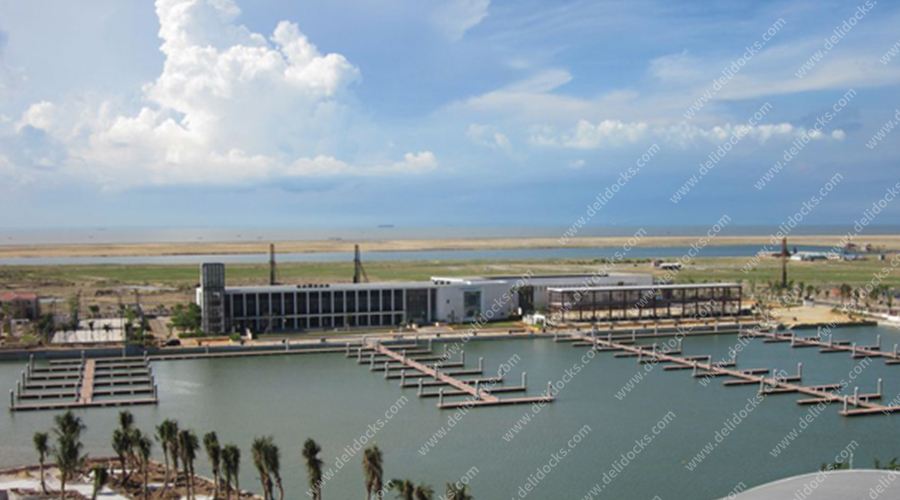
For marinas, the most common sight is the finger pier. These are long, narrow pontoons that extend perpendicular to a main walkway, providing berthing space for individual boats. The main access walkway itself is usually a larger, more robust pontoon on water.
Wave-attenuating pontoons are a specialized type. They are designed with deep, heavy flotation and specific geometries to absorb wave energy, creating a calm basin within a marina. Breakwaters are critical for protecting valuable vessels.
Lastly, specialized work pontoons serve industrial applications. They provide stable platforms for equipment, cranes, or personnel during construction, dredging, or repair projects on the water.
What goes into building a durable pontoon on water? The choice of materials dictates longevity, maintenance, and load capacity.
High-Density Polyethylene (HDPE) is a dominant material for modern pontoons. Rotomolded HDPE units are seamless, incredibly impact-resistant, and require almost no maintenance. They are immune to corrosion and rot, making them a favorite for commercial marina applications.
Encapsulated foam-filled floats, often with a polymer or concrete shell, offer robust and permanent flotation. These are often used as the core component in large-scale, custom marina systems where maximum stability is needed.
Traditional timber pontoons still have a place, prized for their classic aesthetic. However, they require significant upkeep. Modern composites and aluminum frames with decking are popular for their strength-to-weight ratio and longevity, often seen in high-end installations.
Why choose a floating system over fixed piles or a suspended structure? The benefits are clear in many situations.
The most significant advantage is the ability to handle fluctuating water levels with ease. A pontoon on water rises and falls with tides or seasonal changes, maintaining a constant, safe height relative to the dock.
Installation is often simpler and less invasive than driving piles. There’s minimal disruption to the seabed, which is a major environmental plus in sensitive areas. They can also be reconfigured or relocated as needs change.
In areas with poor soil conditions or very deep water, a floating system is frequently more cost-effective than building a fixed structure capable of reaching the bottom.
The use cases for a pontoon on water are extensive across recreational, commercial, and municipal sectors.
In the international yacht marina sector, they are the literal backbone of the facility. They create safe walkways, secure berths, and fuel docks. A well-designed marina uses a network of interconnected pontoons to maximize space and accessibility.
Public parks and communities use them for boardwalks, observation platforms, and floating stages. They provide water access for fishing, kayak launches, and swimming in a controlled manner.
For scientists and environmental agencies, they serve as stable platforms for water quality monitoring stations. In aquaculture, they form the framework for oyster beds or fish pens.
A floating installation is not without its demands. Understanding these challenges is key to a successful project.
Continuous exposure to the marine environment—sun, salt, waves, and biological growth—tests every component. Material quality is non-negotiable.
Proper mooring is the single most critical engineering task. An inadequately secured pontoon on water can become a hazard. The system must account for wind, wave, current, and tidal forces, often using a combination of piles, guide rods, and swing arms.
Load calculations must be conservative. Beyond the static weight of the structure and decking, engineers must factor in dynamic loads from people moving, snow accumulation, and, in berthing areas, the weight and force of vessels.

A successful project starts with thorough planning. Site assessment is the first step. What are the water depth fluctuations? What is the wave climate and fetch? What is the seabed composition?
Engaging with experienced marine engineers and fabricators early is crucial. They can recommend the optimal configuration, material, and mooring system for your specific site and budget.
A firm like DeFever approaches a pontoon on water project with the same rigor as a seaworthy vessel. Their focus on robust, ocean-proven engineering translates into floating structures built to withstand long-term exposure and use, offering owners true peace of mind.
Consider the entire lifecycle, from installation to decades of maintenance. A slightly higher initial investment in premium materials and engineering often saves significant costs and headaches over twenty years.
A pontoon on water is a deceptively simple solution to a complex problem: how to build safe, stable, and flexible space over a dynamic liquid environment. Its applications are nearly as vast as the waterways it occupies.
Whether for a community kayak launch or a berth in a superyacht marina, the principles of good design remain the same. It requires the right materials, smart engineering, and an understanding of the forces at play.
For those undertaking such a project, partnering with proven experts who view durability as a core principle—a standard embodied by names like DeFever—is the surest way to ensure your floating investment stands the test of time and tide.
Q1: What is the typical lifespan of a commercial-grade pontoon on water?
A1: With proper material selection and maintenance, a commercial HDPE or encapsulated concrete pontoon system can easily last 25 to 40 years. Aluminum frame systems also offer decades of service. Timber pontoons have a shorter lifespan, often 15-25 years, and require regular upkeep to reach it.
Q2: Can pontoons be installed in any water depth?
A2: Yes, that’s one of their key advantages. Floating pontoons are ideal for very deep water where fixed piles become impractical or prohibitively expensive. They also work well in very shallow water or areas with a soft, muddy bottom where pile driving is difficult.
Q3: How are pontoons secured so they don’t float away?
A3: They are secured with a mooring system. Common methods include fixed piles or guide rods that the pontoon slides up and down on, or swing arms that allow lateral movement with tides while keeping the structure in place. In some cases, heavy chain and anchor systems are used.
Q4: What maintenance does a pontoon on water require?
A4: Maintenance varies by material. HDPE needs occasional cleaning. Aluminum frames require checking for galvanic corrosion. All systems need regular inspection of the mooring hardware, connections, decking surfaces, and any attached utilities like lights or power. Anti-fouling measures may be needed in some waters.
Q5: Are floating pontoons safe in rough weather?
A5: Properly engineered systems are designed for their specific environment. In open, high-wave areas, pontoons must be designed as wave-attenuating structures or be located within a protected breakwater. For most marina settings, they are designed to handle typical local storm conditions, but may be partially dismantled or vessels removed in forecasted extreme events.