2026-10-15
Developing a commercial marina or a deep-water berthing facility requires a balance between structural durability and initial capital allocation. Heavy-duty concrete pontoons are widely recognized as the standard for high-exposure environments due to their mass, stability, and wave-attenuating properties. However, municipal developers, port authorities, and private marina operators must thoroughly analyze the capital expenditures associated with these systems before breaking ground.
As an established manufacturer in marine engineering, DeFever provides this detailed analysis to clarify the engineering parameters, material choices, and site-specific dynamics that dictate the overall project budget. Understanding these components allows stakeholders to accurately project expenditures and avoid unexpected structural adjustments during construction.
Key Variables Influencing Concrete Floating Dock Cost
The total investment required for a concrete pontoon system is not a static figure. It is determined by the specific requirements of the marine environment and the structural demands of the vessels it will accommodate. Standard pricing models often fail to account for site-specific variations, which can significantly alter the overall concrete floating dock cost.
To establish a realistic budget, engineers must evaluate three primary cost categories:
- Structural Engineering and Dimensioning: The physical size (length, width, draft, and freeboard height) required to support designed live loads and pedestrian traffic.
- Site Oceanographic Conditions: Wave height, wind velocity, current speeds, and water depth fluctuations that demand specific mooring capacities.
- Utility and Auxiliary Integration: Cast-in conduits, service channels, and heavy-duty connection systems required for modern commercial utility supply.
Material Composition and Reinforcement Standards
The foundational component of any high-durability marine pontoon is the concrete mix design itself. Marine-grade concrete must withstand continuous exposure to sulfates, chlorides, and freeze-thaw cycles. To prevent water ingress and subsequent internal degradation, manufacturers utilize high-performance concrete mixes, often specifying C45/55 or higher compressive strength classes.
To achieve this durability, the mix design incorporates supplementary cementitious materials such as silica fume or ground granulated blast-furnace slag. These additives reduce permeability, protecting the internal reinforcement from corrosion. This advanced chemical formulation naturally represents a higher material cost compared to standard civil construction concrete, directly impacting the baseline concrete floating dock cost.
Internal structural support is another major cost driver. Pontoons utilize heavy steel reinforcement grids, which must be protected from oxidation. The industry standard involves hot-dip galvanized steel rebar or, in highly corrosive tropical environments, composite glass-fiber reinforced polymer rebar. The depth of the concrete cover over the reinforcement must also meet strict maritime standards, typically requiring a minimum of 50mm of coverage, which increases the overall volume of concrete needed per linear meter.
Inside the concrete shell lies the flotation core, composed of expanded polystyrene blocks. This EPS core must feature a high density (typically 15 to 20 kg/m³) to resist compression and ensure long-term buoyancy even in the rare event of outer shell damage. The quality of the EPS, combined with the thickness of the surrounding fiber-reinforced concrete wall, determines the dead weight and buoyancy ratio of the system, directly scaling the manufacturing budget.
Hydrodynamic Performance and Environmental Adaptation
The physical location of the marina plays a decisive role in structural specifications. In open water basins or locations subject to heavy commercial traffic, floating breakwaters or heavy-duty attenuation docks are required. These structures must dissipate wave energy, which demands increased draft, wider profiles, and massive internal shear keys.
As the required wave attenuation capacity increases, the mass of the pontoon must scale proportionally. A wider and deeper pontoon requires specialized internal structural calculations and additional reinforcement to resist torsional stresses caused by multi-directional wave action. Consequently, selecting a system capable of handling significant wave heights will dramatically increase the initial concrete floating dock cost compared to sheltered basin installations.
The choice of mooring system is equally dependent on oceanographic data. Deep-water locations with large tidal ranges cannot rely on simple pile guides. They require sophisticated elastic mooring systems or heavy-duty chain-and-anchor configurations. The engineering of these connection points—specifically the stainless steel or galvanized steel cast-in wash plates and heavy-duty bollard pull capacities—adds substantial manufacturing and component procurement costs to the project ledger.
Manufacturing Quality and Structural Integrity
Precasting concrete pontoons in a controlled factory environment is necessary to achieve the precise tolerance levels required for marine exposure. Controlled curing conditions prevent micro-cracking and ensure the concrete achieves its full design strength. DeFever maintains strict adherence to international marine manufacturing standards, ensuring that every cast unit meets precise weight and dimensional tolerances.
The manufacturing process relies on heavy, adjustable steel molds. These molds allow for the seamless integration of utility recesses, pile guide brackets, and dual-pipe connection systems. The complexity of these molds, combined with the labor-intensive process of setting up the internal reinforcement and EPS cores, constitutes a significant portion of the production budget. Attempting to cast such structures on-site without specialized industrial infrastructure often leads to quality control failures and premature structural cracking.
Logistics, Delivery, and Site Installation
The physical weight of concrete pontoons makes transport and installation a major financial consideration. Unlike lightweight aluminum or timber structures, a single concrete pontoon can easily weigh between 10 and 40 metric tons depending on its dimensions. This mass requires highly coordinated transport logistics.
If the manufacturing facility is located far from the installation site, land transport using multi-axle heavy haulers can quickly escalate project expenditures. For this reason, coastal manufacturing plants with direct barge-loading capabilities are highly advantageous. Towing completed pontoons via water to the final installation site is often the most economically viable method, though it remains subject to weather windows and marine safety regulations.
At the installation site, marine construction crews must deploy heavy-duty floating cranes to lift, position, and secure the pontoons. The daily rental rates for these specialized vessels and cranes represent a fixed expense that must be managed through efficient project scheduling. Any delays caused by inaccurate seabed mapping, poorly aligned piles, or adverse weather will compound these daily operational expenditures, inflating the final realized concrete floating dock cost.
Utility Integration and Service Channels
Modern commercial marinas must provide comprehensive utility access to every berth, including high-amperage electrical supply, potable water, fire protection mains, and blackwater pump-out systems. Integrating these services into a floating concrete system requires advanced planning during the design phase.
Heavy-duty concrete pontoons typically feature dedicated utility chases or internal ducts cast directly into the concrete deck. These service channels are covered with removable non-slip composite or aluminum plates to allow for easy maintenance. Designing these recesses reduces the structural cross-section of the pontoon, requiring engineers to compensate with additional reinforcement around the channel walls. This structural modification adds both design complexity and material weight, representing an additional variable in the overall pricing structure.
Comparing Structural Options
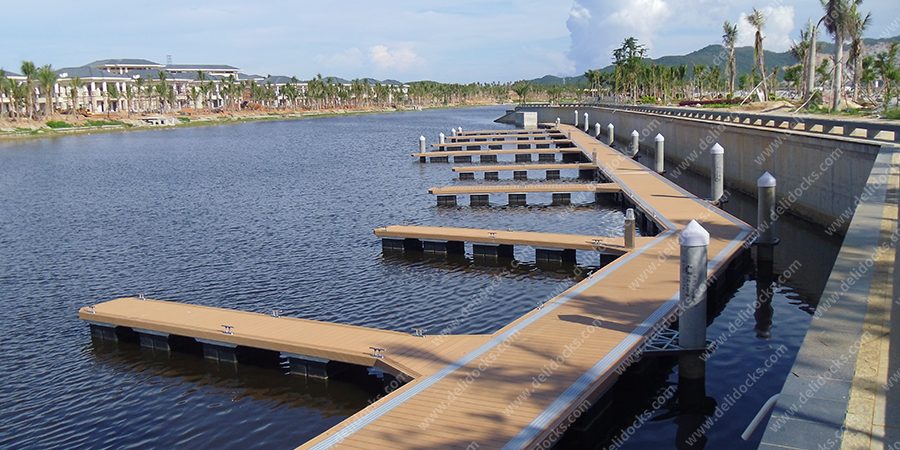
To assist marine developers in their planning phases, the table below outlines the structural differences between standard concrete pontoons and heavy-duty wave attenuators, highlighting how these specifications influence overall budgeting decisions:
| Structural Parameter | Standard Commercial Pontoon | Heavy-Duty Wave Attenuator | Impact on Overall Project Budget |
|---|---|---|---|
| Concrete Compressive Strength | C40/50 | C50/60 or higher | Higher material cost due to advanced mix additives. |
| Reinforcement Density | Standard galvanized steel mesh | Heavy double-grid reinforced steel / composite rebar | Significant increase in raw material and fabrication labor. |
| Average Width | 2.4m to 3.0m | 4.0m to 6.0m | Larger surface area requires more concrete and EPS volume. |
| Draft Depth | 0.5m to 0.6m | 1.0m to 1.8m | Increased draft dramatically raises structural weight and towing complexity. |
| Connection System | Standard elastomeric joints with stainless steel bolts | Heavy-duty friction joints with high-tensile steel tie rods | Requires specialized casting and expensive mechanical hardware. |
By analyzing these physical parameters, marine developers can identify where engineering modifications can be made to align the project scope with available capital resources without compromising structural safety.
Frequently Asked Questions
Q1: What are the primary variables behind the variation in concrete floating dock cost?
A1: The primary variables include the physical dimensions (width, length, and draft), the concrete mix design required for the specific climate, the reinforcement material used (galvanized steel vs. composite), the complexity of the internal utility channels, the chosen anchoring system, and the logistics associated with transporting heavy precast concrete elements to the project site.
Q2: How does wave attenuation capacity impact the engineering specifications?
A2: Dissipating wave energy requires a pontoon with substantial mass, wide dimensions, and deep draft to block wave transmission beneath the structure. Engineering a pontoon for wave attenuation increases the volume of concrete, the density of the internal reinforcement, and the strength of the connection systems, leading to a higher manufacturing cost.
Q3: Why are concrete pontoons preferred over aluminum systems for commercial marinas?
A3: Concrete pontoons offer superior stability, high load capacity, and exceptional resistance to marine environmental degradation. Their heavy mass minimizes movement under foot traffic and wave action, providing a solid feel comparable to a fixed pier. Additionally, concrete does not suffer from the electrochemical corrosion issues associated with metal frames in saltwater environments.
Q4: How do soil conditions and water depth affect anchoring expenses?
A4: Soil conditions (such as solid rock vs. deep silt) dictate the type of piles or anchors required. Deep water or soft seabed soils require longer, thicker piles or heavy concrete sinker blocks with elastic mooring lines. These anchoring components, along with the specialized marine piling barges needed to install them, add significantly to the overall marine construction budget.
Q5: What maintenance requirements should be budgeted for concrete pontoon systems?
A5: Although concrete pontoons require very little maintenance compared to timber or aluminum systems, operators should budget for periodic inspections of the elastomeric connection joints, the tension of the internal tie rods, the wear on pile guide rollers, and marine growth accumulation on the draft line to ensure consistent freeboard heights.
Inquiry and Project Engineering Support
Determining the precise expenditure for a commercial marine development project requires detailed, site-specific engineering analysis. Generic estimates cannot account for local wave energy, seabed soil profiles, or specific utility demands.
The engineering team at DeFever is available to review your project bathymetry, environmental data, and master plan layout. We provide customized, detailed material lists and structural recommendations designed to optimize your marine layout. To receive a detailed structural assessment and an accurate price quotation tailored to your project parameters, please submit your engineering specifications and site layout plans to our technical inquiry department.