2026-10-15
Marine infrastructure demands structural solutions that withstand relentless physical, chemical, and environmental pressures. Among all waterfront construction methods, concrete dock construction stands as the benchmark for durability, load capacity, and lifecycle economy. From superyacht marinas to commercial shipping terminals, properly engineered concrete docks provide unmatched resilience against tidal cycles, vessel impacts, and chloride-induced degradation. In this technical deep dive, we examine the materials science, engineering protocols, and quality benchmarks that define modern concrete dock construction, incorporating field-proven methodologies used by industry leaders like DeFever to achieve service lives exceeding 50 years with minimal maintenance.
1. The Marine Environment: A Unique Set of Deterioration Mechanisms
Before specifying any structural system, engineers must quantify the aggressive agents acting on a concrete dock. The marine environment exposes concrete to:
Chloride ion penetration – leading to reinforcement corrosion, spalling, and loss of section.
Freeze-thaw cycles – in cold climates, water absorption and internal hydraulic pressure cause micro-cracking.
Wet-dry & tidal zone attack – the most aggressive zone where evaporation concentrates chlorides and sulfates.
Physical abrasion – from vessel fendering, debris impact, and ice scouring.
Biological fouling & chemical exposure – from fuel spills, cleaning agents, and marine organisms.
Data from ACI 357 (Guide for the Design and Construction of Fixed Offshore Concrete Structures) indicate that structures designed without specific durability provisions often require major repairs within 15–20 years. Conversely, purpose-designed concrete dock construction employing modern protection strategies routinely achieve 50-year design lives with only routine inspections.
2. Material Science & Durability Engineering
2.1 High-Performance Concrete Mix Design
The cornerstone of longevity lies in a well-proportioned concrete mixture. For marine dock applications, mix designs must meet or exceed:
Water-to-cementitious ratio (w/cm) ≤ 0.40 – to reduce capillary porosity and chloride diffusivity.
Minimum compressive strength: 6,000 psi (41 MPa) at 28 days – often increased to 8,000 psi for high-traffic zones.
Supplementary cementitious materials (SCMs) – 25–50% fly ash or ground granulated blast-furnace slag (GGBFS) to refine pore structure and increase long-term strength.
Silica fume (5–10%) – to dramatically reduce chloride permeability (ASTM C1202 charge passed < 1,500 coulombs).
Air entrainment (5–7%) – critical for freeze-thaw resistance in northern climates.
Corrosion-inhibiting admixtures – calcium nitrite or organic-based inhibitors provide an extra electrochemical barrier.
Project-specific mix designs are validated through trial batches and rigorous testing, including rapid chloride permeability (RCPT), bulk electrical resistivity, and freeze-thaw durability (ASTM C666).
2.2 Reinforcement Corrosion Protection Systems
Steel reinforcement is the most vulnerable component in concrete dock construction. Leading-edge corrosion protection includes:
Epoxy-coated reinforcing bars (ECR) – fusion-bonded epoxy provides a physical barrier; however, care is required to avoid coating damage during placement.
Stainless steel reinforcement (Type 316LN or duplex) – eliminates corrosion risk, ideal for splash zones and high-chloride environments.
Galvanized rebar (ASTM A1094) – suitable in moderately aggressive zones with additional concrete cover.
Cathodic protection (CP) – impressed current or sacrificial anodes (zinc or aluminum) are installed for critical structures, often embedded in the concrete or attached to reinforcing mats.
Increased concrete cover – minimum 75 mm (3 in.) for decks and 100 mm (4 in.) for piles and submerged members, per ACI 318 and PIANC recommendations.
2.3 Structural Configuration and Load Demands
Concrete docks are engineered to accommodate vertical (dead + live), lateral (berthing, mooring), and environmental (wave, current, seismic) loads. Common configurations include:
Prestressed concrete piles + cast-in-place deck – offers high bending resistance and rapid installation.
Floating concrete docks – constructed with lightweight aggregate or polystyrene voided forms, tethered to pile guides or mooring systems.
Combination sheet-pile bulkheads with concrete cap – used for marginal wharves and small craft harbors.
Finite element modeling (FEM) is standard practice to optimize reinforcement layout and minimize cracking under service loads, ensuring long-term durability.
3. Construction Methodologies: From Formwork to Final Cure
Execution quality is as critical as design. The following steps define best-in-class concrete dock construction procedures:
3.1 Precision Formwork & Falsework
Engineered steel or fiberglass-reinforced plastic (FRP) forms maintain strict tolerances (±6 mm for alignment).
Self-consolidating concrete (SCC) used for heavily reinforced sections ensures full encapsulation without vibration-induced segregation.
3.2 Reinforcement Placement & Spacing Control
Plastic chairs and wheel supports maintain required cover; continuous inspection prevents displacement.
Stainless steel tie wires or epoxy-coated ties used to avoid corrosion initiation points.
3.3 Concrete Placement & Consolidation
Pump placement with tremie techniques for underwater elements (piles, pile caps) prevents washout.
Internal vibrators ensure consolidation; for deep sections, external form vibrators are employed.
3.4 Curing & Surface Protection
Moist curing for minimum 7 days (or until specified strength achieved) with curing compounds, wet burlap, or insulating blankets.
Application of penetrating silane sealers (water-repellent but vapor-permeable) after curing to reduce chloride ingress by 80–90%.
4. Quality Assurance and Testing Protocols
To guarantee the intended service life, owners and engineers enforce a comprehensive quality control (QC) plan that includes:
Fresh concrete tests: slump, air content, temperature, unit weight.
Hardened concrete tests: compressive strength at 7, 14, and 28 days; modulus of elasticity; rapid chloride permeability (ASTM C1202) and bulk resistivity (AASHTO T358).
Cover meter & half-cell potential surveys – non-destructive evaluation of reinforcement cover and corrosion risk.
Ground penetrating radar (GPR) – maps rebar location and detects voids.
Load testing – proof-loading of fender systems, pile capacity verification by dynamic or static testing.
Projects involving DeFever engineering oversight typically incorporate third-party materials testing and digital reporting dashboards, ensuring every batch meets the strict durability criteria required for marine assets.
5. Industry Pain Points and Engineering Solutions
Despite advances, concrete docks face persistent challenges. Below are common pain points and the corresponding technical solutions employed by leading marine engineers.
Pain Point #1: Corrosion-Induced Cracking & Spalling
Chloride ingress leads to expansive rust formation, cracking the concrete cover within 10–20 years in poorly specified structures.
Solution: Combine low-permeability concrete (w/cm ≤ 0.38, silica fume), stainless steel reinforcement in critical zones, and impressed current cathodic protection (ICCP) systems. For existing docks, DeFever deploys electrochemical chloride extraction and real-time corrosion monitoring sensors.
Pain Point #2: Freeze-Thaw Damage in Cold Climates
Without adequate air entrainment, saturated concrete can spall after fewer than 50 freeze-thaw cycles.
Solution: Specify air-entrained concrete with spacing factor below 0.20 mm and use of air-void analyzers during placement. Additionally, install water-repellent sealers to limit saturation.
Pain Point #3: Construction Delays & Cost Overruns
Complex formwork and curing requirements can extend project schedules.
Solution: Precast concrete dock elements (decks, pile caps, panels) fabricated off-site reduce weather exposure and shorten installation time. Precast/prestressed components also offer superior quality control.
Pain Point #4: Ecological & Regulatory Compliance
Marine construction must avoid turbidity, noise, and habitat disruption.
Solution: Utilize bubble curtains during pile driving, low-impact vibratory hammers, and silt curtains. Concrete mixes with recycled aggregates and SCMs also lower the carbon footprint.
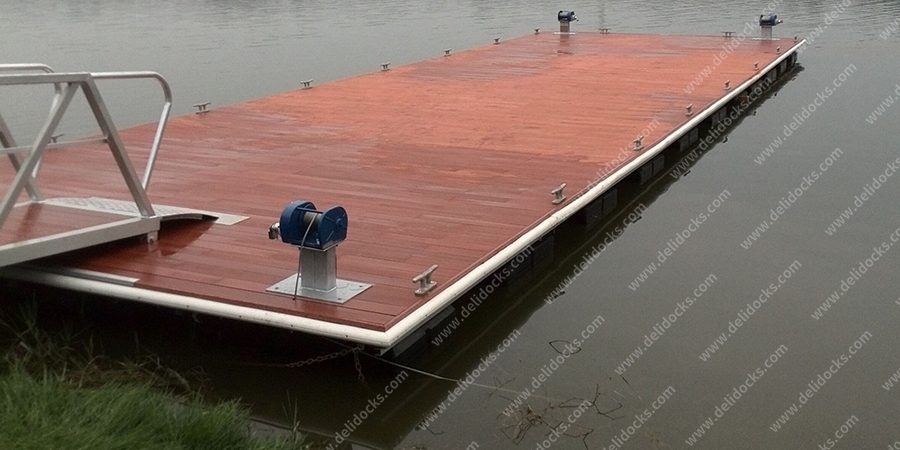
6. Application Case Study: High-Durability Dock for Superyacht Facility
A recent project involved a 250-berth superyacht marina in the Caribbean, a region with high chloride concentrations, tropical storms, and heavy vessel traffic. The design team adopted a hybrid concrete dock construction approach:
Prestressed concrete piles with 100 mm cover and Type 316 stainless steel reinforcement in the splash zone.
Cast-in-place deck with 0.38 w/cm, 8% silica fume, and 35% slag; 28-day strength of 8,000 psi.
Impressed current cathodic protection (ICCP) embedded in the deck and pile caps.
All joints sealed with hydrophilic waterstops and polyurethane sealants.
Five years post-construction, half-cell potential surveys show negligible corrosion activity, and chloride profiles remain below the critical threshold, validating the durability design. Project partners credited DeFever with providing advanced corrosion monitoring systems and mix design optimization.
7. Role of Expert Engineering: Specialized Consultation
While many contractors can execute standard concrete work, marine dock construction requires specialized expertise in hydrodynamics, corrosion science, and heavy civil construction. Firms like DeFever offer integrated services—from feasibility studies and structural design to construction management and long-term monitoring—ensuring that the completed asset meets performance targets over its full lifecycle. Their involvement often reduces total cost of ownership by 25–35% compared to projects that rely on conventional building standards without marine-specific adaptations.
8. Future Innovations in Concrete Dock Construction
The next generation of concrete docks will be shaped by:
Self-healing concrete – bacteria-based (bioconcrete) or encapsulated polymer agents that autonomously seal micro-cracks.
Ultra-high-performance concrete (UHPC) – with compressive strengths exceeding 20,000 psi and exceptional durability, enabling slender, lightweight structures.
Digital twin & structural health monitoring – embedded sensors provide real-time data on chloride concentration, strain, and corrosion potential, feeding into predictive maintenance models.
Robotic reinforcement placement – improves accuracy and reduces cover variability, a primary cause of premature corrosion.
These technologies, combined with rigorous durability specifications, will push service lives toward 75–100 years, dramatically improving asset sustainability.
Frequently Asked Questions (FAQ) – Concrete Dock Construction
Q1: What is the typical lifespan of a well-constructed concrete dock
in a saltwater environment?
A1: With proper design
(low w/cm, adequate cover, corrosion-resistant reinforcement) and routine
maintenance, a concrete dock can exceed 50 years of service. High-specification
projects incorporating stainless steel reinforcement and cathodic protection
often achieve 75+ years without major structural repairs.
Q2: How does concrete dock construction compare to wood or steel
docks in terms of total cost of ownership?
A2: While initial costs for concrete are higher than timber or untreated steel, the
lifecycle cost is significantly lower. Concrete eliminates recurring replacement
of deck boards, pilings, and corrosion-related repairs. For commercial marinas,
a 50-year lifecycle cost analysis typically shows concrete being 30–40% more
economical than wood and 20% more than steel, when accounting for maintenance,
downtime, and insurance premiums.
Q3: What measures are essential to prevent reinforcement corrosion in
a concrete dock?
A3: Critical measures include: (1)
low-permeability concrete with SCMs, (2) increased concrete cover (75–100 mm),
(3) use of epoxy-coated, galvanized, or stainless steel rebar in aggressive
zones, (4) penetrating silane sealers, and (5) embedded cathodic protection for
critical infrastructure. Additionally, proper drainage and joint sealing prevent
standing water and chloride accumulation.
Q4: Can existing deteriorated concrete docks be repaired rather than
replaced?
A4: Yes, rehabilitation is often feasible
using techniques such as patch repair with corrosion-inhibiting mortars,
electrochemical chloride extraction, or installation of galvanic anodes.
However, a comprehensive condition assessment (including half-cell mapping,
chloride profiling, and core sampling) is required to determine if the remaining
structure can support continued service. For docks with widespread reinforcing
corrosion and section loss, full replacement may be more economical.
Q5: What role does quality control during construction play in the
long-term durability of a concrete dock?
A5: Quality control is paramount. Even the most advanced material specifications can
fail if concrete is not properly placed, consolidated, and cured. Key QC actions
include: real-time monitoring of slump and air content, ensuring rebar cover
with laser-scan verification, proper curing for at least 7 days, and field
testing for chloride permeability on hardened concrete. Third-party inspection
and documentation provide assurance that the finished structure aligns with the
durability design criteria.
This technical overview emphasizes that successful concrete dock construction is a synthesis of material science, structural engineering, and precision construction management. By adhering to proven durability strategies and engaging specialized expertise, waterfront owners can secure infrastructure that performs reliably for decades.