2026-10-15
Global waterfront infrastructure is undergoing a fundamental shift. Traditional fixed concrete piers, once considered the gold standard for maritime engineering, are increasingly struggling against volatile water levels and intensifying weather patterns. Reports from the World Association for Waterborne Transport Infrastructure (PIANC) indicate that static coastal infrastructure faces accelerated degradation rates due to these changing environmental dynamics.
For marina operators, commercial developers, and marine engineers, adaptability is no longer a luxury—it is a structural necessity. Utilizing a heavy-duty floating dock portable system offers a reliable way to design resilient, scalable waterfront assets. This article examines the engineering advantages, material science, and financial benefits of integrating modular floating systems into commercial marina projects.
By moving away from static foundations, developers can build marine facilities that adapt to environmental changes. Industry leaders like DeFever offer advanced design and manufacturing capabilities, helping operators implement highly customizable systems that protect vessels and maximize space utilization.
The Shifting Tide: Why Static Marine Infrastructure is Becoming a Liability
Fixed docks are vulnerable to tidal shifts and storm surges. When water levels exceed design limits, fixed structures can submerge, presenting significant hazards to both the dock itself and moored vessels. Conversely, during extreme low tides, the vertical gap between the deck and vessel decks can complicate utility connections and access.
Replacing or repairing fixed structures involves substantial capital expenditures, long permitting processes, and significant operational downtime. Marine concrete and driven piles require heavy machinery, underwater dive teams, and extensive environmental impact assessments before construction can begin.
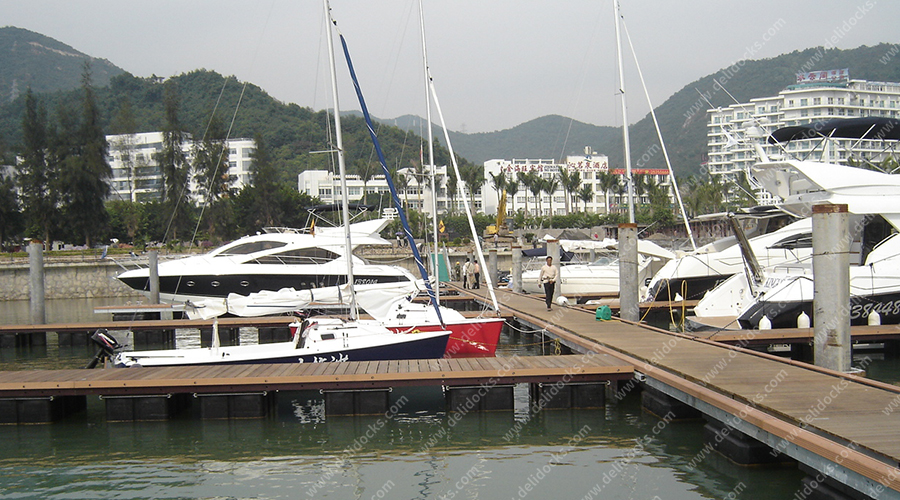
A modular, portable floating dock addresses these issues by adapting to changing water levels. It rises and falls naturally with the tide, maintaining a constant freeboard height relative to moored vessels. This continuous alignment reduces stress on mooring lines and minimizes draft clearance issues during low-water periods.
Additionally, the modular nature of these systems allows operators to reconfigure their layout as slip demand changes. If seasonal patterns or vessel profiles shift, the entire assembly can be uncoupled, rearranged, and expanded with minimal disruption to ongoing operations.
"Resilient maritime infrastructure must incorporate adaptive design principles to mitigate the risks associated with sea-level variability and extreme weather events."
Core Engineering: What Makes a Portable Floating Dock System Structurally Sound?
To perform reliably in commercial marine environments, a floating dock portable system must balance flexibility with structural rigidity. Standard recreational plastic docks often lack the load-bearing capacity and wave attenuation properties required for commercial marina operations.
The structural integrity of a commercial modular dock depends on three primary engineering components: flotation design, frame construction, and connection interfaces. Each must be engineered to withstand torsional stress, wave action, and live loads from pedestrian and utility traffic.
1. Material Selection: Aluminum Alloy vs. HDPE vs. Concrete
Commercial floating docks generally utilize three main materials, each offering distinct performance characteristics:
Marine-Grade Aluminum (6061-T6): Offers an exceptional strength-to-weight ratio, high corrosion resistance, and structural flexibility. It is ideal for structural frames and utility raceways.
High-Density Polyethylene (HDPE): Excellent for flotation pontoons. It resists UV degradation, impact, chemical spills, and marine growth, requiring minimal maintenance.
Pre-stressed Concrete Monohulls: Provide high mass and stability, making them excellent for wave attenuation, though they are much heavier and more difficult to relocate.
2. Connection Mechanisms: The Critical Link
The connection joints between modules are often the most vulnerable points in a floating system. Under continuous wave action, these joints experience constant shear and bending stresses. Commercial systems use heavy-duty elastomer or polyurethane shear blocks reinforced with stainless steel bolts.
These flexible connection systems absorb and dissipate kinetic energy across the entire grid rather than concentrating stress on a single joint. This dampening effect reduces structural fatigue and extends the overall service life of the marina installation.
The Hydro-Adaptive Modular Grid (HAMG) Framework
To optimize the deployment of portable floating assets, we utilize a design framework called the Hydro-Adaptive Modular Grid (HAMG). This methodology categorizes marina design into three distinct functional layers:
| Layer | Primary Function | Engineering Focus | Key Components |
|---|---|---|---|
| 1. Stabilization Layer | Mooring and anchoring preservation | Load distribution, pile guide friction reduction, elastic tethering | Seaflex tethers, pile guides, self-adjusting anchors |
| 2. Structural Grid Layer | Modular distribution of live and dead loads | Torsional rigidity, shear stress mitigation, flexural strength | 6061-T6 Aluminum frames, heavy-duty elastomeric bypass blocks |
| 3. Utility & Surface Layer | Operational services and pedestrian safety | Anti-slip properties, integrated service channels, ease of maintenance | WPC decking, integrated power pedestals, quick-connect plumbing |
By separating the design into these distinct layers, engineers can customize individual components to meet site-specific wave climates without redesigning the entire system. For example, if a site experiences high wave energy, the stabilization layer can be reinforced with specialized tethers while keeping the structural grid layer standard.
This systematic division also simplifies long-term maintenance. If a utility line requires repair or upgrade, technicians can access the utility layer without compromising the structural integrity of the flotation modules below, reducing service costs.
Comparative Analysis: Fixed vs. Traditional Floating vs. Portable Floating Docks
When planning a marina expansion or new development, decision-makers must evaluate several structural configurations. The choice between fixed piers, permanent floating concrete docks, and portable modular systems directly impacts capital expenditure, maintenance budgets, and long-term adaptability.
Fixed concrete structures are highly stable but offer no flexibility. They are susceptible to storm surges and cannot be easily reconfigured if vessel sizes change over time. Permanent concrete floating docks offer excellent stability but remain difficult and expensive to relocate or alter once anchored.
A heavy-duty floating dock portable system provides a balanced alternative. It offers comparable stability to medium-duty permanent docks while remaining highly adaptable. The modular units can be towed, reconfigured, or stored on land during severe winter ice or extreme hurricanes, protecting the asset from damage.
From an investment perspective, modular portability also offers tax advantages in several jurisdictions. Because these systems are non-permanent and relocatable, they can often be classified as equipment rather than real property, allowing for accelerated depreciation schedules that improve short-term cash flow.
Practical Checklist for Marina Operators and Marine Engineers
Before selecting and deploying a modular portable dock system, engineers and operators should perform a comprehensive site assessment. This checklist outlines the key environmental and operational factors to evaluate:
Wave Climate Assessment: Measure maximum wave height ($H_{max}$) and wave period ($T$). Ensure the system's attenuation ratings can handle localized wave energy.
Bathymetric Survey: Determine water depth profiles and soil composition to select the appropriate anchoring method (piles, deadweight anchors, or elastic tethers).
Load Calculations: Calculate both dead loads (utility lines, gangways) and live loads (pedestrian traffic, light utility vehicles) to determine required buoyancy margins.
Regulatory and Permitting Review: Check local environmental regulations regarding bottom-disturbing activities. Modular floating systems often require fewer permits than driven piles.
Utility Integration Planning: Confirm that electrical conduits, potable water lines, and fire suppression systems can flex along with the modular connections.
Frequently Asked Questions (FAQ)
Q1: Can a portable floating dock withstand freezing water and ice buildup?
A1: High-density polyethylene (HDPE) pontoons and marine-grade aluminum frames are engineered to tolerate cold climates. HDPE is flexible enough to withstand the pressure of expanding ice without cracking. However, in areas with severe moving ice flows, we recommend uncoupling the modular sections and towing them to a protected basin or storing them on land for the winter season.
Q2: How are portable floating docks anchored in deep water?
A2: In deep-water environments where traditional driven piles are impractical or cost-prohibitive, portable systems are anchored using heavy-duty underwater deadweights (such as concrete blocks) paired with high-tensile elastic mooring systems like Seaflex. These tethers expand and contract with the tides, holding the dock in position without requiring vertical piles.
Q3: What is the expected service life of a marine-grade aluminum modular dock?
A3: A well-engineered modular dock utilizing 6061-T6 marine-grade aluminum and UV-stabilized HDPE flotation floats typically has a service life of 20 to 25 years with basic maintenance. The structural frame resists salt-water corrosion, and individual worn components or bumpers can be replaced without replacing entire dock sections.
Q4: How does a portable floating dock handle utility connections like power and water?
A4: Modern commercial systems feature integrated, covered utility raceways built directly into the aluminum structural frame. These channels allow power cables, water lines, and fuel hoses to run safely beneath the deck surface. Flexible expansion joints are installed at module connection points to prevent utility lines from shearing during wave motion.
Q5: Is it possible to expand a portable floating dock system after installation?
A5: Yes, one of the primary benefits of modular design is scalability. New modules can be integrated into the existing structure using standard connector kits. This allows marina operators to adjust their layout, add finger piers, or extend the main walkway to accommodate larger vessels as customer demands change.
Securing the Waterfront Investment
As the marine industry adapts to changing environmental conditions, infrastructure must become more flexible. The integration of modular, portable floating docks represents a practical, resilient option for modern marina design. By choosing adaptable structures, developers can lower initial installation costs, simplify maintenance, and build facilities capable of adapting to future challenges.
For projects requiring high-performance marine solutions, partnering with experienced manufacturers like DeFever ensures that your infrastructure meets rigorous commercial standards. Investing in quality engineering today helps protect your waterfront assets for decades to come.