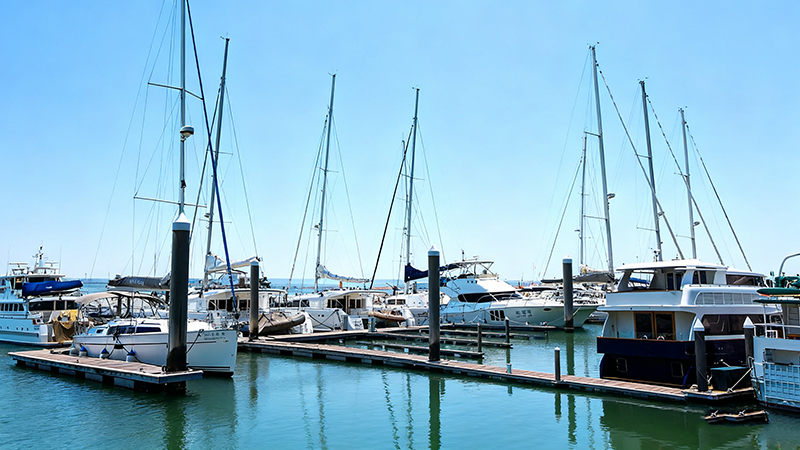
Waterfront developments face continuous challenges from changing environmental conditions, fluctuating water levels, and the need for structural longevity. Traditional fixed pier structures often struggle to accommodate significant tidal shifts and can cause disruption to benthic ecosystems. Consequently, modern marine developers and commercial operators favor the installation of a floating dock marina system. These engineered structures rise and fall with the tide, presenting a consistent freeboard height for vessel boarding while minimizing impact on the underlying aquatic habitat.
Designing and deploying a large-scale commercial marina requires a comprehensive understanding of marine engineering, material dynamics, and hydrodynamic forces. Marine engineering firms such as DeFever focus on producing robust solutions that balance buoyancy, structural rigidity, and long-term service life. This analysis examines the primary design parameters, material selections, mooring configurations, and utility integrations required to establish a high-performing marine facility.
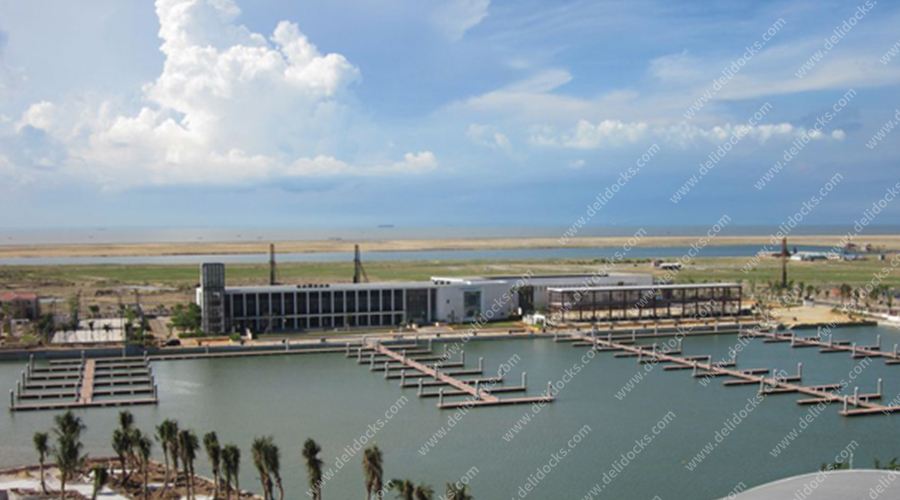
The structural integrity of a floating dock marina depends on precise hydrostatic and hydrodynamic calculations. Unlike land-based structures, a floating platform must maintain equilibrium under a complex matrix of constant and variable forces.
Engineers categorize the forces acting on a floating pontoon into two main types:
Dead Loads: The permanent, static weight of the dock components, including the structural frame, decking, flotation units, internal utilities, cleats, pile guides, and gangways.
Live Loads: Temporary forces exerted by pedestrians, utility vehicles, stored equipment, and the transient vertical forces from moored vessels. Standard commercial specifications generally require a minimum uniform live load capacity ranging from 1.5 kPa to 2.4 kPa (approximately 30 to 50 lbs/sq.ft), depending on local maritime regulations and the intended usage of the facility.
Freeboard—the distance between the water surface and the top of the deck—must remain consistent to ensure safe passenger boarding and vessel mooring. Under full dead load conditions, a typical commercial floating dock maintains a freeboard of 500 mm to 600 mm. When maximum design live loads are applied, the remaining freeboard should not fall below 300 mm to prevent deck wash and localized instability. The draft (the depth of the submerged portion of the pontoon) must be planned relative to the local bathymetry to avoid grounding during extreme low tides.
When a concentrated load is applied to the edge of a floating finger pier, it induces a roll moment. To counteract this, the flotation pontoons must be spaced and sized to provide adequate metacentric height. High torsional stiffness is required throughout the structural frame to distribute these eccentric loads across multiple flotation modules, preventing localized twisting and structural fatigue at the connections.
The choice of materials directly governs the operational lifespan and maintenance requirements of a floating infrastructure project. Saline environments, UV radiation, and mechanical impacts demand high-performance materials.
The structural backbone of the dock must withstand continuous bending moments and shear stresses. Marine-grade aluminum alloys, specifically the 6000-series (such as 6061-T6 and 6082-T6), are widely specified due to their high strength-to-weight ratio and natural resistance to atmospheric corrosion. These alloys form a protective oxide layer that resists degradation in saltwater environments. Steel frames, while offering high yield strength, require hot-dip galvanizing or specialized protective coatings and demand routine inspection to mitigate oxidation.
Modern flotation units generally utilize one of two manufacturing methodologies:
Rotomolded HDPE Shells: High-Density Polyethylene (HDPE) pontoons offer seamless construction, high impact resistance, and complete immunity to chemical degradation and marine growth. The interior is typically filled with expanded polystyrene (EPS) foam to ensure buoyancy is maintained even in the event of an outer shell puncture.
Heavy-Duty Concrete Pontoons: For deep-water facilities exposed to significant wave action, concrete pontoons provide the necessary mass and inertia to dampen wave movement. These units consist of a reinforced concrete skin cast over an EPS core, offering high load capacities and long-term durability.
Decking surfaces must offer slip resistance, durability, and UV stability. Standard options include high-durability hardwoods (such as Ipe or Teak), mineral-composite boards, and open-mesh polypropylene panels. Open-mesh decking is highly effective in areas prone to storm surges, as it allows water and light to pass through, reducing uplift forces on the dock and supporting local marine ecosystems by allowing sunlight to reach the seabed.
A floating platform must be securely anchored to resist lateral forces from wind, currents, and vessel berthing, while freely allowing vertical movement in response to tidal changes. Selecting the appropriate mooring configuration is a key phase in the design of a floating dock marina.
Through systematic design methodologies, **DeFever** offers engineered solutions tailored to specific site parameters, ensuring the optimal selection of anchoring systems based on localized data.
| Mooring Method | Primary Application | Advantages | Limitations |
|---|---|---|---|
| Guide Piles (Steel or Concrete) | Shallow to medium depths, high wind and current zones. | Excellent lateral stability, neat aesthetic, minimal footprint. | Limited by maximum pile length; high installation requirements. |
| Elastic Mooring Systems (e.g., Seaflex) | Deepwater applications, sensitive benthic habitats. | Adapts smoothly to tides, dampens shock loads, quiet operation. | Requires regular tension monitoring and specialized anchors. |
| Chain and Anchor Arrays | High-depth basins with varying bottom profiles. | Highly adaptable, capable of securing large pontoon masses. | Large underwater footprint, potential drag damage to seabed. |
When utilizing guide piles, the connection between the dock frame and the pile is a high-stress point. Internal or external pile guides must be equipped with low-friction, impact-resistant wear blocks or rollers, often manufactured from Ultra-High-Molecular-Weight Polyethylene (UHMW-PE). These rollers minimize wear on both the pile and the dock frame, ensuring smooth vertical movement during rapid tidal transitions.
A fully functional commercial waterfront facility must deliver essential services directly to the berths. Integrating these services within a floating dock marina requires careful routing to accommodate the constant motion of the floating structure.
To preserve safety and aesthetic appeal, utilities should be routed through dedicated service channels or chases integrated into the structural frame beneath the decking. These chases isolate electrical conduits from potable water lines and blackwater pump-out hoses. Access hatches must be positioned periodically along the main walkways to facilitate inspection and maintenance without requiring the disassembly of the structural deck panels.
The transition zone between the fixed land-side infrastructure and the floating dock system represents a primary point of wear. Flexible conduits, high-pressure flexible hoses, and articulated joint systems are necessary at the gangway transitions. These connections must accommodate multi-axis rotation, including pitch, roll, and yaw, preventing structural stress and potential leakage during extreme environmental events.
Wave energy is one of the most significant external forces acting on marine installations. Without appropriate attenuation, persistent wave action can lead to structural wear and uncomfortable berthing conditions.
In locations where fixed breakwaters are impractical due to water depth or environmental regulations, floating wave attenuators are deployed. These specialized, high-mass pontoons are designed with deep drafts and specific cross-sectional geometries to disrupt wave transmission. By reflecting a portion of the wave energy and dissipating the remainder through turbulent flow around the structure, attenuators protect the inner berths from excessive motion.
Modern coastal planning regulations demand that marine infrastructure minimizes its ecological footprint. Floating docks contribute to this goal by reducing the need for extensive seabed dredging and seafloor disruption compared to solid-fill piers. Furthermore, using non-toxic materials, such as inert polymers and untreated hardwoods, prevents the leaching of heavy metals or harmful chemicals into the surrounding marine environment.

Every waterfront project presents a unique combination of bathymetric profiles, wind patterns, and usage requirements. Standardized configurations rarely satisfy the complex demands of commercial and public marine installations. Consulting with seasoned producers like **DeFever** ensures that every structural calculation, material selection, and anchoring arrangement is tailored precisely to the site conditions.
If you are planning the development, expansion, or modernization of a commercial waterfront facility, we invite you to submit your site plans, wave climate data, and operational specifications to our engineering team. We provide detailed design evaluations, loading analyses, and custom layout proposals to assist you in executing a durable and efficient marine infrastructure project. Please contact our technical sales department to initiate a formal consultation.
A1: Environmental forces, particularly wind and current, exert lateral pressure on the draft portion of the pontoon and the freeboard profile of both the dock and moored vessels. This creates a tilting moment. To counteract this, designers adjust the pontoon width and draft depth to optimize the metacentric height. Under maximum design wind loads, the dock must maintain a stable horizontal plane to ensure pedestrian safety and prevent torsional stress on the frame connections.
A2: Marine-grade concrete pontoons utilize a core of high-density Expanded Polystyrene (EPS) foam. The EPS core is block-molded and inserted into the concrete formwork before casting. This ensures that even if the outer concrete shell experiences micro-cracking or localized impact damage, the unit remains completely unsinkable, as the closed-cell structure of the EPS prevents water absorption.
A3: Tidal variations are accommodated by installing an articulated aluminum or steel gangway. The landward side of the gangway is mounted on a pivoting hinge assembly, while the dockside rests on sliding rollers or a transition plate. This configuration allows the gangway to change angle dynamically as the floating dock rises and falls. Utility conduits running along the gangway must utilize loop configurations or flexible marine-grade hoses to handle this continuous movement.
A4: To prevent rotational deformation and snaking along extended walkways, engineers use high-strength structural connectors, such as elastomeric bypass blocks or dual-bolt stainless steel hinges. These connectors allow vertical deflection to accommodate wave swells but provide high horizontal rigidity to maintain a straight alignment. Additionally, finger docks are strategically attached perpendicular to the main walkway to act as structural outriggers, increasing the overall torsional resistance of the system.
A5: The choice of mooring system directly dictates the spatial layout of the basin. Guide piles keep the dock footprint confined to the pile locations, allowing for maximum slip density and clear navigation channels. Conversely, chain-and-anchor arrays require a significant radial spread of anchor lines underwater, which can limit vessel drafts and restrict the placement of adjacent finger docks. It is important to evaluate the sub-bottom soil profiles and navigation requirements before final system selection.