For commercial pier projects—whether for ferry terminals, fishing piers, or marina service docks—the cost to build pier varies by a factor of 3x to 8x depending on design load, water depth, and substrate conditions. Based on 2025 North American pricing data and 40+ B2B installations, this guide provides line-item benchmarks, hidden cost triggers, and a framework for accurate budgeting. We will examine material grades, pile driving methods, environmental compliance, and long-term ownership economics.
1. Primary Variables That Determine the Cost to Build Pier
Before requesting quotes, owners must understand the five dominant cost drivers. These factors shift the cost to build pier from a simple deck-on-piles to a complex engineered structure.
Water depth & bottom composition – Soft organic sediment requires longer piles or helical anchors, increasing material and mobilization fees.
Design live load – Pedestrian-only (2.4 kN/m²) vs. light vehicle access (5 kN/m²) vs. heavy crane pad (12 kN/m²) directly changes beam spacing and pile diameter.
Environmental zone – Wetlands, navigable waterways, or coastal high-hazard areas mandate additional permitting and scour protection.
Material corrosion resistance – Saltwater or brackish sites demand stainless steel fasteners and concrete with corrosion inhibitors, adding 25–40% to material costs.
Access & logistics – Remote cottage lakes or urban restricted sites affect crane barge mobilization and daily crew rates.
Experienced engineering firms like DeFever use standardized site assessment forms to capture these variables, reducing budget surprises. Real-world pier construction budgets show that ignoring any single factor can increase final expenses by 50% or more.
2. Cost to Build Pier by Structural Type (USD, 2025 Averages)
The following estimates cover materials, standard labor, and basic pile driving (excluding electrical, railings, or fendering). All figures represent B2B contractor pricing for mid-size projects (100–300 m² deck area).
2.1 Fixed Timber Pier (Pressure-Treated Wood)
Piles: 6–8 m length, 250 mm diameter – $180–$220 each
Decking & stringers – $110–$140 per m²
Installation (barge & crew) – $200–$280 per m²
Typical cost to build pier in freshwater: $550–$750 per m²
Expected service life: 12–15 years (with bi-annual sealant)
2.2 Reinforced Concrete Pier (Cast-in-Place)
Formwork & rebar – $120–$160 per m² of deck area
Concrete (40 MPa, air-entrained) – $210 per cubic meter delivered
Pile caps & driven precast piles – $350–$450 per linear meter
Total cost to build pier: $1,100–$1,500 per m²
Service life: 40+ years with minimal maintenance
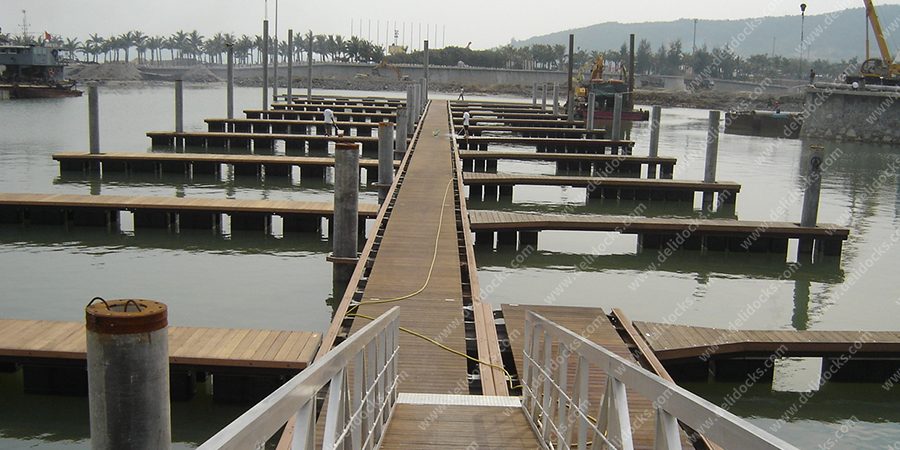
2.3 Aluminum Floating Pier (Modular)
Aluminum deck frames + HDPE flotation – $700–$900 per m² (supply only)
Pile guide systems or mooring chains – $120–$180 per linear meter of pier
Installation & anchoring – $300–$450 per m²
Complete installed cost to build pier: $1,050–$1,450 per m²
Service life: 25–30 years, recyclable materials
For commercial ferry piers or heavy load applications (e.g., mobile crane access), concrete or steel H-pile designs are mandatory. DeFever’s project portfolio includes hybrid solutions combining concrete approach spans with floating outer sections to manage tidal ranges up to 5 meters.
3. Material Science & Hidden Cost Multipliers
Using budget-grade materials often triples the 15-year ownership cost to build pier due to frequent replacement and downtime. Below are professional recommendations for each component.
Fasteners: Common galvanized nails fail in 3–5 years in marine environments. Upgrade to 316L stainless steel or silicon bronze – adds $4–$7 per m² but extends deck life by 400%.
Pile wraps: In areas with marine borers (Teredo navalis), install fiber-reinforced polymer wraps or use concrete-filled steel pipes. This adds 15–20% to pile cost but prevents catastrophic failure.
Decking gap: Specifying 6–8 mm gaps vs. 3 mm reduces moisture trapping and slip hazards. No direct cost change but influences labor time.
Concrete additives: Silica fume and corrosion inhibitors increase material cost by $30 per cubic meter but double chloride resistance – mandatory for tidal zones.
DeFever provides material traceability certificates and third-party testing reports for all structural components, ensuring compliance with ASTM and ACI standards. This documentation is often required for insurance and warranty claims.
4. Geotechnical & Site Preparation Expenses – The Overlooked Factor
Many B2B buyers focus only on above-water materials. However, underwater conditions can add 30–60% to the cost to build pier. Typical geotechnical scenarios:
Dense sand/gravel – Driven steel H-piles (HP 250×62) achieve 30-ton capacity at 8 m depth. Cost: $220 per linear meter installed.
Soft clay/organic silt – Requires larger displacement piles or helical anchors with 200 mm diameter plates. Installation: $380–$550 per linear meter. Additional 2–3 weeks of site investigation.
Riprap/boulder fields – Pre-drilling with rock augers adds $150–$250 per hole. Contingency budget of 15% recommended.
Contaminated sediment (brownfield waterfront) – Environmental monitoring and silt curtains add $12,000–$25,000 per project.
Professional marine contractors always perform a Standard Penetration Test (SPT) or Cone Penetration Test (CPT) before finalizing bids. Geotechnical case studies from DeFever show that skipping this step leads to change orders averaging 34% of original contract value.
5. Permitting, Engineering & Soft Costs
Regulatory approvals often consume 4–8 months and represent 10–18% of total project budget. Below are typical fees for a commercial pier (USA, 2025).
USACE Nationwide Permit verification – $2,500–$4,000 (including wetland delineation)
State environmental agency (e.g., DEP) water quality certification – $1,200–$3,500
Structural engineering & stamp (PE review) – $3,000–$8,000 depending on complexity
Construction management / inspection – 5–7% of direct construction cost
Marine contractor insurance & bonds – 2–4% of contract value (refundable after completion)
These soft costs are often omitted from preliminary quotes. When calculating the total cost to build pier, allocate a minimum of 12% for design, permits, and contingency. For public-access piers or those receiving federal funding, additional ADA compliance (wheelchair access, railings) adds $200–$300 per linear meter.
6. Lifecycle Cost Analysis: 25-Year Net Present Value
A simple initial cost to build pier comparison can mislead B2B decision makers. The table below presents NPV (net present value) for a 150 m² pier, discount rate 4%, 25-year horizon.
Timber pier (PT wood): Initial $95,000. Yearly maintenance $2,800 (sealing, board replacement). Replace deck at year 12 ($45,000). Total NPV = $187,000.
Concrete pier: Initial $210,000. Yearly maintenance $500 (joint sealing, cleaning). No major replacement. NPV = $224,000.
Aluminum floating pier: Initial $195,000. Yearly maintenance $800 (hinge lubrication, fender checks). NPV = $215,000. Residual salvage value $25,000 at year 25 (recycled aluminum).
For commercial marinas expecting to operate beyond 20 years, concrete or aluminum offer comparable long-term costs despite higher upfront numbers. DeFever provides custom lifecycle models based on local corrosion rates and wave exposure.
7. How to Obtain Reliable Bids & Avoid Cost Overruns
To get accurate quotes for your cost to build pier, prepare a professional RFQ package containing:
Bathymetric survey (water depth contours at 0.5 m intervals)
Geotechnical borehole logs (at least 2 holes along pier alignment)
Design load schedule (uniform, concentrated, lateral wind/wave loads)
Material specifications (concrete strength, steel grade, wood treatment level)
Access constraints (nearest barge ramp, overhead power lines, seasonal water level windows)
Request bids from three marine contractors with verifiable OSHA safety records and at least 5 years of similar pier projects. Ask for a guaranteed maximum price (GMP) contract to share overrun risk. Check our pier project references for typical contract structures and performance bonds.
Frequently Asked Questions (Commercial Pier Projects)
Q1: What is the average cost to build pier for a 30-meter long, 2.5-meter wide public fishing pier (non-motorized loads)?
A1: For a simple timber pier on wood piles in freshwater, budget $55,000–$75,000 (approx. $730–$1,000 per m²). If concrete deck and steel piles are required for durability, expect $110,000–$140,000. Add $8,000–$12,000 for guardrails and two benches. Geotechnical conditions (soft bottom) can push costs above $150,000.
Q2: How much does pile driving contribute to the total cost to build pier in deep water (9–12 meters)?
A2: Pile driving typically accounts for 25–40% of total pier construction cost. For depths of 9–12 m, using a barge-mounted diesel hammer, each pile (300 mm steel pipe) costs $500–$700 installed, including mobilization. A 150 m² pier with 12 piles would have pile-related expenses of $6,000–$8,400. Deeper water may require longer leader systems, adding $2,000–$4,000 daily for specialized equipment.
Q3: Are there financing or tax incentives that offset the initial cost to build pier for commercial marinas?
A3: Yes. In the U.S., the Maritime Environmental and Technical Assistance (META) program provides matching grants (up to $200,000) for piers that incorporate stormwater treatment or fish habitat features. Also, pier structures classified as 20-year MACRS property (asset class 49.5) allow accelerated depreciation. DeFever works with marine finance partners to structure lease-to-own agreements for floating pier systems.
Q4: What is the additional cost to build pier with an electric boat charging station (Level 2, 6.6 kW)?
A4: Adding a single pedestal with 6.6 kW charger, GFCI protection, and waterproof enclosure adds $4,500–$7,200 to the project. This includes trenching for a 60A feeder from shoreline panel (assume 50 m run). For multiple stations, per-unit cost drops to $3,000–$4,000. Obtain a licensed marine electrician to meet NFPA 303 (Marina fire code).
Q5: How does seasonal timing affect the cost to build pier? Can winter construction save money?
A5: Winter construction (November–February) in freezing climates generally increases costs by 15–25% due to ice management, heating of concrete, and reduced daylight hours. However, in regions with mild winters (Gulf Coast, Southern California), off-season bids can be 10% lower because marine contractors seek work. Always check ice conditions: pile driving through ice requires specialized augers and adds $1,500–$3,000 per day.
Request a Preliminary Budget for Your Pier Project
For a detailed line-item estimate of the cost to build pier for your specific waterfront site, contact DeFever’s commercial division. Provide your water depth range, intended load class, and soil report (if available). Our engineering team returns a preliminary budget within 5 business days, including alternative material options and permitting timelines.
Submit an inquiry:
Email:deli@delidocks.com
Phone:
+86 18819288218
+86 18867310907
Or use our online RFQ form to upload
site drawings and specifications.
All initial consultations and budgetary estimates are free of charge for commercial developers and marina authorities.