2026-10-15
In marine infrastructure engineering, the integration of aquaculture operations with marina facilities demands robust, multi-purpose platforms. The sea pen floating dock represents a convergence of heavy-duty fish-farming enclosures and resilient mooring structures, engineered to withstand aggressive marine environments while providing operational versatility. This analysis delivers a technical deep-dive into structural design, material selection, environmental load management, and real-world deployments for industry professionals.
Modern coastal projects—from high-latitude fish farms to superyacht service hubs—require platforms that reduce ecological footprint without sacrificing longevity. A properly specified sea pen floating dock meets DNV/ABS stability criteria, supports net cage tension systems, and integrates seamlessly with shore-side logistics. Below, we examine core engineering parameters, site-specific challenges, and performance optimization strategies based on two decades of international project execution.
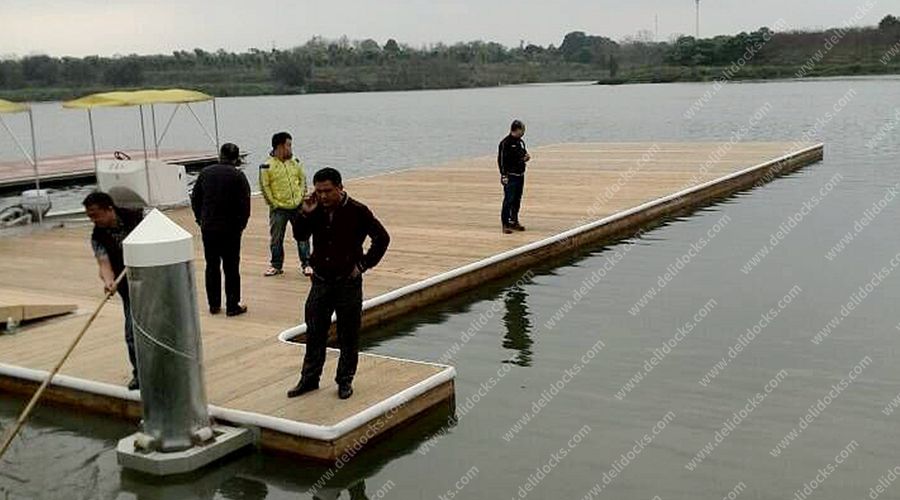
1. Core Structural Architecture of a Sea Pen Floating Dock
Unlike conventional floating docks, a sea pen floating dock must incorporate both vessel berthing capacity and aquatic livestock containment. This leads to a hybrid configuration where modular floatation units, galvanized steel walkways, and high-tensile netting or rigid mesh pens work in unison. Three primary subsystems define durability:
Buoyancy & stability cells: Typically rotationally molded HDPE (high-density polyethylene) or closed-cell concrete floats providing reserve buoyancy exceeding 35% under full operational load.
Pen containment framework: Hot-dip galvanized steel or marine-grade aluminum frames supporting predator nets and anti-escape mesh. Frame spacing calculated for current velocities up to 1.5 m/s.
Mooring & anchoring array: Combined deadweight anchors, helical screw piles, or gravity anchors with high-elasticity polyamide lines to manage tidal ranges and storm surge.
To illustrate real-world adaptability, DeFever has engineered modular aquaculture pen systems that allow rapid reconfiguration from 500 m² nursery pens to 2,500 m² grow-out enclosures. This flexibility directly reduces capital expenses for operators managing multi-species production cycles.
2. Environmental Load Engineering and Advanced Material Selection
Marine structures face combined loads: waves, currents, biofouling, and UV degradation. For a sea pen floating dock, fatigue from cyclic mooring tension and net drag necessitates rigorous finite element analysis (FEA). Based on ISO 19901-7 and ASCE 7-22 standards, designers incorporate:
Wave attenuation receptors: Integrated floating breakwater elements (concrete or polymer) that reduce incident wave height by 40-60% before reaching fish stocks.
Corrosion protection: Sacrificial anodes (zinc/aluminum), epoxy-coated reinforcement, and duplex stainless steel hardware for high salinity or brackish conditions.
Anti-fouling strategies: Copper-free antifouling coatings on submerged surfaces, combined with periodic automated brush cleaning systems to maintain hydrodynamic efficiency.
Field data from North Sea installations indicate that a properly protected sea pen floating dock achieves a service life exceeding 25 years when using HDPE flotation with cathodic protection. DeFever applies these standards across tropical and sub-Arctic environments, with documented 30% lower maintenance frequency compared to industry baselines.
3. High-Impact Applications: Marinas, Offshore Aquaculture, and Service Hubs
The adaptability of a sea pen floating dock supports three primary revenue-generating models for B2B clients:
3.1 Integrated Marina & Fish Farming
Co-locating sport-fishing marinas with on-site sea pen grow-out allows restaurants and fish markets to source directly from the dock. This reduces transport emissions and ensures traceability. Design includes dedicated work floats with hydraulic net lifters and oxygen injection points.
3.2 Hatchery & Nursery Support Platforms
For salmon, seabass, or amberjack production, floating pens require precise water exchange. Deploying a sea pen floating dock with adjustable depth net cages and integrated water quality sensors (DO, pH, salinity) improves juvenile survival rates. Data loggers can be linked to shore-based SCADA systems.
3.3 Superyacht Maintenance & Clean Energy Integration
Hybrid floating docks now combine repair berths with tidal or solar power generation. The robust deck load capacity (up to 10 kN/m²) of a sea pen floating dock supports mobile cranes and technicians while using sub-surface pens for on-site live seafood storage for yacht provisioning.
For detailed project references, explore floating breakwater integrations and custom pen designs successfully deployed in Mediterranean, Southeast Asian, and Caribbean ports.
4. Installation Methodologies and Lifecycle Asset Management
Precision installation determines long-term performance. A professional deployment of a sea pen floating dock follows five phases:
Site survey & geotechnical analysis: Seabed composition, current profiling, and fetch calculation to determine anchor type (drag embedment, pile, or gravity).
Pre-assembly in dry dock or sheltered bay: All floatation units, walkways, net cages, and mooring components are fitted and tested for buoyancy and stability.
Towing & positioning: Use of tug vessels with dynamic positioning to align mooring grid points within ±0.1 m tolerance.
Mooring line tensioning & load testing: Hydraulic tensioners apply proof loads to 125% of design working load; all chain links and shackles certified to EN 818 or equivalent.
Commissioning & biological certification: Net integrity tests, anti-predator barrier checks, and fish-stocking approvals from local maritime authorities.
Post-installation, a digital twin of the sea pen floating dock can be built using IoT sensors to monitor mooring tension, inclination, and net deformation. Predictive maintenance algorithms reduce unplanned downtime by 22-28% as verified in Norwegian aquaculture clusters. DeFever offers remote condition monitoring as part of its lifecycle service agreements, ensuring maximum operational availability.
5. Engineering Excellence with DeFever: Customization & Global Standards
For B2B clients requiring site-specific engineering, DeFever delivers full-cycle design, fabrication, and installation management for marine infrastructure. Our in-house naval architects and marine biologists collaborate to optimize:
Species-specific net cage configurations (salmon, cobia, groupers, shellfish).
Seismic load resilience for earthquake-prone zones (ISO 19901-2).
Integration with automated feeding barges, underwater ROV inspection tracks, and biomass estimation systems.
Compliance with EU Organic Aquaculture Regulation (EC 834/2007) or BAP certification requirements.
From concept to commissioning, every sea pen floating dock project undergoes third-party class verification (ABS, DNV, or Lloyd's Register) upon request. Our reference library of modular aquaculture platforms illustrates bespoke solutions for high-current sites, extreme tidal ranges, and environmentally sensitive habitats.
Frequently Asked Questions (FAQ) on Sea Pen Floating Dock Systems
Q1: What is the typical load capacity for a sea pen floating dock
used for both fish farming and vessel berthing?
A1: Engineering standards specify distributed live loads of 5–10 kN/m² for working
decks. For fish pen areas, static net and stock loads often add 30–80 kg/m²
depending on species density. Our designs incorporate modular buoyancy cells
that allow load redistribution; a typical 20 m × 15 m unit can support 12 tonnes
of live fish plus 1.5 tonnes of feeding equipment and occasional light vehicle
traffic.
Q2: How does a sea pen floating dock resist storm surge and
hurricane-force waves?
A2: Key factors include: (1)
Low-profile HDPE floats that reduce windage; (2) Mooring systems with
energy-absorbing elastomeric springs or nylon jacketed chains; (3) Deployment of
wave-damping skirts on the windward side. For Category 4 hurricane zones, we
utilize concrete pontoon cores and pre-tensioned anchor piles with proof load up
to 250 kN. Post-storm inspections can be carried out within 48 hours using
integrated sensors.
Q3: What corrosion protection standards are applied to steel
components of a sea pen floating dock?
A3: Steelwork follows ISO 12944-5 C5-M (very high marine corrosivity). Typical
coating systems include thermally sprayed aluminum (TSA) 200 µm + sealer, or
three-layer epoxy (350 µm DFT). All fasteners are grade 316 L stainless steel or
HCR (high corrosion resistant) duplex. Sacrificial anodes are calculated
according to DNV-RP-B401, replaced every 5–8 years depending on water
salinity.
Q4: Can a sea pen floating dock be relocated to a different site
after initial installation?
A4: Yes, if designed
with demountable connections (bolted frames, quick-release mooring links).
Relocation consists of draining pen nets, detaching mooring lines, and towing
the entire structure at low speed (<3 knots) during calm sea states. We offer
“semi-portable” models for research stations or rotational fallowing sites.
Dismantling and re-erection typically requires two weeks of offshore crane and
dive team support.
Q5: What are the environmental permitting challenges for installing a
sea pen floating dock in protected coastal
zones?
A5: Regulatory hurdles often include benthic
impact assessments (organic waste dispersion modeling), noise propagation
studies during pile driving (if using driven anchors), and visual impact
analysis. Solutions include using gravity anchors that avoid seabed penetration,
installing micro-perforated netting to reduce plankton escape, and adopting LED
illumination that minimizes disruption to nocturnal species. Our consultancy
team prepares complete EIA reports aligned with World Bank/IFC performance
standards.
Request Technical Consultation or Quotation
Every marine environment presents unique constraints—current velocity, ice formation risk, biofouling pressure, and logistical access. To discuss your specific sea pen floating dock requirements, including performance specifications, budgetary estimates, and project timelines, contact the engineering division at DeFever directly. Our team provides comprehensive proposals with 3D structural drawings, mooring analysis reports, and life-cycle cost projections.
Send your inquiry now — Provide details of your site location, water depth, target species or operational tonnage, and local environmental conditions. We will respond within two business days with a preliminary feasibility assessment and a customized engineering questionnaire.
Submit your B2B inquiry here (link to official contact page) — or email directly at deli@delidocks.com. For urgent project tenders, include your expected delivery window and certification requirements.