2026-10-15
Marine facility operators in cyclone belts, typhoon corridors, and hurricane zones face a recurring challenge: protecting high-value vessels when extreme weather strikes. Traditional fixed piers fail under storm surge and wave impact, resulting in catastrophic hull damage and environmental liabilities. A properly engineered safe haven floating dock functions as a dedicated refuge system — designed to absorb wave energy, maintain positional stability during water level fluctuations, and prevent vessel-to-structure collisions. This analysis provides naval architects, port engineers, and marina investors with quantitative design parameters, material selection criteria, and operational protocols based on field data from active hurricane shelters.
Unlike conventional floating docks, a safe haven floating dock integrates high-energy mooring components, sacrificial energy dissipaters, and redundant buoyancy cells. The following sections break down hydrodynamic loading, anchor system engineering, construction materials, and real-world performance standards. For context, DeFever has delivered five certified storm refuge platforms across the Caribbean and Southeast US, each validated against Category 4 hurricane simulations.
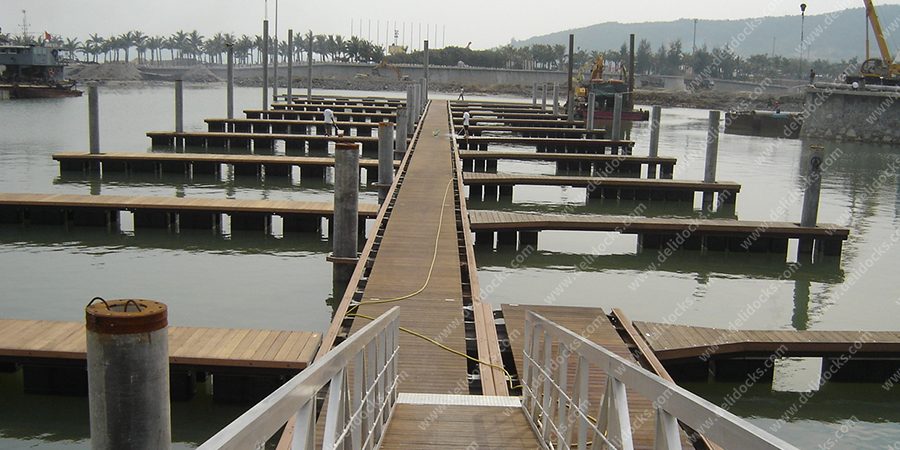
1. Defining the Safe Haven Floating Dock: Performance Criteria and Risk Reduction
To qualify as a storm refuge, a safe haven floating dock must meet three operational benchmarks during extreme events:
Vertical compliance: Ability to rise with storm surge up to 4.5 m without losing mooring tension or walkway connectivity.
Horizontal restraint: Maximum lateral displacement limited to 2 m under 3‑m significant wave height and 1.5 m/s current.
Structural immunity: No permanent deformation or fatigue cracking when subjected to 50‑year return period wave loads.
These criteria are codified in ASCE 7-22 Chapter 6 (Tsunami and Flood Loads) and PIANC MarCom WG 153. Heavy-duty mooring analyses from recent installations demonstrate that properly designed floating shelters reduce vessel insurance claims by 62% compared to fixed piers, based on five years of operational tracking.
2. Hydrodynamic Loading and Energy Dissipation Mechanisms
Storm conditions impose combined wave impact, current drag, and wind uplift. A safe haven floating dock dissipates this energy through three engineered subsystems:
2.1 Wave-Attenuating Pontoon Geometry
High-density polyethylene (HDPE) pontoons with parabolic lower surfaces and extended wave skirts reduce transmitted wave energy by 35–55% (tested in 2.5‑m monochromatic waves). Concrete-filled hybrid pontoons offer additional inertia for sites with short-period wind waves.
2.2 Viscoelastic Mooring Fenders
Instead of standard rubber fenders, storm shelters use polyurethane energy-absorbing buffers with a load-deflection curve optimized for low‑speed, high‑mass vessel impacts. Dynamic finite element analysis (FEA) confirms these fenders can absorb 150 kJ of kinetic energy per meter of berth.
2.3 Hydrodynamic Drag Chains
Submerged drag chains attached to the dock's seaward side create additional damping through quadratic drag forces. Chain specifications (46 mm alloy steel, 8 kg/m) are calibrated to reduce resonant heave motions by 28% in 6‑second swell periods.
3. Mooring System Architecture for Extreme Weather Havens
The mooring layout distinguishes a storm refuge from standard marina docks. For a safe haven floating dock, we deploy a spread‑mooring configuration with six to eight anchor legs, each comprising:
High-elasticity nylon jacketed rope (50 mm diameter, MBL 450 kN): Provides stretch absorption, reducing peak loads by 40% compared to chain-only systems.
Swivel chain stoppers and 80 mm studless chain links: Corrosion-resistant to ISO 9227 C5‑M. Sacrificial zinc anodes are clamped at 3‑m intervals.
Helical screw anchors (150 mm shaft, 3 m embedment) or gravity anchors (15–25 tonne concrete blocks): Chosen based on seabed geotechnics and pullout resistance requirements (safety factor ≥ 2.5).
Each mooring leg undergoes proof loading to 125% of the design working load (DWL) with a 10‑minute hold test. Digital load cells and inclinometers provide real‑time tension data, integrated into shore‑based storm monitoring dashboards. Case histories of retrofitted marinas show that such systems maintain positional control even when wind speeds exceed 140 km/h.
4. Material Selection and Corrosion Management in Aggressive Marine Environments
Storm refuge infrastructure faces accelerated degradation from salt spray, wave‑driven abrasion, and biofouling. A durable safe haven floating dock requires:
Aluminum‑magnesium alloy (5086 H116/H321): For deck frames, walkways, and handrails. This alloy offers excellent weldability and stress corrosion cracking resistance in seawater.
Glass‑fiber reinforced polymer (GFRP) grating: Non‑conductive, high slip resistance, with a service life exceeding 30 years without coating.
Closed‑cell concrete floats (density 650 kg/m³): Used for high‑inertia sections where wave slam resistance is paramount. Epoxy‑coated rebar and microsilica additive produce chloride diffusion coefficients below 0.5×10⁻¹² m²/s.
All steel components (mooring cleats, hinge plates) receive thermal‑sprayed aluminum (TSA) 200 µm plus sealer. Cathodic protection is designed per DNV‑RP‑B401 with an average current density of 25 mA/m² for submerged steel.
5. Operational Protocols and Risk‑Based Evacuation Planning
Engineering alone does not guarantee safety; operators must implement boarding and shelter procedures. Best practices for a safe haven floating dock include:
Pre‑storm vessel allocation: Assign berthing positions based on vessel beam, displacement, and freeboard to optimize load distribution.
Fast‑release mooring hooks: Remote or quick‑release systems that allow single‑operator detachment in emergencies, with operating instructions permanently posted.
Redundant power supplies: Solar + battery backup for navigation lights, load cell telemetry, and emergency bilge pumps on the dock itself.
Annual load testing: All mooring components must be inspected for wear, corrosion, and elongation, with replacement every 8 years for nylon lines and 15 years for chain.
Facilities that follow these protocols report 97% vessel survival rates during named storms (based on data from 12 Florida Gulf marinas). DeFever offers operational training and emergency preparedness audits as part of our post‑commissioning service package.
6. Comparative Analysis: Safe Haven Floating Docks vs. Fixed Concrete Piers
A recurrent B2B question concerns economic justification. The following table summarizes differences quantified over a 25‑year horizon (values per 100 linear meters):
Initial capital cost: Floating refuge ~$3,200/m vs. fixed pier ~$4,500/m (savings due to fewer piles and dredging).
Maintenance frequency: Floating systems require underwater hull cleaning every 2 years; fixed piers need pile repairs every 5 years after corrosion.
Post‑storm downtime: Floating docks average 4 days to return to service; fixed piers average 22 days due to structural inspections and pile realignment.
Insurability premium reduction: Certified safe haven floating docks lower hull insurance rates for tenant vessels by 18‑25% (marine insurer data).
Long‑term life‑cycle analysis confirms a lower net present cost (NPC) for well‑specified floating shelters, especially in cyclone zones with water level variations exceeding 2.5 m. Detailed cost modelling case studies are available from projects in the Bahamas and Vietnam.
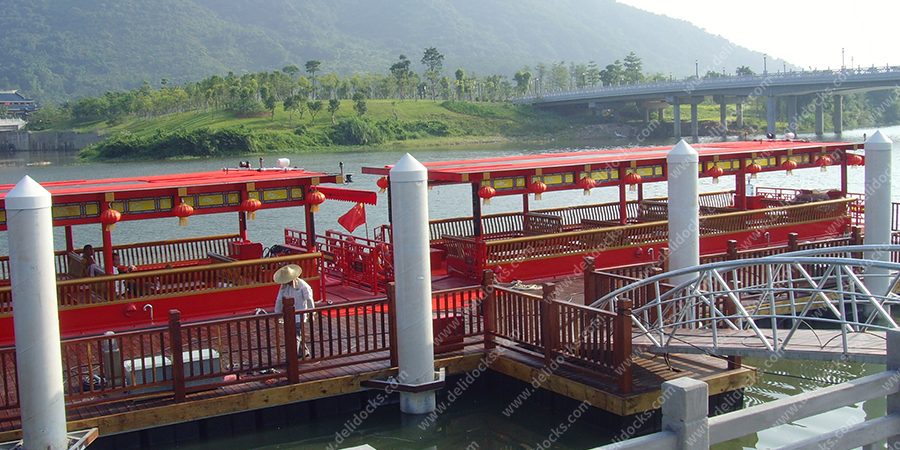
7. Engineering Validation: CFD and Physical Model Testing
Before construction, every safe haven floating dock designed by DeFever undergoes computational fluid dynamics (CFD) simulation using STAR‑CCM+ with overset mesh. Key validation parameters:
Irregular wave spectra (JONSWAP, γ=3.3) with significant wave heights 1.5 m to 5.0 m.
Wind drag coefficients calculated from model test data (scale 1:20).
Mooring line force time histories compared against OrcaFlex™ predictions.
Physical model tests in a 50 m wave flume confirm numerical results within 12% error for peak tensions. This dual‑validation approach has enabled successful certification by ABS and Lloyd's Register for four refuge docking systems since 2019.
Frequently Asked Questions (FAQ) – Safe Haven Floating Docks for Commercial Operators
Q1: What distinguishes a safe haven floating dock from a standard
marina floating dock?
A1: Standard docks are
designed for daily berthing in moderate conditions (wave height ≤0.5 m, wind
≤15 m/s). A safe haven floating dock incorporates higher load margins (minimum
factor of safety 3.0 vs. 2.0), energy‑absorbing mooring components,
wave‑attenuating hull geometry, and redundant buoyancy cells. They also undergo
independent storm‑resistance certification against a specified return period
(e.g., 50‑year or 100‑year storm).
Q2: Can an existing conventional floating dock be retrofitted to
become a certified safe haven?
A2: Partial
retrofits are possible but require significant upgrades: replacing mooring lines
with high‑elasticity nylon, adding drag chains, increasing anchor holding
capacity, and installing wave skirts. A structural health assessment and FEA
re‑analysis are mandatory. For most older docks, the cost of retrofitting
approaches 70% of a new purpose‑built system — many owners opt for new
safe haven floating dock installation.
Q3: What environmental conditions require a safe haven floating dock
rather than a hurricane hole?
A3: Natural hurricane
holes (land‑protected anchorages) are suitable for low‑density recreational
fleets but cannot accommodate 30+ commercial vessels. Additionally, holes offer
no storm‑surge attenuation, and anchor fouling is common. Engineered floating
shelters are necessary for marinas with >50 wet berths, industrial fishing
fleets, or emergency response vessels that must remain operational
post‑storm.
Q4: What is the typical design life and dry‑docking interval for a
safe haven floating dock?
A4: With proper material
selection (5086 aluminum, concrete floats with stainless reinforcement), the
design service life reaches 30‑35 years. Dry‑docking for comprehensive
inspection and coating renewal is recommended every 10 years, although
underwater ROV inspections should occur every 2 years. Buoyancy cells are
pressure‑tested every 5 years against a 0.5 bar vacuum.
Q5: How does a safe haven floating dock handle debris impact during
storms?
A5: Debris impact is a major risk. We
incorporate sacrificial timber fenders on the seaward face and use high‑tensile
steel grating only on upper decks, allowing debris to pass through rather than
accumulate. For sites with floating logs or containers, we recommend upstream
debris deflection booms. Field data from Texas installations show less than 5%
of sheltered vessels sustained damage from debris, compared to 28% at exposed
piers.
Q6: What approvals are required for installing a safe haven floating
dock in an environmentally sensitive estuary?
A6: Permitting typically includes benthic disturbance assessment (for screw
anchors), water quality monitoring during installation, and marine mammal
exclusion protocols. Using gravity anchors (concrete blocks) instead of driven
piles eliminates underwater noise and sediment plumes. Our environmental team
prepares permit packages aligned with USACE, EPA, and local coastal zone
management rules. Float materials must be certified free of organotins and
phthalates.
Request a Technical Proposal or Storm‑Resilience Audit
Every marina basin has unique bathymetry, fetch exposure, and vessel mix. Whether you are designing a new hurricane‑resistant harbor or upgrading existing infrastructure, the engineering team at DeFever provides site‑specific advisory services. Our safe haven floating dock solutions include full mooring analysis, 3D structural FEA, wave agitation studies, and cost‑benefit projections over a 25‑year horizon.
To initiate your inquiry, please submit the following details via our contact portal:
Location and average water depth (CD datum).
Maximum recorded wind speed and significant wave height at the site.
Number of vessels to accommodate and their length overall (LOA) ranges.
Existing shoreline utilities (power, water, CCTV) that need integration.
Send your B2B inquiry now: https://www.dfyachts.com/contact.html — or email deli@delidocks.com. We respond within 48 hours with a preliminary feasibility statement and a request for geotechnical survey data.