2026-10-15
Unlike fixed structures, a floating pier responds dynamically to water level fluctuations, wave action, and vessel loads. Its design integrates naval architecture, geotechnical engineering, and material science to ensure safe and durable operation in challenging marine conditions. This article examines the engineering principles behind modern floating pier systems, with a focus on high‑capacity terminals, exposed waterfronts, and environmentally sensitive sites. Drawing on decades of marine structure expertise, DeFever provides a framework for specifying, designing, and maintaining these complex assets.
1. Floating pier vs. fixed pier: when to choose a floating solution
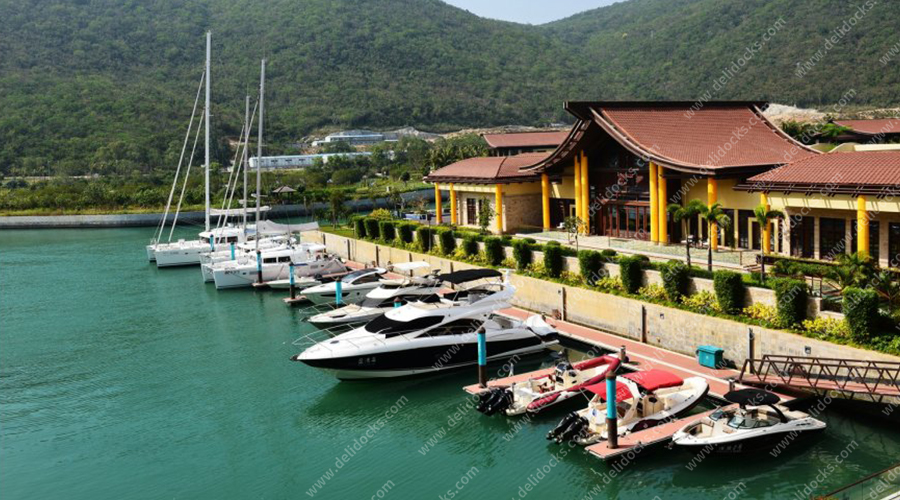
The decision to adopt a floating pier is driven by water depth, tidal range, and seabed conditions. Fixed piers become prohibitively expensive in depths >10 m, require pile driving (which may be restricted near coral or archaeological sites), and cannot accommodate large vertical water level variations. In contrast, a floating pier rests on the water surface, supported by buoyancy modules, and is held in place by guide piles or mooring chains. Typical applications include:
Deep‑water ferry terminals (water depth 15‑30 m).
Marinas in macro‑tidal regions (tidal range >6 m).
Temporary or seasonal installations (e.g., event piers, fishing platforms).
Eco‑sensitive shorelines where dredging or piling is prohibited.
LSI terms: pile‑guided pontoon, free‑floating structure, tidal compensation, eco‑mooring. The choice also affects vessel transfer: gangway slopes must remain within ±12 % for accessibility, a requirement that dictates the length of the access bridge.
2. Core components of a floating pier system
A modern floating pier consists of three integrated subsystems: the flotation units, the deck structure, and the restraint/mooring system. Each must be engineered for the specific wave climate, water chemistry, and operational loads.
2.1 Buoyancy elements
Flotation can be achieved with:
Reinforced concrete pontoons – preferred for permanent piers due to durability and ballast stability. Typical density 2.5 t/m³, with hollow cells providing buoyancy. Concrete grades C35/45 with air‑entrainment for freeze‑thaw resistance.
Steel hulls – used for very large piers (e.g., floating docks for ship repair) but require strict corrosion protection (epoxy + sacrificial anodes).
Rotomolded polyethylene (HDPE) – modular, lightweight, and UV‑stabilised. Suitable for pedestrian piers and wave attenuators.
Composite sandwich panels – gaining traction for military floating piers where weight is critical.
Buoyancy reserve is calculated as (total displaced volume – weight of structure) / total displaced volume. Industry standards (BS 6349, PIANC) recommend a minimum reserve of 35 % for passenger piers and 50 % for ferry terminals to accommodate wave crests and overload.
2.2 Deck and superstructure
The deck transfers live loads (pedestrians, vehicles, mooring forces) to the flotation units. Materials include:
Cast‑in‑place or prestressed concrete – high mass reduces wave‑induced accelerations.
Aluminium trusses (welded 5083‑H116) – used for long spans and low draft.
Steel grating – for industrial piers requiring high drainage.
Deck surfaces need high slip resistance (R12 or above) and may incorporate utility conduits (power, water, data). DeFever specifies integral raceways within concrete decks to avoid external cable trays that can be damaged by vessels.
2.3 Restraint and mooring systems
A floating pier must resist wind, current, and wave drift forces while allowing vertical movement. Common solutions:
Vertical guide piles – steel or concrete piles pass through guides attached to the pier. Low‑friction pads (HDPE, bronze) reduce wear. Suitable for tidal ranges up to 10 m.
Chain or cable moorings – catenary or taut‑line systems allow the pier to swing with wind/current. Used in open water where piles are not feasible.
Spud poles – retractable vertical poles that rest on the seabed; used for temporary piers.
The design horizontal load typically includes 1‑kn current + 30‑m/s wind + berthing impact of a 200‑tonne vessel at 0.3 m/s. Dynamic amplification factors (DAF) are applied based on natural period analysis.
3. Hydrodynamic performance and wave response
A floating pier behaves as a rigid body with six degrees of freedom. For serviceability, vertical accelerations must not exceed 0.2g for passenger comfort, and relative motion between pier and vessel should be<0.5 m="" to="" enable="" safe="" boarding.="" engineers="" use="" diffraction="">
Perforated breakwater skirts attached to the pier.
Offshore floating breakwaters that reduce incident wave height.
Tuning the pier’s natural period away from dominant wave periods (typically 3‑8 s).
Case data from a ferry floating pier in the Shetland Islands (designed by DeFever) showed that a concrete pontoon with 40 % porosity side skirts reduced wave transmission by 60 %, allowing year‑round operation in 1.5 m significant wave height.
4. Material durability in marine environments
Corrosion and biofouling are the primary life‑cycle cost drivers. For steel components, hot‑dip galvanising (minimum 85 µm) plus three‑coat epoxy is recommended. Aluminium 5083‑H116 is self‑passivating but must be insulated from dissimilar metals. Concrete durability requires:
Low water/cement ratio (
<0.40).<>Cover to reinforcement ≥ 60 mm in splash zone.
Use of stainless steel or epoxy‑coated rebar in critical areas.
HDPE floats are immune to corrosion but can suffer UV degradation; carbon black stabilisation ensures >25‑year life. Antifouling coatings on submerged surfaces reduce drag and weight gain. Recent projects by DeFever have incorporated copper‑nickel sheathing on guide piles to prevent marine growth without biocides.
5. Installation and constructability
Floating piers are often prefabricated off‑site and towed to location, reducing in‑water work and environmental impact. Sections are typically 15‑30 m long, joined by flexible connections (rubber bumpers or hinges) that accommodate wave‑induced rotation. Ballasting is adjusted on‑site to achieve design freeboard. For a recent 300‑m floating pier in Dubai, the entire structure was installed in 10 days using GPS‑guided tugs, compared to 6 months for a piled alternative.
6. Environmental considerations and permitting
Because a floating pier does not require dredging or extensive pile driving, it often faces fewer regulatory hurdles in sensitive ecosystems. The footprint on the seabed is limited to anchor points or guide piles. Some designs incorporate artificial reef elements underneath the pier to enhance marine habitat. Water circulation under the pier is maintained, preventing stagnation – a key advantage over solid fill structures.
7. Industry standards and design codes
Internationally, floating pier design follows ISO 21650 (actions from waves and currents), ISO 13005 (marina design), and national codes like AS 3962 (Australia) or BS 6349 (UK). For passenger safety, access gangways must meet ADA/SIA requirements (maximum slope 1:12). Load combinations include 100‑year storm events, accidental mooring failure, and seismic loads in active zones.
8. Case study: DeFever’s modular floating pier for a remote island terminal
In 2021, floating pier technology was deployed for a new roll‑on/roll‑off (RoRo) terminal in the Maldives, where coral protection prohibited any dredging. DeFever engineered a 120 m long, 18 m wide concrete floating pier supported by 44 prestressed concrete pontoons. The design included a stern loading ramp that adjusted to vessel trim variations. After two years of monitoring, the pier showed zero differential settlement, and wave‑induced motions were within 0.1 m vertical during monsoon swells. This performance validated the numerical models and highlighted the resilience of properly engineered floating systems.
Frequently Asked Questions About Floating Piers
Q1: What is the typical design life of a floating pier?
A1: With proper material selection and maintenance, concrete floating piers often achieve 40‑50 years. Steel and aluminium structures can last 30‑40 years if corrosion protection is maintained. HDPE floats generally require replacement after 25‑30 years.
Q2: How does a floating pier withstand hurricanes or cyclones?
A2: During extreme events, the pier is designed to survive while submerged or overtopped. Guide piles are long enough to prevent the pier from floating off. Mooring chains may be pre‑tensioned to limit surge. Some floating piers are designed to be towed to a sheltered location before a storm. The key is ensuring that all connections can withstand the loads without brittle failure.
Q3: Can a floating pier be used for heavy vehicles (e.g., fire trucks, forklifts)?
A3: Yes. Commercial floating piers are designed for vehicle loads up to 30‑tonne axle loads. Concrete decks with high reinforcement ratios are used, and the pontoons are sized to provide adequate buoyancy reserve. DeFever has delivered piers supporting 70‑tonne mobile cranes for shipyard applications.
Q4: What maintenance does a floating pier require?
A4: Routine inspections (annual) of mooring hardware, anodes, and utility connections. Every 5 years, a dry‑dock or diver inspection of hull/pontoon condition. Deck coatings may need renewal every 10‑15 years. Biofouling on submerged surfaces may be cleaned every 2‑3 years depending on location.
Q5: How much does a floating pier cost compared to a fixed pier?
A5: In shallow water (<5 m="">10 m) or poor soil, floating piers are often 20‑40 % less expensive to install. Life‑cycle costs favour floating piers when relocation or environmental mitigation is factored in. A detailed cost‑benefit analysis should include installation time, maintenance, and operational flexibility.
Q6: Are floating piers safe for passengers with disabilities?
A6: Yes. The gangway connecting the shore to the pier is designed with a maximum slope (usually 1:12) and often includes lifting platforms for extreme tidal ranges. Handrails, non‑slip surfaces, and level deck areas are provided. Modern designs comply with universal accessibility codes.
Q7: Can a floating pier be expanded later?
A7: Modular floating piers are inherently expandable. New sections can be added at the end or alongside, provided the mooring system is designed for future extension. This is a major advantage for growing ports or marinas.
In summary, the floating pier is a sophisticated engineering solution that offers unparalleled adaptability to water level changes and environmental constraints. By understanding the principles outlined above—buoyancy, restraint, material durability, and dynamic response—engineers and owners can specify systems that deliver safe, low‑maintenance, and long‑lasting waterfront infrastructure. With expertise from firms like DeFever, the floating pier continues to evolve as the preferred choice for challenging marine environments.