2026-10-15
Selecting the right floating pontoon dock is a multidisciplinary decision — naval architecture meets material science, hydrodynamics, and long‑term operational planning. Modern marinas, ferry terminals, and private waterfront developments demand structures that withstand variable water levels, heavy vessel loads, and corrosive environments while remaining user‑friendly and compliant with environmental regulations. This article examines the engineering principles, application scenarios, and industry‑proven solutions that define today’s most reliable floating pontoon dock installations, with insights from DeFever’s decades of marine engineering experience.
1. Understanding floating pontoon dock technology
Key components and material selection
A floating pontoon dock consists of three primary subsystems: the buoyancy element (pontoons), the deck and superstructure, and the mooring/restraint system. Engineers specify materials based on water chemistry, ice load, and expected traffic. Common options include:
Reinforced concrete pontoons: Preferred for permanent marinas due to ballast stability and low maintenance. Typical densities allow 300–500 kg/m² live load capacity.
Rotomolded polyethylene (HDPE): Lightweight, UV‑stabilised, and modular. Often used for seasonal or residential applications.
Welded aluminium frameworks: Offer highest strength‑to‑weight ratio; ideal for exposed sites with wave action. Aluminium 5083‑H116 is the marine standard.
Advanced floating dock systems integrate utility conduits (fresh water, shore power, data) inside the structure. Deck surfaces can be timber, composite, or polymer‑coated for slip resistance. DeFever specifies hybrid aluminium‑concrete designs where wave heights exceed 0.5 m, ensuring decades of fatigue resistance.
Buoyancy and stability calculations
Stability of a floating pontoon dock is governed by Archimedes’ principle and metacentric height (GM). For every linear metre, engineers calculate:
Displaced volume at design freeboard (typically 300–450 mm).
Moment to trim 1° – critical when a 10 t forklift moves onto the dock.
Reserve buoyancy: minimum 35% for commercial marinas (ISO 13005).
Modern CFD modelling helps predict dynamic response under passing vessels. Wave attenuation can be improved by perforated skirts or wave‑dissipating pontoons. These technical choices directly affect the longevity of the entire marina infrastructure.
2. Applications across different waterfront environments
High‑traffic recreational marinas
Marinas with 300+ berths require floating pontoon dock layouts that maximise space while allowing safe manoeuvring. Finger piers of 3–4 m length, combined with main walkways of 2.5–3 m width, are typical. LSI terms: berthing capacity, cleat spacing, mooring loads, gangway slope. The dock must accommodate peak seasonal loads – up to 5 kN/m² for congregation areas. In the Mediterranean and SE Asia, concrete floating docks with rubber fenders dominate because of their durability against UV and accidental impact.
Exposed waterfronts and tidal ranges
Locations with tidal variations >4 m (e.g. Bay of Fundy, UK estuaries) demand robust guide‑pile systems. Here, the floating pontoon dock rises and falls on steel or concrete piles with roller guides. Engineers at DeFever have developed low‑friction HDPE guides that eliminate galvanic corrosion while ensuring smooth vertical travel. In such projects, the total horizontal wind and current load can exceed 20 kN per pile, requiring finite‑element analysis of the entire docking system.
Specialised uses: ferry terminals and industrial ports
Passenger ferry landings require floating pontoons that adjust to varying freeboard of vessels. Heavy‑duty rubber keel pads and quick‑mooring hooks are integrated. Industrial applications include floating platforms for fishing fleets or bulk material transfer. These installations often use concrete pontoons post‑tensioned to 5–8 MPa to withstand point loads from cranes. The term floating breakwater is sometimes used when the structure also serves wave attenuation.
3. Industry challenges and engineering solutions
Water level fluctuations and extreme weather
Climate change increases the frequency of storm surges and droughts. A fixed‑pile floating pontoon dock must accommodate extreme low water (ELW) and extreme high water (EHW) without grounding or over‑stressing the mooring components. Designers now incorporate longer pile stalks (up to 12 m) and telescopic gangways. Polyurethane bumpers with 50 % compression capacity reduce impact forces during storms. Data from hurricane‑prone marinas (Florida, Gulf of Mexico) show that double‑guided pile systems reduce failure rates by 80 % compared to single‑guide designs.
Longevity in saltwater and brackish environments
Corrosion remains the primary lifecycle cost driver. For steel components, hot‑dip galvanisation (minimum 85 µm) plus epoxy topcoats are standard. Aluminium pontoons benefit from isolation from concrete using rubber gaskets to prevent crevice corrosion. In the Middle East, where salinity and temperature are extreme, floating pontoon dock manufacturers increasingly turn to fibre‑reinforced polymer (FRP) rebar in concrete elements. A 2022 study by PIANC found that well‑specified concrete floating docks have a service life exceeding 40 years, compared to 15–20 years for early HDPE systems.
Environmental compliance and sustainability
Modern marina projects must meet stringent water quality regulations. Floating docks can be designed with openings that allow sunlight penetration, promoting seagrass growth underneath. Some specifications now require “clean marina” certifications that mandate no leaching of antifouling paints. Eco‑friendly materials like recycled HDPE and low‑carbon concrete are gaining traction. Additionally, the floating pontoon dock layout should minimise shadowing and allow water circulation to prevent stagnation.
4. DeFever’s approach to robust floating pontoon dock systems
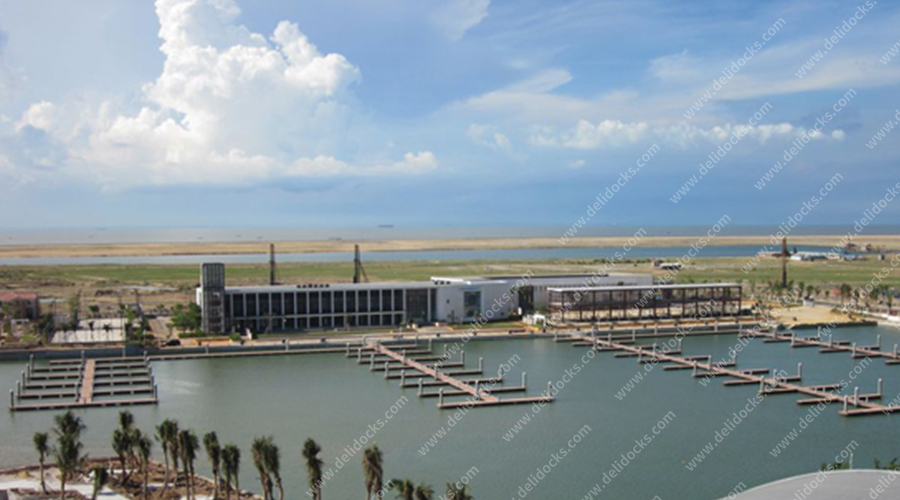
With over six decades of marine architecture, DeFever applies a systems‑engineering methodology to every dock project. Their team combines on‑site hydrographic surveys, vessel traffic analysis, and finite‑element modelling to deliver customised solutions. A signature project is the 350‑berth Marina Al Bahr in the Arabian Gulf, where floating pontoon dock sections were precast with integral raceways for chilled water lines. The docks incorporate self‑adjusting mooring cleats that reduce line chafe by 40 %. DeFever’s specification documents often exceed ISO 13005 and AS 3962, giving clients confidence in extreme conditions.
5. Case studies and performance data
Independent monitoring of a floating pontoon dock installed in 2014 (Victoria, Canada) showed zero structural defects after 8 years. The dock, designed for 250 vessels up to 18 m LOA, experienced 12 storm events with winds >70 knots. Key performance metrics:
Freeboard variation < 50 mm under full berthing load.
Mooring pile deflection < 1:150 under 30‑kn current.
Utility uptime 99.7 % due to IP68 junction boxes.
Such data reinforce the importance of selecting a qualified engineering partner. Another project in Tokyo Bay used a hybrid aluminium‑concrete system to reduce seismic mass while maintaining rigidity – an approach pioneered by DeFever engineers.
Frequently Asked Questions About Floating Pontoon Docks
Q1: What is the typical lifespan of a commercial floating pontoon dock?
A1: With proper material selection and maintenance, concrete floating docks often exceed 40 years. Aluminium/HDPE systems can last 25–30 years, though sacrificial anodes and deck replacements may be needed every 15–20 years depending on environment.
Q2: How does a floating pontoon dock handle ice formation?
A2: In regions with ice, engineers specify ice‑resistant concrete (air‑entrained, 35 MPa minimum) and rounded pontoon edges to reduce ice crushing. Air‑bubbler systems can be installed to prevent ice buildup, but they increase operational costs. Some northern marinas use removable docks or ice‑recess areas.
Q3: Can floating pontoons be installed in protected historical or ecologically sensitive areas?
A3: Yes. Modern installation methods use spud piles or helical anchors that minimise seabed disturbance. Docks can be designed with grated sections to allow light penetration. Environmental impact assessments (EIA) are mandatory, and many projects achieve “low impact” certification.
Q4: What maintenance does a floating pontoon dock require?
A4: Routine tasks include checking mooring hardware torque (every 6 months), cleaning utility penetrations, and inspecting flotation units for water ingress. Every 2‑3 years, a diver should inspect submerged pile guides and anodes. Timber decks may need recoating; concrete surfaces generally only require pressure washing.
Q5: How do I calculate the required size of a floating pontoon dock for my marina?
A5: Sizing depends on vessel mix, turning radii, and local regulations. A common rule: main walkways width = 1.2 × (longest tender length) but not less than 2.0 m. Finger piers length = 0.75 × average vessel LOA. Berthing pockets need width = vessel beam + 1.5 m. Detailed layout should be performed by a marine engineer using berth occupancy simulations.
Q6: Are there specific certifications for floating dock materials?
A6: Yes. For concrete, ASTM C39 (compressive strength) and ASTM C642 (density/absorption) are standard. Aluminium should meet ASTM B928 for marine grade. HDPE floats require UV stabilisers and testing per ASTM D1505. International standards: ISO 21650 (actions from waves/currents) and ISO 13005 (marina design).
Q7: What is the cost difference between concrete and HDPE floating pontoon docks?
A7: Initial material costs for HDPE are typically 20‑30 % lower, but concrete offers lower whole‑of‑life costs due to minimal maintenance. For a 100‑berth marina, concrete may have a 15‑year NPV 12 % lower than HDPE when factoring in durability. However, projects requiring fast installation or relocation often prefer HDPE.
In the evolving world of waterfront infrastructure, the choice of a floating pontoon dock remains a foundational decision. By integrating robust engineering, quality materials, and site‑specific analysis, developers can ensure their investment serves the community for decades. Whether it is a small yacht club expansion or a large commercial port, the principles outlined above — backed by the expertise of firms like DeFever — guarantee safety, functionality, and environmental harmony.