2026-10-15
A well-executed floating pontoon design is the unsung hero of any successful marina or waterfront structure. It directly impacts safety, longevity, and operational smoothness. Whether for a private dock or a large commercial marina, the principles of buoyancy, stability, and engineering integrity remain paramount. This article delves into the practical aspects of pontoon design, moving beyond theory to on-the-water application. Brands like DeFever, with their hands-on experience in vessel construction, inherently understand the importance of robust, reliable floating infrastructure that meets these demanding conditions.
Types of Floating Pontoon Designs
Choosing the right type is the first major decision. The design must match the intended use, environmental conditions, and budget.
Concrete pontoons are favored for their mass, stability, and low maintenance. They are often precast and ideal for high-load applications like large marina fingers or wave attenuation barriers.
Steel pontoons offer immense strength and are frequently used in commercial and industrial settings. They require robust corrosion protection systems but provide excellent durability in tough conditions.Polyethylene pontoons have gained huge popularity for smaller docks and recreational marinas. They are rotationally molded, making them virtually unsinkable, resistant to corrosion, and relatively lightweight for installation.
Composite or fiberglass pontoons provide a smooth finish and good strength-to-weight ratio. They can be customized into various shapes but may have a higher initial cost.
Construction and Engineering Principles
The integrity of any floating pontoon design rests on sound engineering. It’s a blend of naval architecture and civil engineering.
Buoyancy calculations are fundamental. Engineers determine the precise volume of air-filled chambers or foam required to support the deck load, anticipated live loads (people, equipment), and the pontoon’s own weight.
Stability is non-negotiable. The design must account for dynamic loads—wind, waves, and the movement of boats moored to it. A wide beam and a low center of gravity are key. Internal baffles within the pontoon chambers prevent water from sloshing and destabilizing the unit.
Connection systems are critical stress points. The design of how individual pontoon units connect to each other and to the shore must allow for vertical and horizontal movement while resisting torsion. Heavy-duty galvanized or stainless steel pins, brackets, and rubber fenders are standard.
Advantages and Limitations
Understanding the pros and cons informs better project planning.
The primary advantage is adaptability to water level fluctuations. Unlike fixed docks, a floating pontoon design maintains a constant height relative to the water, ensuring safe and easy boarding.
Installation is often faster and less disruptive than driving piles. It can also be more cost-effective in deep water or soft bottom conditions.
Environmental impact can be lower, as construction avoids extensive seabed disruption. Many modern designs also incorporate fish-friendly features.
However, limitations exist. Floating systems are more susceptible to damage from extreme weather or ice if not properly designed and moored. They generally require more robust and expensive anchorage systems.
Long-term wear on moving parts—connections, fenders, and mooring lines—demands a proactive maintenance schedule.
Primary Applications in Modern Marinas
The floating pontoon design is versatile, serving numerous functions beyond simple boat parking.
Main access walkways and finger piers are the most common use. They form the backbone of the marina, providing stable walkways and dedicated vessel berths.
Wave attenuation systems use specially designed floating pontoons to break up wave energy before it reaches the inner marina basin, creating calmer mooring conditions.
Fuel docks and service piers benefit from floating designs, ensuring a consistent working platform regardless of tides for safe fueling and operations.
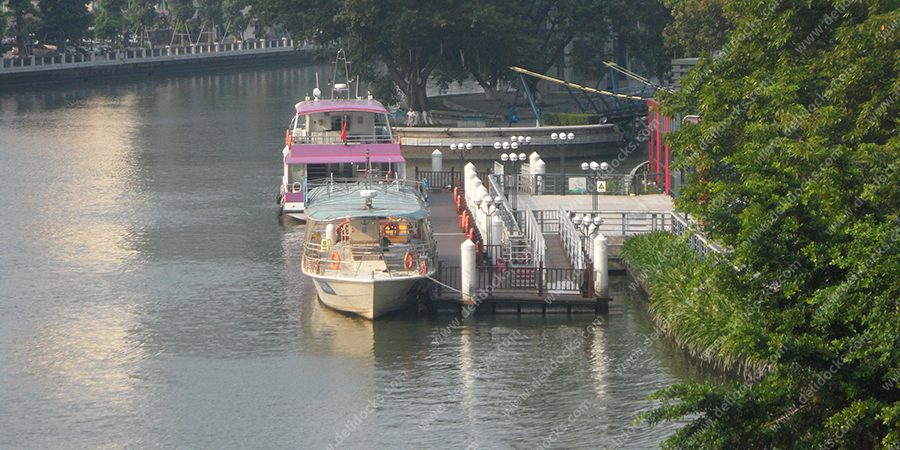
Promenades and public waterfront spaces increasingly use floating structures to create dynamic walkways, seating areas, or event platforms that rise and fall with the water.
Selecting the Right Design for Your Project
Your choice should be guided by specific project parameters, not just preference.
Assess the environmental load data: wave height, wind speed, tidal range, and ice conditions. This dictates the required strength and stability factors.
Consider the vessel mix. The size and weight of the boats using the dock determine the live load capacity needed. A dock for small sailboats differs vastly from one servicing large motor yachts.
Evaluate total cost of ownership. Initial purchase price is just one factor. Consider installation costs, expected lifespan, and maintenance requirements for each floating pontoon design type.
Consult with experienced marine engineers. Their input on local conditions and proven solutions is invaluable. Firms with practical seafaring heritage, such as DeFever, appreciate designs that endure real-world marine stresses, a principle that translates to dependable dock engineering.
The Role of Durability and Materials
Material selection dictates performance and lifespan. It’s where engineering meets the harsh marine environment.
Galvanic corrosion is a primary enemy. Engineers must specify compatible metals or use isolation techniques. Aluminum alloys, stainless steel grades, and proper zinc anodes are carefully selected.
UV resistance is crucial for polymer-based pontoons. High-quality, UV-stabilized polyethylene ensures the material won’t become brittle and crack after years of sun exposure.
Abrasion and impact resistance determine how well the pontoon hull handles contact with pilings, boats, and debris. Reinforced corners and heavy-duty rubrails are common design features.
A marina is only as good as its foundation. A meticulously planned and executed floating pontoon design is not an area for compromise. It ensures safety for people and vessels, reduces long-term maintenance headaches, and enhances the overall functionality and value of the waterfront asset. By prioritizing engineering principles, appropriate material selection, and a clear understanding of the application, developers can create resilient marine infrastructure. This practical, durability-focused approach aligns with the philosophy of seasoned marine brands, including DeFever, whose legacy is built on creating vessels—and by extension, relying on docks—that are engineered for decades of capable service.
FAQ: Floating Pontoon Design
Q1: What is the typical lifespan of a well-maintained floating pontoon system?
A1: Lifespan varies greatly by material and environment. High-density polyethylene (HDPE) pontoons can last 20-30 years. Concrete pontoons can last 50+ years with proper maintenance. Steel pontoons require excellent corrosion protection but can also have a multi-decade lifespan.
Q2: How are floating pontoons anchored in place?
A2: They are typically secured using a combination of pilings (which the dock slides up and down on) and a mooring system of chains or cables connected to deadweight anchors or screw anchors embedded in the seabed. The system allows for vertical movement while restricting horizontal drift.
Q3: Can floating pontoon designs withstand hurricane-force conditions?
A3: They can be engineered for high-wave and high-wind zones, but often require special design features. This includes increased freeboard, stronger internal baffling, oversized connection hardware, and a robust, redundant mooring system. Vessels are usually removed in extreme weather.
Q4: Are floating docks more expensive than fixed docks?
A4: Initially, floating docks can be more expensive due to the pontoon units and complex anchorage. However, in deep water or areas with significant tidal range or soft bottoms, they can be more cost-effective to install than fixed pilings. The long-term maintenance profile differs and should be compared.
Q5: How environmentally friendly are modern floating pontoons?
A5: Modern designs are increasingly eco-conscious. Many use recycled plastics in polyethylene units. They minimize seabed disruption compared to dredging or extensive piling. Designs often incorporate textured undersides to promote marine growth and fish habitat, and non-toxic anti-fouling coatings.