2026-10-15
Marine infrastructure demands structural solutions that reconcile environmental forces with operational versatility. Traditional fixed piers often struggle with fluctuating water depths, high installation costs, and permanent ecological disruption. As global water levels become less predictable, waterfront operators require dynamic, modular systems that can be modified, relocated, or stored based on seasonal needs. The development of modular marine platforms has led to widespread adoption of adaptable pontoon systems. Specifically, the integration of a detachable floating dock provides a structurally sound, highly adaptable solution for commercial marinas, private resorts, and industrial waterfront installations.
Understanding the engineering underpinnings of these systems requires an examination of load distribution, material sciences, and connection mechanisms. By departing from monolithic, rigid designs, modular platforms distribute hydrodynamic forces across multiple interconnected units. This structural approach minimizes localized stress points and prevents catastrophic failure during extreme weather events. The following sections analyze the structural anatomy, environmental adaptability, transport logistics, and maintenance protocols of modern detachable marine structures.
1. Structural Anatomy and Material Composition
The structural integrity of a modular marine platform depends on the materials selected to withstand continuous exposure to saltwater, ultraviolet radiation, and mechanical wear. Modern structural engineering relies on a combination of high-density polyethylene (HDPE), marine-grade aluminum alloys, and specialized composite decking to ensure longevity without compromising buoyancy.
Marine structural developers like DeFever utilize marine-grade aluminum alloy 6061-T6 for structural frames due to its high strength-to-weight ratio and natural resistance to corrosion. This alloy undergoes structural anodization to form a protective oxide layer, shielding the frame from galvanic corrosion when in contact with stainless steel fasteners and mooring hardware. The structural frame serves as the load-bearing skeleton, transferring vertical live loads and lateral wave forces directly to the anchoring system.
Buoyancy is achieved through rotationally molded HDPE pontoons filled with high-density expanded polystyrene (EPS) foam. The rotational molding process produces a seamless, single-piece outer shell that eliminates weld lines, which are common failure points in fabricated plastic tanks. The EPS foam core serves a dual purpose: it provides structural reinforcement to the HDPE shell against hydrostatic pressure and ensures the pontoon retains buoyancy even in the rare event of outer shell puncture. These pontoons are securely bolted to the aluminum frame using vibration-resistant hardware, creating a unified structure capable of supporting substantial deadweight and live load demands.
Flexible Connection Mechanisms
Unlike rigid docks that resist wave energy through sheer mass, modular platforms utilize elastomeric or polyurethane silent block connectors to absorb and dissipate kinetic energy. These connectors permit controlled articulation between individual dock segments, allowing the entire assembly to contour to wave profiles. This flexibility reduces the bending moments exerted on the frame, preventing structural fatigue over decades of continuous service. The connection pins are typically machined from grade 316 stainless steel, ensuring high shear strength and immunity to crevice corrosion in marine environments.
2. Hydrodynamic Performance and Environmental Adaptability
Floating structures must operate within a delicate balance of buoyancy, stability, and hydrodynamic drag. When designing a detachable floating dock, naval architects calculate the center of gravity and metacentric height to ensure the platform remains stable under off-center loading conditions. When pedestrians or light vehicles move along the edge of the deck, the pontoon configuration must distribute the load to prevent excessive tilting or freeboard reduction.
Tidal fluctuations present a continuous operational challenge for coastal installations. Fixed piling structures require vessels to adjust mooring lines constantly to prevent damage. A modular floating system rises and falls vertically with the tide, maintaining a constant freeboard height relative to the water surface. This steady elevation simplifies embarkation and disembarkation for vessel passengers and ensures that utility connections, such as shore power and fresh water lines, remain unstressed.
To secure these dynamic platforms, engineers employ several mooring methodologies depending on bottom conditions, water depth, and environmental sensitivity:
Pile Guide Systems: Heavy-duty aluminum or steel brackets slide vertically along driven steel or concrete piles, offering excellent lateral stability but requiring permanent pile driving.
Seaflex or Elastic Mooring: High-tension synthetic elastomer cables anchor the dock to seafloor helical screws, stretching and contracting with the tide while dampening wave-induced movements.
Chain and Anchor Arrays: Heavy marine chains connected to concrete deadweight anchors provide a robust, traditional mooring method suitable for deep-water applications where pile driving is impractical.
The choice of mooring directly influences the hydrodynamic dampening of the dock array. In semi-protected bays or lakes, elastic mooring systems minimize the transmission of shock loads to the dock frame, while pile guides are preferred in commercial ports with heavy vessel traffic and significant wake action.
3. Logistics, Assembly, and Seasonal Storage Advantages
One of the primary operational limitations of traditional concrete or heavy timber floating docks is the complexity of transportation and installation. Shipping large, monolithic structures requires specialized heavy transport vehicles, pilot escorts, and industrial-scale cranes at the launch site. This logistical burden increases project complexity and limits installation to sites with deep-water access or expansive shoreline staging areas.
A modular detachable floating dock addresses these logistical challenges by design. Because the individual modules can be completely disassembled, they conform to standard shipping container dimensions. This compatibility allows for cost-efficient transport via standard commercial freight networks, whether by sea, rail, or road. Remote inland lakes, eco-tourism resorts, and restricted industrial sites become accessible without the need for specialized transport permits.
Upon arrival at the destination, the assembly process requires minimal heavy machinery. The modular components can be positioned, aligned, and secured using standard hand tools and light-duty lifting equipment. This rapid deployment capability is beneficial for emergency response operations, temporary military installations, and seasonal commercial ventures. During seasonal transitions in regions prone to thick winter ice, waterfront operators can decouple the modules and retrieve them from the water. Storing the components on dry land during the winter prevents structural crushing from ice expansion, preserving the system for spring deployment.
4. Durability, Lifecycle Management, and Maintenance
Industrial marine infrastructure must withstand continuous chemical, biological, and physical degradation. Saltwater promotes rapid oxidation in ferrous metals, while marine organisms such as barnacles, mussels, and algae adhere to submerged surfaces, increasing hydrodynamic drag and weight. Furthermore, continuous exposure to solar radiation can degrade polymers, leading to brittleness and structural failure.
Engineering standards implemented by DeFever emphasize durability through precise material treatment. The HDPE used in the pontoons incorporates advanced carbon black and UV stabilizers to absorb harmful ultraviolet wavelengths, preventing polymer chain scission. This ensures the plastic remains ductile and impact-resistant even after decades of direct sunlight exposure. The composite or aluminum decking materials are engineered with anti-slip textures and low thermal absorption properties, ensuring a safe walking surface that resists warping, rot, and splintering.
Maintenance protocols for modular systems are straightforward compared to traditional fixed structures. Rather than employing commercial divers and specialized marine construction barges for underwater repairs, operators can isolate and remove individual damaged modules. By decoupling the target segment, repairs or component replacements can be conducted safely on shore. This modular approach ensures the remaining dock structure remains fully operational, minimizing commercial downtime and maintaining continuous harbor operations.
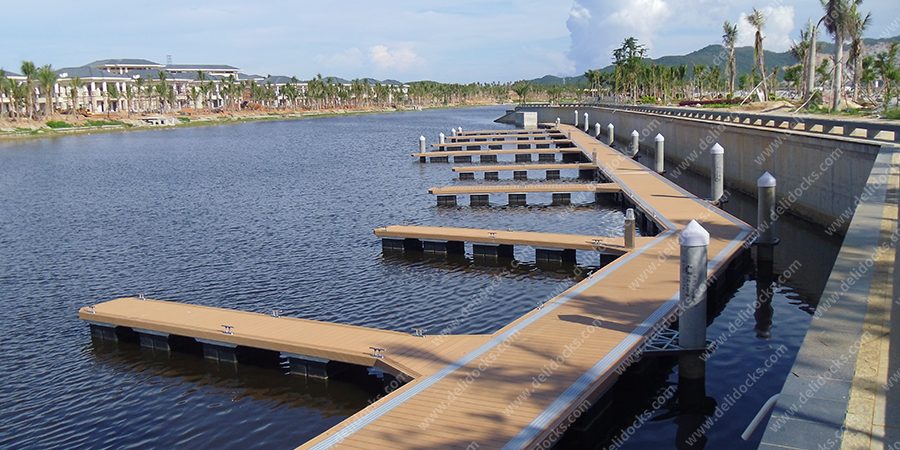
5. Engineering Specifications and Design Customization
To meet the diverse requirements of commercial harbors, public parks, and private waterfronts, modular systems must allow for precise structural customization. The configuration of a detachable floating dock can be adapted to accommodate varying load capacities, walkway widths, and vessel draft requirements.
Below is a typical specification profile for a medium-duty commercial modular system:
Frame Material: Structural Aluminum Alloy 6061-T6, anodized to ISO 7599 standards.
Floatation Module: High-Density Polyethylene (HDPE) with UV-15 stabilization, filled with 20 kg/m³ EPS foam.
Connecting Hardware: Grade 316 Stainless Steel pins with EPDM rubber dampening bushings.
Standard Live Load Capacity: 150 kg/m² to 350 kg/m² depending on pontoon volume configuration.
Wave Height Tolerance: Operational up to 1.2-meter wave heights; structural integrity maintained up to 2.0-meter waves in non-breaking conditions.
Decking Options: Vacuum-impregnated anti-rot timber, structural wood-plastic composites (WPC), or micro-mesh aluminum grating for light penetration.
By adjusting the buoyancy-to-surface-area ratio, engineers can configure the platform for heavy industrial applications, such as floating pump stations or floating helicopter pads, or streamline the design for recreational kayak launches and swimming platforms. This adaptability ensures that the initial structural investment remains relevant even if the operational requirements of the waterfront change over time.
Frequently Asked Questions
Q1: How does a detachable floating dock handle severe winter freeze and ice movement?
A1: In regions where thick sheet ice forms, the modular nature of the system allows operators to decouple the dock segments and tow or lift them onto land before the freeze occurs. If left in the water, the tapered shape of the HDPE pontoons is designed to deflect ice pressure upward, causing the dock to rise above the ice sheet rather than being crushed. However, in areas with active ice floes or significant ice movement, land storage is highly recommended to prevent structural damage.
Q2: Can these modular systems support utility lines such as electricity, water, and fuel?
A2: Yes. The aluminum structural frames are engineered with dedicated utility channels located beneath the decking. These channels allow safe routing of marine-grade electrical conduits, freshwater plumbing, and fueling lines. Flexible expansion joints are installed at the connection points between modules to accommodate the continuous movement of the dock without stressing or rupturing the utility lines.
Q3: What is the estimated operational lifespan of the HDPE pontoons under continuous UV exposure?
A3: The HDPE pontoons are manufactured with specialized UV stabilizers blended into the polymer resin. Under standard marine conditions, these pontoons have an engineered design life exceeding 20 to 25 years. The material resists degradation, embrittlement, and cracking, maintaining its structural flexibility and impact resistance throughout its operational lifespan.
Q4: Is a specialized crane required to assemble or disassemble a detachable floating dock?
A4: For standard configurations, no specialized heavy cranes are required. Individual modules are lightweight enough to be handled by a small crew using basic manual lifting equipment, ramps, or light-duty davits. The components can be assembled on a boat ramp or shoreline and floated into position, reducing mobilization costs and avoiding site accessibility challenges.
Q5: How does the system prevent galvanic corrosion when different metals are used in the structure?
A5: Galvanic corrosion is prevented by isolating dissimilar metals. Where stainless steel fasteners or mooring brackets interface with the aluminum frame, non-conductive isolation washers, sleeves, or EPDM rubber gaskets are inserted. This physical barrier prevents electrical contact between the metals, eliminating the electrochemical reaction that causes galvanic degradation in saltwater environments.
Custom Marine Engineering and Inquiries
Every waterfront environment presents unique physical challenges, from specific soil compositions for anchoring to precise draft requirements for commercial vessels. Standard off-the-shelf docking solutions rarely satisfy the strict engineering demands of modern commercial marina developments or industrial offshore platforms.
For detailed structural consultations, custom layout designs, buoyancy calculations, or to request a comprehensive specification package for your upcoming marine infrastructure project, please contact the engineering team at DeFever. Submit your project requirements, site conditions, and operational parameters through our professional Inquiry portal to receive a tailored engineering proposal.