2026-10-15
Waterfront infrastructure demands exceptional resilience due to the harsh nature of marine environments. Traditional fixed piers often fall short in deep-water installations or regions subject to significant tidal fluctuations. Consequently, modern marina operators and commercial developers are turning to advanced floating structures. High-end pontoon systems, designed to withstand dynamic hydrodynamic forces, provide a stable and durable solution for berthing high-value vessels. As a leading provider of premium marine infrastructure, DeFever designs pontoon systems that refine how berths handle load distribution and environmental stress. Implementing high-performance deluxe floating docks ensures long-term operational viability for commercial harbors, private yacht clubs, and public waterfronts.
Structural Framework and Material Selection in Premium Pontoon Engineering
The selection of structural materials determines the operational lifespan and maintenance profile of a floating pontoon system. When specifying materials for deluxe floating docks, marine structural designers evaluate environmental chemistry, mechanical stresses, and load requirements to prevent premature material fatigue.
Marine-Grade Aluminum vs. Structural Steel
Aluminum alloys, specifically 6082-T6 and 5083-H116, are widely utilized in high-end pontoon design. These alloys offer an exceptional strength-to-weight ratio and natural resistance to atmospheric corrosion. Under marine exposure, aluminum forms a passive oxide layer that protects the underlying metal from further degradation. For heavy commercial applications where vessels exert massive mooring forces, hot-dip galvanized steel frames are preferred. Steel components must undergo hot-dip galvanization conforming to ISO 1461 standards, ensuring a zinc coating thickness of at least 85 microns. This coating acts as a sacrificial barrier against oxidation in high-salinity zones.
Heavy-Duty Concrete Pontoon Core Composition
Heavy-duty concrete pontoons provide maximum mass and stability, dampening wave action effectively. The concrete mixture must feature a high cement content, typically combined with ground granulated blast-furnace slag (GGBS) or silica fume, to reduce porosity and prevent chloride ion penetration. The structural core consists of high-density expanded polystyrene (EPS) with a density ranging from 15 kg/m³ to 20 kg/m³. This closed-cell structure guarantees that even if the outer concrete shell experiences micro-cracking due to localized impacts, water absorption is prevented, and buoyancy is maintained.
Hydrodynamic Performance and Load Distribution Metrics
A floating dock must perform reliably under both static and dynamic loads. The engineering team must calculate buoyancy, freeboard heights, and metacentric heights to ensure safe passenger transit and vessel mooring.
Dead Load Analysis: This calculation accounts for the self-weight of the pontoon frame, concrete or polyethylene floats, utility conduits, and decking material.
Live Load Capacity: Commercial marine standards require a uniform live load capacity of 3.0 kN/m² to 5.0 kN/m² for public-access pontoons. This allows the structure to support heavy equipment, service vehicles, and crowds of passengers safely.
Freeboard Management: Standard high-end berthing configurations target a dry freeboard height of 550mm to 750mm under dead load conditions. Under full design live load, the freeboard must not drop below 300mm to prevent water washing over the deck surface.
Metacentric height (GM) calculations are performed to analyze the transverse and longitudinal stability of the floating units. A positive GM ensures that when asymmetrical loads occur—such as passengers crowding to one side of a vessel boarding gate—the pontoon resists twisting and capsizing forces, maintaining a level walking surface.
Advanced Mooring and Anchoring Dynamics
The structural integrity of deluxe floating docks under severe lateral load relies entirely on the anchoring system. Mooring configurations must absorb kinetic energy from wind, wave action, and vessel docking impacts without transferring excessive stress to the pontoon connections.
Pile Guiding Systems
Steel or concrete piles driven into the seabed are the most reliable method for micro-tidal and high-energy locations. The guide collars must use non-metallic wear pads, such as Ultra-High-Molecular-Weight Polyethylene (UHMW-PE), to minimize mechanical friction and prevent galvanic action between the steel pile and the aluminum guide frame. Pile guides can be integrated internally within the pontoon frame for a clean aesthetic or mounted externally to maximize usable deck space.
Elastic Mooring Systems
In deep-water harbors or environmentally protected marine sanctuaries where piling is prohibited, elastic mooring systems are specified. These systems use highly durable rubber cords that stretch to accommodate tidal ranges of up to 10 meters while maintaining constant tension on the pontoons, reducing lateral swaying. The tension profiles are calculated using marine dynamic analysis software to ensure the system handles extreme storm surge events.
Chain and Anchor Arrays
Traditional chain systems utilize heavy-duty stud-link chains secured to drag-embedment anchors or heavy concrete sinkers. While highly robust, they require periodic inspections to assess link wear and tension adjustment.
Utility Integration and Service Channels
High-end marina layouts prioritize clean aesthetics and safety by concealing all utility routing beneath the deck surface. This approach protects vital service lines from ultraviolet degradation, salt spray exposure, and accidental physical damage.
Utility chases are integrated directly into the structural frame of the pontoon, accessible via removable decking panels. To comply with international safety regulations, electrical conduits must be run in separate channels isolated from water supply pipes, fuel lines, and blackwater pumpout lines. This separation eliminates safety hazards and prevents electromagnetic interference with marina management systems.
Decking materials must be chosen based on thermal performance, slip resistance, and structural life. Composite wood-plastic decking (WPC) with a co-extruded protective layer is popular due to its resistance to rotting and splitting. Alternatively, sustainable dense hardwoods like Ipe offer natural durability, though they require periodic treatment to prevent weathering and maintain their mechanical integrity.
Solving Common Operational Failures in Marine Environments
Marine structures face several degradation mechanisms that must be addressed during the initial design phase.
Preventing Galvanic Corrosion
When dissimilar metals, such as stainless steel fasteners and aluminum structural frames, are in direct contact in the presence of saltwater, galvanic corrosion occurs rapidly. Marine engineers prevent this by utilizing isolating bushings made of Delrin or Teflon, breaking the electrical connection between the two metals. Additionally, sacrificial anode arrays—typically zinc or aluminum-indium-activated anodes—are attached to the steel or aluminum frame to protect the primary structure.
Mitigating Joint Fatigue
The continuous motion of waves places immense strain on the connections between pontoon modules. Rigid connections quickly fail under shear stress. Modern systems utilize flexible elastomer joints composed of neoprene or polyurethane dampers. These joints distribute tensile and compressive forces, allowing the pontoons to flex independently while maintaining structural continuity.
Engineering Specifications for Specialized Mega-Yacht Berths
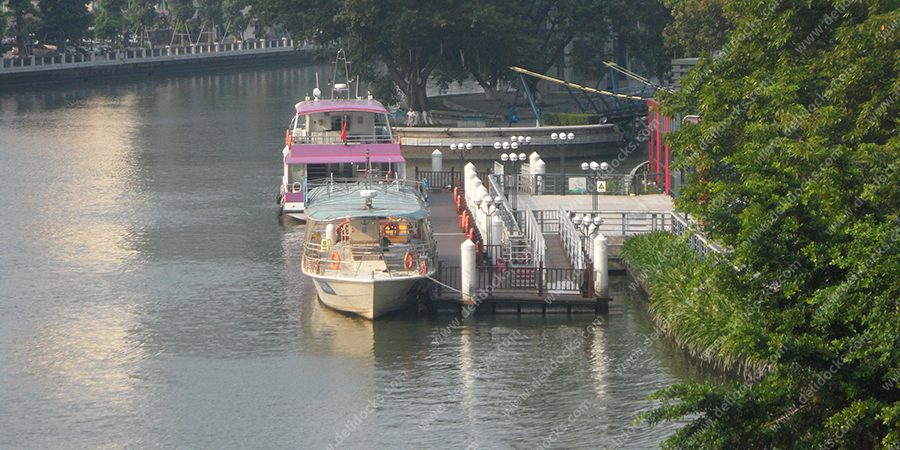
Berthing mega-yachts (vessels over 30 meters) presents unique challenges due to their significant displacement and windage area. To safely accommodate large displacement hulls, deluxe floating docks incorporate heavy-duty steel structural frames, high-load bollards, and dual-axis mooring hinges.
Structural engineers at DeFever focus on custom load-bearing configurations that handle line pulls exceeding 150 kN. These specialized berths utilize thicker concrete pontoon walls and reinforced internal bulkheads to distribute the massive localized forces generated by heavy vessels during storm events. Deeper draft designs are also employed to raise the pontoon freeboard, aligning the deck with the high boarding gates of mega-yachts.
Marina Design Consultations
Developing a high-performance commercial waterfront requires a thorough understanding of local wave climates, soil conditions, and environmental regulations. To explore custom pontoon configurations, structural load calculations, or site-specific anchoring options, contact the marine engineering specialists at DeFever for professional design support and technical inquiries.
Frequently Asked Questions
Q1: How do deluxe floating docks maintain stability during severe tidal changes?
A1: High-end systems utilize vertical guide piles fitted with self-adjusting UHMW-PE rollers or high-tension elastic mooring lines. These systems allow the pontoons to rise and fall seamlessly with the tide while restricting horizontal movement, ensuring the walking surface remains stable and level.
Q2: What is the expected lifespan of a concrete floating pontoon in salt water?
A2: When engineered with high-strength, low-porosity concrete mixes and reinforced with composite or galvanized rebar, a concrete pontoon can achieve an operational lifespan of 30 to 50 years. Regular inspections of the flexible connections and sacrificial anodes are required to reach this longevity.
Q3: Can aluminum-framed pontoons handle high-energy wave environments?
A3: Yes, provided they are engineered with heavy-wall 6082-T6 aluminum profiles and flexible polyurethane connection dampers. However, in extremely high-energy commercial environments where heavy vessels are moored, concrete pontoons are often preferred due to their greater mass and superior wave attenuation properties.
Q4: How are utility lines protected from freezing in cold-climate installations?
A4: Utility chases located beneath the deck are insulated with closed-cell polyurethane foam or equipped with trace heating cables. This prevents potable water lines from freezing during sub-zero winter temperatures while keeping the pipes accessible for seasonal maintenance.
Q5: How do flexible elastomer connectors prevent joint failure between pontoons?
A5: These connectors utilize heavy-duty neoprene or polyurethane blocks held in place by high-tensile stainless steel bolts. The elastomer material absorbs three-dimensional forces (pitch, roll, and yaw) caused by wave action, preventing the metal components of adjacent pontoons from colliding and wearing out.