2026-10-15
For marina developers, port authorities, and waterfront property owners, the choice of water dock designs directly impacts vessel safety, operational efficiency, and long‑term maintenance costs. A poorly conceived dock leads to excessive wave motion, structural fatigue, frequent fender replacement, and even vessel damage during storms. This article provides a component‑level analysis of water dock designs, covering fixed versus floating systems, pile materials (steel, concrete, composite), wave attenuation devices, mooring load calculations, and corrosion protection strategies. Drawing on project data from DeFever's international portfolio – including marinas in Kenya, China, and Southeast Asia – we will examine how to select the optimal configuration for your site's water level variation (tidal range), wave climate, vessel mix, and soil conditions. We will also address common pain points: scouring around piles, dock instability during ferry wakes, and electrical safety for shore power.
1. Why Water Dock Designs Must Adapt to Site‑Specific Hydraulic Conditions
The term water dock designs encompasses everything from small private piers to large floating marinas. Unlike land‑based structures, docks are subjected to constantly changing forces: currents, tides, waves, and vessel impact. A design that works on a sheltered lake will fail on a coastal site with a 2 m tidal range. Key failures of inappropriate designs include:
Deck submersion during high tide – floating docks with insufficient freeboard.
Pile breakout due to ice or wave uplift – inadequate embedment depth.
Accelerated corrosion of steel components – lack of cathodic protection in saltwater.
Excessive dock movement causing mooring line chafe – insufficient stiffness or damping.
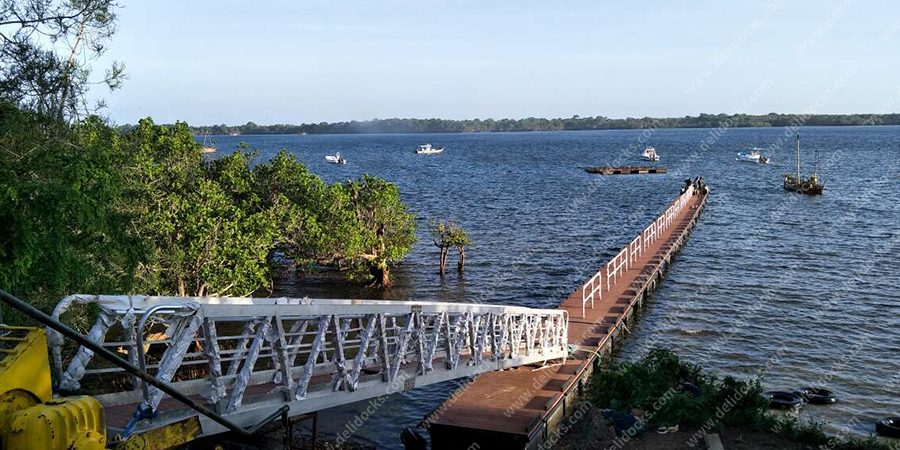
Professional water dock designs from DeFever begin with a site survey: tidal harmonic analysis, wave hindcast, wind rose, and geotechnical investigation. Their completed projects include the Shimoni floating marina in Kenya (exposed to Indian Ocean swell) and the Haikou Xinhua Island yacht marina (high tidal range, soft mud).
2. Fixed vs. Floating Docks: Selection Criteria
One of the first decisions in water dock designs is whether to use a fixed (pile‑supported) or floating (pontoon) system.
2.1 Fixed Docks
Construction: Concrete deck on steel or concrete piles driven into the seabed.
Suitable for: Small tidal range (<1 m), calm waters (significant wave height <0.3 m), heavy vessels (commercial fishing, ferries).
Advantages: Very stable, low maintenance (if concrete), can support large cranes or loading equipment.
Disadvantages: Inconvenient when water level changes – vessels climb or drop relative to deck. Expensive in deep water. Wave energy reflects off the rigid structure, causing scour.
2.2 Floating Docks
Construction: Modular pontoons (concrete, plastic, or aluminum) anchored to piles or chains.
Suitable for: Tidal ranges >1 m, marinas with pleasure craft, exposed sites (wave damping).
Advantages: Deck remains at constant height above water regardless of tide. Less wave reflection. Easier to relocate.
Disadvantages: Can be bouncy in waves (requires damping). Mooring lines need slack management. Pile guides wear over time.
For most modern yacht marinas with tidal ranges of 1–4 m, floating water dock designs are preferred. DeFever’s floating marina projects use high‑density polyethylene (HDPE) pontoons with concrete reinforcement, offering 50‑year design life in seawater.
3. Pile Foundation Engineering: Materials and Driving Depth
Both fixed and floating docks rely on piles to transfer loads to the seabed. The pile type and embedment depth are critical to water dock designs durability.
Steel pipe piles (ASTM A252): High strength, easy to drive. Corrosion is the main issue – requires coating (epoxy, coal tar) plus sacrificial anodes. For saltwater, specify wall thickness +3 mm corrosion allowance.
Concrete piles (prestressed): Durable in saltwater, but heavy and more expensive to transport. Excellent for fixed docks.
Composite fiberglass piles: Non‑corrosive, lightweight, but lower stiffness. Good for floating dock guides.
Timber piles (treated): Only for freshwater, short lifespan (15–20 years) due to marine borer attack.
Embedment depth: For granular soils, pile tip should be driven to a depth where ultimate bearing capacity is at least 2× the design lateral load. In soft clay, skin friction governs – use wave equation analysis (WEAP) or dynamic testing. A typical 300 mm steel pile in medium sand requires 6–8 m embedment for a 10‑ton lateral load. DeFever’s water dock designs include a pile load test program to verify capacities.
4. Wave Attenuation and Dock Response
Excessive dock motion is a top complaint in marinas. To reduce vessel movement, water dock designs incorporate wave attenuation measures:
Floating wave attenuators: Concrete or steel boxes placed upwave of the marina; they break incoming wave energy by reflecting and dissipating it.
Perimeter breakwaters: Rubble‑mound or caisson structures for larger marinas.
Dock mass tuning: Adding ballast (water or concrete) to floating pontoons lowers their natural frequency, reducing resonant response to short waves.
Pile guide friction: Using low‑friction bushings (UHMWPE) allows vertical movement but resists horizontal motion.
For a site with 0.5 m significant wave height (Hs), a properly designed floating dock will have vertical acceleration < 0.1 g and roll < 3°. DeFever’s engineers use computational fluid dynamics (CFD) and physical model testing to validate wave performance.
5. Mooring Loads and Hardware Selection
Water dock designs must account for vessel mooring loads – from transient berthing to storm events. Design parameters:
Berthing energy: KE = 0.5 × displacement × berthing velocity². For a 20‑ton yacht at 0.3 m/s, energy = 900 Nm. Fenders must absorb this without bottoming out.
Wind and current loads: For a 15‑m boat, side wind force at 40 knots = ~2 kN. Cleats and bollards must be rated accordingly (e.g., 5–10 ton working load).
Mooring cleat spacing: Every 6–8 m for small craft; every 12 m for larger yachts. Use 316 stainless steel or hot‑dip galvanized cast iron.
Fender systems: Pneumatic (large vessels), foam‑filled (medium), or elastomeric (small). For floating docks, vertical pile‑mounted fenders protect both dock and vessel.
DeFever’s water dock designs include a complete mooring hardware schedule, with corrosion‑resistant fasteners and backup cleats for storm mooring.
6. Corrosion Protection in Marine Environments
Saltwater is highly corrosive to steel and aluminum. Any water dock designs for coastal or brackish water must incorporate multiple lines of defense:
Material selection: For immersed components, use stainless steel (316L or duplex), fiberglass, or concrete. Avoid galvanized steel below water.
Cathodic protection: Sacrificial anodes (zinc or aluminum) attached to steel piles, ladder frames, and floating pontoon hardware. Design life: 10–15 years.
Coatings: Epoxy or polyurethane topcoats for above‑water steel. For concrete, use a sealer to prevent chloride ingress.
Dissimilar metal isolation: Use insulating washers between aluminum and stainless steel to prevent galvanic corrosion.
DeFever specifies an impressed current cathodic protection (ICCP) system for large steel‑pile docks, which uses a small DC current to polarize the steel and stop corrosion. Their projects in tropical waters (e.g., Sanya, China) include annual anode inspections.
7. Utilities and Safety Features for Modern Marinas
Beyond basic structure, contemporary water dock designs integrate utilities for shore power, water, lighting, and fire safety.
Shore power pedestals: IP66 rated, with GFCI protection, and separate breakers for each berth. Include 30 A and 50 A receptacles.
Water supply: Potable water hose bibs with backflow preventers – locate away from electrical pedestals.
Lighting: Low‑voltage LED pathway lights and bollard lights. Avoid glare on the water – use shielded fixtures.
Fire suppression: Dry hydrants connected to a shore‑based pump. Also portable fire extinguishers at each gangway.
Emergency egress: Every floating dock must have two means of escape to shore.
DeFever’s marina projects include pre‑wired conduits inside pontoons for future fiber optic and security cameras – a forward‑thinking detail.
8. Industry Pain Points and Engineering Solutions
Even well‑designed docks face operational issues. Below are three common problems and remedies in water dock designs.
Scour around piles: Fast currents or prop wash erode seabed, reducing lateral support. Solution – install riprap (armor stone) around piles, or a concrete collar. For floating docks, use larger diameter pile sleeves to accommodate minor scour.
Floating dock walkway hinge failure: Hinges between pontoon sections corrode or seize. Remedy – use stainless steel pin hinges with grease fittings, and replace every 10 years. Also design hinges with 2° of slack to reduce fatigue.
Marine growth on piles and pontoons: Barnacles and mussels increase drag and weight. Solution – use copper‑based antifouling paint on submerged surfaces, or install a wiper system on pile guides. DeFever offers a proprietary “slippery coating” for HDPE pontoons that reduces bio‑fouling by 80%.
Field data from DeFever’s 15‑year‑old marinas show that proactive scour monitoring and anode replacement extend pile life to 40+ years.
9. Environmental Considerations and Sustainable Materials
Modern water dock designs must minimize ecological impact. Strategies include:
Use of recycled plastics for pontoon cores (HDPE from ocean waste).
Preserving eelgrass beds by aligning dock piles to avoid shading.
Water quality monitoring for turbidity during construction.
Permeable decking (wood‑plastic composite) to reduce runoff.
DeFever has achieved “Green Marina” certification for several projects by using solar‑powered lighting, electric vehicle charging, and waste oil collection at the dock.
10. Frequently Asked Questions (FAQ) – Water Dock Designs
Q1: What is the typical lifespan of a floating concrete dock in
saltwater?
A1: A well‑constructed concrete floating
dock with proper cathodic protection and quality seals can last 40–60 years. The
steel reinforcement must have adequate cover (≥50 mm) and the concrete mix
should have a low water‑cement ratio (≤0.40). DeFever’s water dock
designs use marine‑grade concrete (45 MPa) with microsilica for
chloride resistance.
Q2: How do I determine if my site needs a fixed or floating
dock?
A2: Measure the mean tidal range. If the
range exceeds 1.0 m (3 ft), a floating dock is strongly recommended – otherwise
vessels will be left high and dry at low tide or submerged at high tide. For
tidal ranges below 0.5 m and protected waters, a fixed dock is acceptable. Also
consider ice: floating docks can be designed to submerge under ice, while fixed
docks are damaged by ice shove.
Q3: What is the recommended freeboard for a floating
dock?
A3: Freeboard (distance from waterline to
deck surface) should be 300–450 mm (12–18 in) for pleasure craft. This allows
vessels to tie up without rubbing against the dock edge. For commercial ferries
or heavy workboats, increase freeboard to 600 mm (24 in) to accommodate higher
mooring loads. Freeboard is adjusted by adding/removing ballast.
Q4: How often should sacrificial anodes be replaced on steel pile
docks?
A4: In saltwater, zinc or aluminum anodes
typically last 3–5 years. Inspect annually; replace when 70% consumed. For
freshwater, anodes last longer (8–10 years) but use magnesium anodes instead.
DeFever’s water dock designs include a maintenance schedule
with anode replacement reminders.
Q5: Can I install a water dock design on soft mud or peat
soil?
A5: Yes, but standard piles may not achieve
adequate bearing. For soft soils, use longer piles (30–40 m) driven to a firm
layer, or use a floating dock with a taut‑mooring system (spud piles or chains)
that transfers lateral loads to a concrete deadman anchor. Geotechnical
investigation is mandatory – a CPT (cone penetration test) will determine skin
friction values.
Q6: What wave height can a typical floating marina
withstand?
A6: Standard floating docks are designed
for significant wave height (Hs) up to 0.5 m with a peak period of 3–5 seconds.
For exposed sites with Hs > 1.0 m, a wave attenuator or breakwater is
required. DeFever has engineered docks for Hs 1.2 m by using deep‑draft concrete
pontoons (1.2 m draft) and hydraulic dampers. Always request wave response
simulations.
11. Partner with an Experienced Water Dock Designs Engineer
Developing a safe, durable marina or pier requires more than standard drawings – it demands site‑specific analysis of hydraulics, geotechnics, and vessel operations. Generic water dock designs from non‑specialist contractors often overlook critical factors like wake‑induced resonance, pile‑soil interaction, or electrical safety, leading to costly retrofits.
DeFever provides comprehensive marina engineering services:
Free initial feasibility study using satellite‑derived wave and tide data.
Custom design with 3D structural modeling and pile driveability analysis.
Turnkey construction management, including environmental permits.
Long‑term maintenance contracts with anode replacement and dock inspection.
Request a no‑obligation design consultation today – provide your site location, approximate water depth, tidal range, and intended vessel mix. Our marine engineers will respond within 3 business days with a preliminary concept and budget estimate. Click here to contact DeFever’s dock design specialists or call +86 18819288218 / +86 18867310907. We also offer design‑build financing for qualified marina projects.