
For luxury marinas, floating restaurants, and exclusive yacht clubs, the two story floating dock represents a paradigm shift in waterfront architecture. Unlike conventional single‑level pontoons, a two‑story structure doubles the usable area without expanding the water footprint, enabling upper‑deck lounges, bars, crew quarters, or control towers above vessel berthing. However, designing a stable, safe, and durable two story floating dock requires solving complex engineering challenges: maintaining low center of gravity (CoG) despite a raised mass, resisting wind overturning moments, managing live loads from crowds, and preventing fatigue in connectors. This article provides a component‑level analysis of two story floating dock systems, covering pontoon sizing, ballast distribution, structural framing (steel or aluminum), mooring pile guides, and seismic/hurricane resilience. Drawing on project data from DeFever's international portfolio – including floating marinas in Asia and Africa – we will examine how to optimize these structures for tidal ranges, wave exposure, and usage patterns. We will also address common pain points: excessive roll, weld fatigue, and corrosion in splash zones.
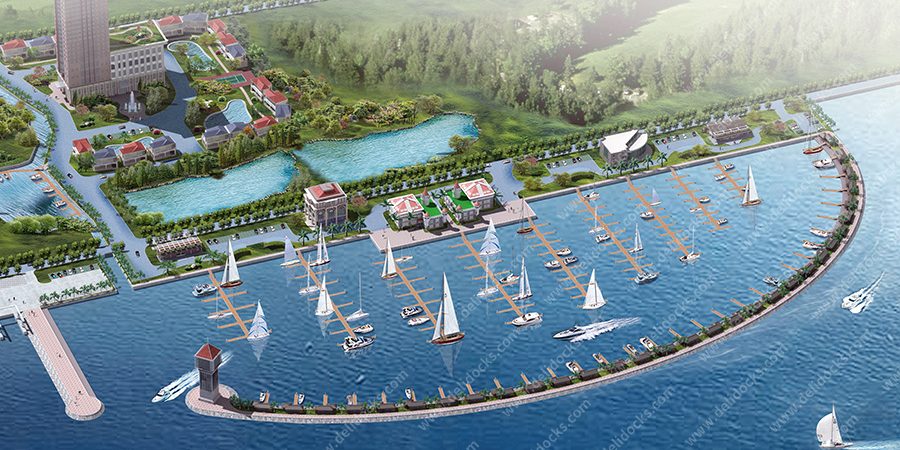
The primary driver for a two story floating dock is space efficiency. In congested marinas or high‑value waterfront locations, horizontal expansion is impossible. By adding a second level, developers gain:
Premium outdoor amenities: Rooftop bars, sunbathing decks, or event spaces with panoramic water views.
Operational areas: Security offices, equipment storage, or crew restrooms above the water, leaving lower deck for vessel berthing.
Revenue generation: Leasable commercial space (cafés, boutiques) on the upper level.
Improved safety: Elevating electrical panels and fuel stations away from wave splash.
However, a poorly designed two story floating dock can be dangerously unstable. The raised center of gravity increases roll amplitude and reduces metacentric height (GM). Therefore, engineering must prioritize static and dynamic stability. DeFever's floating marina projects demonstrate that with proper ballast and wide pontoons, two‑story docks can achieve GM > 1.5 m, exceeding safety standards for small passenger vessels.
The lower hull (pontoon) of a two story floating dock must provide sufficient buoyancy to support:
Dead load: structural weight of both decks, railing, stairs, utilities.
Live load: people (typically 4 kN/m² or 85 lb/ft²), furniture, bar equipment.
Snow load (if applicable) and wave‑induced vertical acceleration.
Pontoon volume (displacement) required: V = (Total weight + safety margin) / (density of water). For saltwater (1,025 kg/m³), a 200 m² two‑story dock with dead load 250 kg/m² and live load 300 kg/m² → total 550 kg/m² → 110,000 kg total → displacement = 107 m³. With a pontoon depth of 1.2 m, required footprint = 89 m² (e.g., 10 m × 8.9 m). DeFever typically uses two parallel steel pontoons (each 2 m wide, 1.5 m deep) spaced 6 m apart, providing 18 m³/m length – sufficient for most loads.
Freeboard (height from waterline to lower deck) should be at least 0.5 m to prevent wave overtopping. For exposed sites, increase to 0.7 m.
Stability of a two story floating dock is quantified by metacentric height (GM). The formula:
GM = KB + BM - KG
Where KB = center of buoyancy (half pontoon depth), BM = second moment of waterplane area / displaced volume, KG = center of gravity above keel. For a conventional single‑deck dock, GM typically 2–3 m. For a two‑story dock, KG increases (higher mass), so GM may drop below 1 m, leading to sluggish recovery from roll.
Solutions to increase GM:
Widen the pontoon spacing: Increasing the waterplane area moment (BM) dramatically improves stability. DeFever uses pontoons spaced at 0.6–0.8× the dock width.
Add permanent ballast in the pontoons: Concrete or water ballast lowers KG. A 0.3 m layer of concrete at the bottom of each pontoon (≈700 kg/m²) reduces KG by 0.4–0.6 m.
Use a deeper pontoon: Increases KB and lowers KG relative to the keel.
DeFever’s two story floating dock designs aim for a minimum GM of 1.2 m in operational condition, ensuring roll natural period > 4 s to avoid resonance with typical waves.
The superstructure of a two story floating dock must be lightweight yet stiff. Material choices:
Steel (ASTM A572 Grade 50): High strength, weldable, cost‑effective. Requires heavy corrosion protection (epoxy + anodes). Weight ~7850 kg/m³. Suitable for large industrial two‑story docks.
Marine aluminum (5083‑H116): 1/3 the weight of steel, naturally corrosion‑resistant in saltwater (no painting). Higher initial cost, but lower maintenance. Preferred for luxury yacht club docks.
Prestressed concrete: Very heavy (2,400 kg/m³), used for lower deck only. Upper deck typically steel or wood. Good fire resistance.
DeFever recommends aluminum for the upper structure of a two story floating dock because weight savings directly reduce required pontoon volume and improve stability. Their standard design uses 5083‑H116 extruded beams, with welded connections and K‑bracing for lateral stiffness.
Unlike single‑level docks, a two story floating dock presents a larger windage area – the upper deck catches wind, creating horizontal forces that must be transferred to piles. Typical mooring configurations:
Fixed pile guides: Steel or composite piles driven into seabed; the dock slides vertically on low‑friction bushings (UHMWPE or bronze). For two‑story docks, use at least four piles (corners) to resist wind‑induced torsion.
Spud piles: Vertical steel pipes that drop through the dock into the mud; suitable for calm waters, but limited wave resistance.
Chain moorings: Multiple anchor points with catenary chains – allows dock to swing, but not recommended for two‑story structures due to potential collision with adjacent vessels.
Pile guide design must account for a maximum lateral load equal to wind force plus berthing impact. For a 20 m × 10 m two‑story dock (upper deck 3 m above water), wind load at 50 knots = 0.5 × air density × (wind speed)² × projected area × shape factor (1.2) ≈ 3.5 tons. Each pile guide should be rated for at least 2 tons lateral capacity. DeFever uses helical or driven steel piles with a 20‑year corrosion allowance.
In earthquake‑prone regions, a two story floating dock must accommodate ground shaking without damage. Since floating docks are decoupled from the seabed (they rest on piles with sliding guides), seismic forces are minimal – the dock simply moves with water. However, the pile guides must allow vertical movement without binding during soil liquefaction. DeFever uses oversized pile sleeves (50 mm clearance) and flexible rubber bumpers to prevent impact damage.
For hurricane‑prone areas, the main risk is wave overtopping and debris impact. Design measures:
Raise freeboard to 0.7 m.
Use breakaway railings on the lower deck to reduce wave load.
Install sacrificial fenders around piles to absorb impact from floating debris.
Pre‑planned emergency tie‑down points to secure the dock to shore‑based deadmen.
DeFever’s floating dock projects in typhoon zones include a “storm mode” procedure: remove upper deck furniture, flood ballast compartments for extra weight, and double up mooring lines.
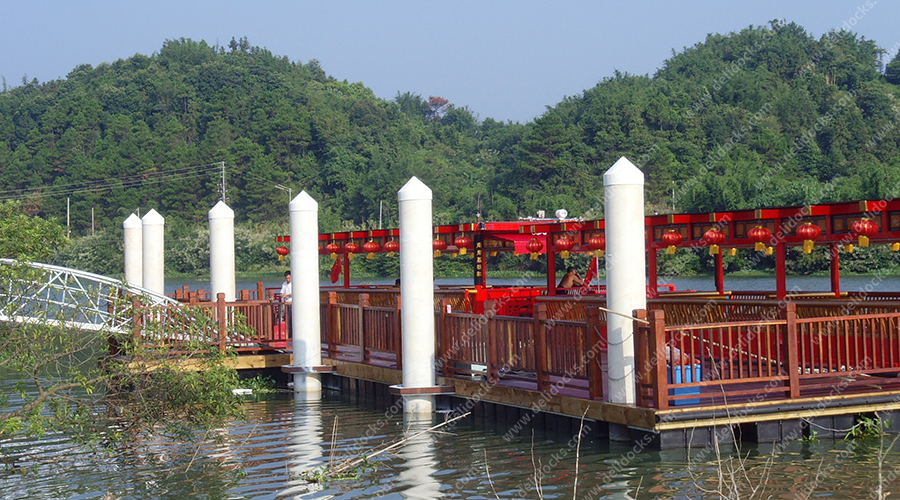
Integrating utilities into a two story floating dock requires careful planning:
Electrical: Main shore power cable runs through a flexible conduit attached to the gangway. Distribute to lower deck pedestals and then vertically inside a waterproof column to the upper deck. Use IP66 junction boxes and GFCI breakers.
Plumbing: Freshwater and wastewater lines must be flexible enough to accommodate tidal movement. Use marine‑grade potable water hose (NSF 61) and a holding tank with pump‑out.
Accessibility: Stairs between levels must have non‑slip treads, handrails on both sides, and a slope ≤ 35°. For wheelchair access, install a vertical platform lift (enclosed) – though challenging on a floating structure.
Fire safety: Upper deck requires a dry hydrant connected to a shore pump, plus portable extinguishers at each stair landing. For commercial use, a wet‑pipe sprinkler system with a jockey pump on the dock.
DeFever’s engineering team provides a complete MEP (mechanical, electrical, plumbing) layout for each two story floating dock, with flexible loops to accommodate ±1 m tide variations.
Even with robust design, operators face recurring issues. Below are three common problems and remedies for two story floating dock structures.
Excessive roll during crowded events: As people move to one side, the dock tilts. Solution – install active ballast trim tanks: pumps transfer water between port and starboard pontoons to level the dock. DeFever has implemented this on a 200‑person floating bar in China, reducing roll from 6° to 1.5°.
Fatigue cracks at weld joints: Repeated wave‑induced flexing causes cracking in aluminum or steel. Remedy – use high‑fatigue‑detail connections (e.g., rounded corners, backer bars) and perform annual dye‑penetrant inspections. Switch to friction‑stir welded panels for aluminum.
Galvanic corrosion between aluminum superstructure and steel pile guides: Dissimilar metals in saltwater create a battery, corroding the aluminum. Solution – install insulating washers (glass‑filled nylon) and a sacrificial zinc anode block at each contact point. DeFever specifies a 50 mm gap with rubber pads between aluminum and steel.
Field data from DeFever’s 10‑year‑old two‑story docks show that with proper maintenance (anode replacement every 3 years, annual weld inspection), the structure remains serviceable for 30+ years.
A two story floating dock may face stricter environmental review than a single‑level dock due to increased shading of the water column and visual impact. Mitigation measures:
Use translucent deck grating on the lower level to allow light penetration for eelgrass.
Install bird deterrent spikes on railings to prevent perching.
Collect all runoff from the upper deck (oil‑water separator for deck wash).
Obtain a coastal zone management (CZM) permit and demonstrate that the two‑story height does not obstruct scenic views from adjacent properties.
DeFever assists clients with environmental impact assessments, including shadow modelling and marine biology surveys.
Q1: What is the maximum wave height a two story floating dock can
tolerate?
A1: A properly ballasted two‑story dock
with 0.5 m freeboard can withstand significant wave height (Hs) up to 1.0 m
without water overtopping the lower deck. For Hs > 1.2 m, a breakwater is
required. The dock will remain stable but may experience roll up to 5°–8°.
DeFever designs for a 50‑year return period wave based on site data.
Q2: How much does a two story floating dock cost compared to a
single‑level dock?
A2: Typically 2.5 to 3.5 times
the cost of a single‑level dock of the same footprint. The increase comes from
heavier pontoon structure, additional steel/aluminum framing, second decking,
stairs, and more complex pile guides. For a 100 m² luxury two‑story dock, budget
$2,000–$4,000 per m², including utilities. A single‑level commercial dock runs
$800–$1,500 per m². However, the extra leasable space often yields a shorter
payback period.
Q3: Can I convert an existing single‑level floating dock into a two
story structure?
A3: Possible but rarely
economical. The existing pontoons likely lack the buoyancy and stability for a
second story. You would need to add buoyancy modules, widen the beam, and
reinforce the deck connections. Most owners find it cheaper to build a new
purpose‑built two story floating dock. DeFever offers a
feasibility study to evaluate existing structures.
Q4: What safety systems are mandatory for a two story floating dock
open to the public?
A4: At a minimum: 1.1 m high
guardrails on both levels (infill to prevent 100 mm sphere passage), anti‑slip
deck coating, emergency lighting, two means of egress (stairs at opposite ends),
and life rings with throw lines. For commercial use, also require a fire alarm
system, PA system, and crowd load calculations (maximum 300 kg/m² for assembly
areas). Local building codes may classify the dock as a “floating structure” and
require inspection by a marine surveyor.
Q5: How does ice affect a two story floating dock in northern
climates?
A5: Ice can crush pontoons and damage
pile guides. Mitigation: use a bubble system (compressed air) to keep water
moving around piles, or install ice‑resistant piles with a tapered shield.
Alternatively, design the dock to be removed each winter – but two‑story docks
are heavy and difficult to haul out. DeFever recommends locating two‑story docks
in ice‑free marinas or constructing a protective ice boom upstream.
Q6: What is the typical lead time for a custom two story floating
dock?
A6: Engineering and permitting: 4–6 months.
Fabrication (aluminum or steel): 3–5 months. On‑site assembly and launch: 1–2
months. Total 8–13 months from contract to commissioning. DeFever offers a
design‑build contract to streamline the process, with early procurement of
long‑lead items (piles, winches).
Designing a safe, stable, and durable two story floating dock requires expertise in marine hydrostatics, structural dynamics, and corrosion control. Generic waterfront contractors often lack the specialized knowledge to calculate metacentric height, design pile guides for windage, or prevent galvanic corrosion. DeFever brings two decades of experience, having delivered multi‑level floating structures for luxury marinas, floating restaurants, and yacht clubs across Asia and Africa.
DeFever’s comprehensive service includes:
Free initial stability assessment using your site’s bathymetry and wave climate.
Detailed 3D structural modeling and GM calculation (including crowd load scenarios).
Procurement of marine‑grade aluminum and corrosion‑resistant fasteners.
Turnkey installation, pile driving, and utility hookup.
Annual inspection and maintenance contracts (anode replacement, weld testing).
Request a no‑obligation design consultation today – provide your intended water location, dock dimensions, number of berths (lower deck), and desired upper‑deck use (bar, lounge, office). Our marine engineers will respond within 5 business days with a preliminary concept, stability summary, and budget estimate. Click here to contact DeFever’s floating structure specialists or call +86 18819288218 / +86 18867310907. We also offer financing and lease‑back options for commercial marina projects.
