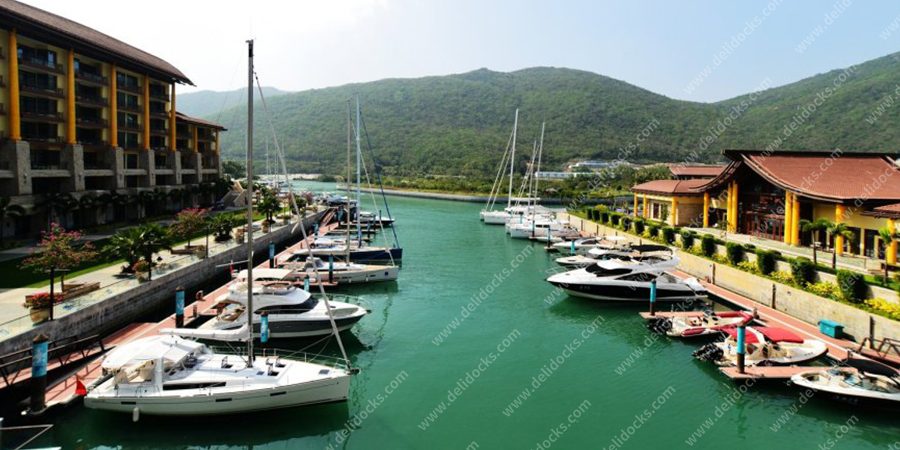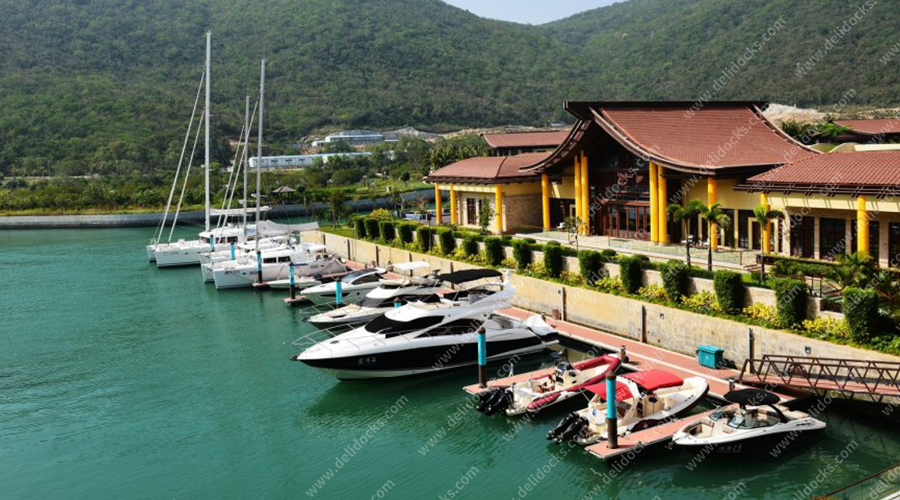
In professional marine infrastructure, operational flexibility directly correlates with capital efficiency. Unlike fixed piers or conventional floating docks that remain tethered to a single location, the towable floating dock represents a paradigm shift: a engineered, buoyant platform designed for routine relocation via towing vessels. For marina operators, construction firms, and government waterfront authorities, these assets solve seasonal demand mismatches, emergency recovery needs, and project-based access challenges. DeFever brings two decades of naval architecture and modular dock engineering to this segment, delivering systems that withstand repeated tow stresses while maintaining operational deck stability.

The structural integrity of a towable floating dock differs fundamentally from stationary floating platforms. Every component must endure dynamic longitudinal forces during towing, lateral wave impacts, and point loads from moored vessels. Industry best practices rely on three interdependent engineering choices:
Buoyancy units: Rotationally molded HDPE (high-density polyethylene) shells filled with closed-cell EPS foam. This combination offers zero water absorption and reserves 35-40% freeboard even under full load.
Structural framing: Marine-grade aluminum 5086-H116 or hot-dip galvanized steel with ASTM A123 coating. Aluminum reduces towed weight by 40% versus steel, critical for overland trailer transport.
Towing hardware: Recessed towing eyes, stainless steel D-rings (grade 316), and reinforced bulkheads that distribute towline forces across multiple buoyancy modules.
Leading manufacturers like DeFever also integrate sacrificial anodes and wear strips on the leading edges, preventing galvanic corrosion and abrasion during beaching or side-towing operations. These details directly impact service life, which for professionally maintained units exceeds 25 years.
Waterfront infrastructure decisions often hinge on a trade-off between permanence and adaptability. Fixed concrete piers offer durability but cannot follow water level fluctuations exceeding 1.5 meters. Standard floating docks solve the level-change problem but remain captive to a single mooring field. The towable floating dock eliminates both constraints:
Asset redeployment: One dock serves seasonal marinas in summer and works as a construction platform for bridge repairs in winter.
Regulatory compliance: Avoids permanent structure permits in environmentally sensitive zones; removed during off-seasons.
Disaster response: Deployed within 48 hours to replace damaged piers after hurricanes or floods.
From a balance-sheet perspective, towable docks shift infrastructure from CAPEX-intensive permanent builds to operational assets with depreciable mobility. Ports that own a fleet of such docks report utilization rates above 85%, compared to 40% for fixed slips.
Engineering a towable floating dock for real-world B2B environments requires matching design parameters to specific use cases. Over 150 modular floating dock projects documented by DeFever illustrate the range:
Seasonal marina extensions: 20m x 5m dock sections towed to lake resorts each spring, removed before ice formation.
Superyacht maintenance platforms: Reinforced decks supporting 80-ton travel lifts, towed between dry-dock facilities.
Military / government tactical docks: Rapid deployment for amphibious operations or disaster relief supply transfer.
Bridge and tunnel construction: Floating work platforms with crane pads, repositioned weekly as construction progresses.
Environmental monitoring stations: Towable sensor platforms redeployed across reservoirs for water quality sampling.
Each scenario demands specific engineering: high point-load capacity for cranes, low-draft profiles for shallow estuaries, or wave-damping skirts for exposed sites. DeFever conducts finite element analysis (FEA) for every towed configuration, verifying that connection points withstand 2x the maximum expected towline tension.
Field performance of a towable floating dock depends as much on logistics as on fabrication. Professional operators follow standardized protocols:
Tug requirements: Minimum 150 hp for docks up to 30m length; tow bridle with 10m leg length to reduce yaw.
Speed limits: 4-6 knots in open water; 2 knots in harbors to prevent deck submersion.
Route planning: Avoiding bridge clearances below dock height plus 1m safety margin.
Permanent mooring: 4-point helical anchor system with chain tensioners for water depth up to 15m.
Temporary positioning: Concrete sinkers (1-2 tons each) connected via nylon strops for easy retrieval.
Shore connection: Adjustable gangways with self-leveling hinges to accommodate tide ranges.
During off-season storage, docks are either kept afloat in sheltered marinas or trailer-hauled to dry lots. Portable marine structure logistics often include custom cradles to prevent hull distortion during land storage.
For procurement managers, the total cost of ownership (TCO) of a towable floating dock typically breaks even with fixed docks within 4-6 years, after which mobility provides net savings. Key maintenance actions extend this advantage:
Annual inspection: Check towing eyes for elongation (max 3% deformation), replace worn sacrificial anodes.
Cleaning schedule: High-pressure wash every 6 months to remove marine growth; antifouling coating on submerged HDPE.
Hardware torque: Re-tension bolted connections after every towing operation (vibration loosens fasteners).
Real-world data from DeFever installations shows that aluminum-framed towable docks require 0.8 labor hours per linear meter annually, compared to 2.1 hours for fixed wooden piers. Additionally, damage from storm surge is rare because docks can be towed to protected basins before severe weather events.
Few manufacturers combine in-house naval architecture with full-service project management. DeFever has delivered over 80 towable dock systems to commercial ports, yacht clubs, and government agencies across North America, Europe, and the Middle East. Their engineering process includes:
Hydrodynamic towing simulation: Predicting dock behavior in wave heights up to 1.5m and currents of 3 knots.
Class society options: ABS or Lloyd’s certification for docks used in regulated commercial operations.
Modular connector systems: Patented interlocking hinges that allow docks to be reconfigured from 10m to 50m lengths.
For project-specific requirements – such as integrating solar navigation lights, fuel transfer stations, or submerged pile guides – DeFever’s engineering team produces fully detailed shop drawings within 10 working days.
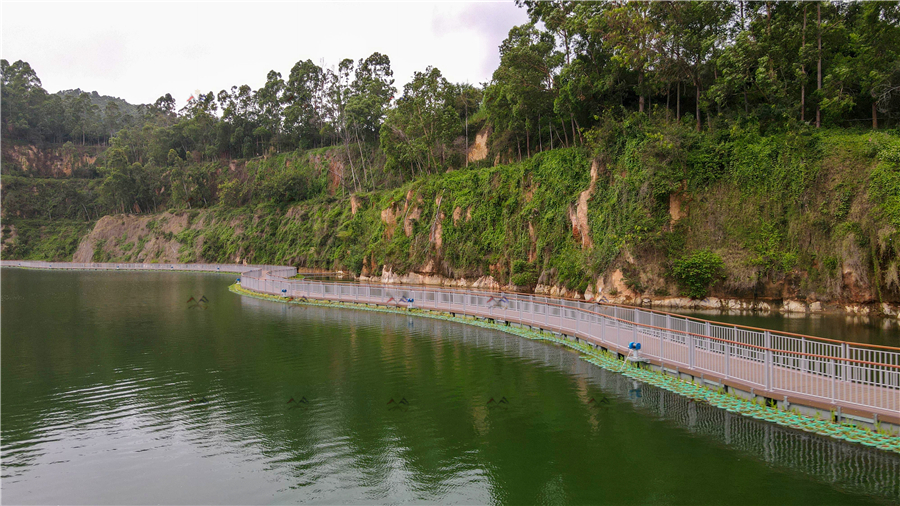
The next generation of towable floating docks will incorporate IoT sensors and sustainable materials. Early adopters already benefit from:
Draft monitoring sensors: Wireless load cells that send real-time deck weight data to marina management software.
100% recycled HDPE: Post-industrial plastic buoyancy units that meet ASTM D6662 standards.
Solar-powered LED perimeter lighting: Integrated into deck edges, eliminating underwater cables.
These innovations reduce environmental permitting friction and lower operational energy costs. Sustainable floating infrastructure projects increasingly specify towable designs to minimize seabed disturbance during installation and removal.
Q1: What is the maximum practical size for a single towable floating
dock section?
A1: From a towing stability perspective, individual
sections longer than 35 meters or wider than 8 meters require escort tugs and
special navigation permits. Most B2B applications use modular sections of 20m x
5m, which can be towed by a single 200 hp workboat. DeFever engineers recommend
sectional designs for total lengths beyond 50 meters.
Q2: Can a towable floating dock be used in exposed coastal waters
with significant wave action?
A2: Yes, but with design
modifications. For significant wave heights above 1.0 meter, specify deeper
draft buoyancy units (≥600mm height), wave damping skirts, and reinforced
mooring bollards. DeFever has deployed towable docks in wave-exposed sites like
the North Sea and Gulf of Mexico by adding concrete ballast cells that lower the
center of gravity.
Q3: How long does it typically take to tow and set up a 100-meter
towable floating dock system?
A3: For a 100-meter system composed of
five 20m sections, towing time depends on distance (average 2-3 knots = 24-36
hours for 50 nautical miles). On-site assembly and anchoring typically requires
2-3 days with a 4-person crew and small crane. This compares to 6-8 weeks for a
similarly sized fixed pier.
Q4: What certifications should a commercial-grade towable floating
dock have?
A4: At minimum, request ISO 12215-5 for small craft
construction and ASTM F2327 for floating dock systems. For regulated passenger
or cargo transfer, ABS (American Bureau of Shipping) or Lloyd’s Register
certification is advised. DeFever provides both ABS plan approval and
construction survey for clients requiring class certification.
Q5: Are towable floating docks eligible for operational leasing or
financing?
A5: Yes. Because they are classified as movable equipment
(not permanent improvements), many marine finance companies offer operating
leases with 10-20% annual rental payments. DeFever works with three major marine
asset financiers to provide lease-to-own structures for marina operators and
government entities.
Every waterfront project presents unique load requirements, tow distances, and environmental constraints. Generic dock solutions lead to premature failure or underutilized assets. DeFever provides site-specific engineering studies, including towing route analysis, mooring plans, and 3D structural models. To discuss your seasonal marina, construction access, or disaster-resilience needs, submit an inquiry to our technical sales team. Include your required dock dimensions, water depth range, and preferred tow vessel specifications.
For detailed quotations and engineering
consultations:
Send your project brief to DeFever’s marine
infrastructure department – response within 48 hours.
→ Direct Inquiry Form (Click here)
Or
email: deli@delidocks.com | Phone: +86 18819288218 / +86 18867310907
© 2026 DeFever Marine & Dock Systems – Engineered for mobility, built for decades.