2026-10-15
For marina developers, port engineers, and commercial waterfront property owners, understanding the price to build a dock is rarely about a simple per-linear-foot figure. In my 20 years directing large-scale marine construction projects across North America and Europe, I have seen budgets vary by over 300% for structures with similar dimensions—solely due to differences in geotechnical conditions, hydrodynamic exposure, material specifications, and regulatory complexity. This article provides a comprehensive, data-backed framework to forecast the price to build a dock with accuracy, moving beyond generalizations to site-specific engineering realities.
1. Geotechnical Conditions: The Foundation of Cost Variability
Subsurface conditions constitute the largest variable in any dock construction budget. The price to build a dock on stable, dense sand with 15 meters of water depth can be half that of a project on soft organic clay requiring extensive pile driving or ground improvement. Key geotechnical cost drivers include:
Soil bearing capacity: Sites with standard penetration test (SPT) N-values below 10 require driven piles at closer spacing (2.4m centers) or larger-diameter piles. This can increase foundation costs by $120–$250 per square meter of dock surface.
Presence of rock or obstructions: Pre-drilling through limestone or glacial till adds $80–$150 per pile in drilling time and specialized tooling. In some Florida and Caribbean projects, we encountered coral rock requiring core drilling and steel casing, adding 18% to the total foundation budget.
Liquefaction potential: In seismic zones (Site Class D/E), piles must extend to depths where shear wave velocity exceeds 250 m/s. This often doubles pile lengths compared to non-seismic designs, directly elevating the price to build a dock by 25–40%.
Our firm DeFever routinely conducts geotechnical investigations with cone penetration testing (CPT) to reduce uncertainty; a $20,000 site investigation can prevent $500,000 in change orders during construction.
2. Material Selection and Its Impact on Capital Expenditure
Material choices directly influence both initial capital outlay and long-term replacement cycles. Below is a comparative cost analysis for three typical systems in a 200-linear-foot dock (10 ft wide), based on 2024 contractor pricing in coastal U.S. markets:
Treated timber (Southern Yellow Pine): $650–$850 per linear foot. Initial cost is lowest, but marine borer protection requires chemical treatment (ACQ or CCA). Lifecycle cost over 30 years often exceeds concrete due to 2–3 full replacements.
Marine-grade aluminum (5086-H116) with composite decking: $1,200–$1,800 per linear foot. Higher upfront cost, but zero corrosion with proper anodes, and 50-year design life. Ideal for high-salinity environments.
Precast concrete floating docks with FRP pile guides: $1,500–$2,400 per linear foot. Highest initial investment, but lowest maintenance (no painting, no galvanic corrosion). Our projects using this system have achieved 60-year service lives, with annual maintenance under 0.5% of replacement cost.
When evaluating the price to build a dock, consider net present value (NPV) of lifecycle costs. Concrete and composite systems often yield lower NPV over 30 years despite higher initial investment.
3. Fixed vs. Floating Configurations: Structural Cost Differentials
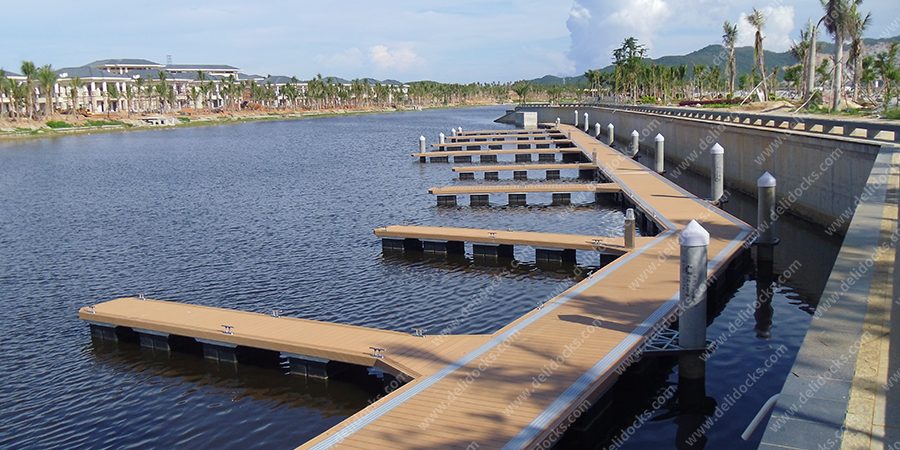
The choice between fixed (pile-supported) and floating dock systems has profound cost implications. Fixed docks require driven piles every 6–8 feet, with pile caps and framing. Floating docks require anchoring systems (helical piles, concrete anchors, or mooring chains) plus articulation hardware. Key cost differences:
Fixed docks: Average price to build a dock in 8-12 ft water depth ranges from $900–$1,500 per linear foot. Costs escalate with deeper water (piles up to 30+ meters) and wave exposure requiring larger pile diameters (16”–24”).
Floating docks: Typically $1,200–$2,200 per linear foot, depending on anchoring complexity. For tidal ranges > 3 meters, floating systems are mandatory, and the anchoring system can represent 30% of total cost. High-load floating docks (e.g., for mega-yachts) require concrete anchors weighing 10–20 tons, increasing mobilization costs by $40,000–$80,000.
In mixed-use marinas, we often combine fixed access piers (lower cost per linear foot) with floating dock fingers, optimizing the overall project budget while maintaining operational functionality.
4. Permitting, Environmental Compliance, and Soft Costs
Regulatory approval processes are frequently underestimated in dock construction budgets. For commercial marinas and multi-slip facilities, soft costs typically constitute 18–30% of the total price to build a dock. These include:
Permit application fees and biological assessments: USACE Section 10/404 permits average $15,000–$45,000 in filing costs, plus $10,000–$30,000 for protected species surveys (e.g., manatee, salmon, sea turtle).
Mitigation banking or compensatory restoration: In sensitive ecosystems, mitigation costs can reach $200,000 per acre of impact. We recently completed a project where 0.3 acres of submerged aquatic vegetation impact required $180,000 in offsite mitigation credits.
Construction monitoring: Turbidity monitoring, marine mammal observers, and underwater acoustic monitoring add $15,000–$50,000 depending on project duration.
Engaging a firm with in-house permitting specialists—such as DeFever—can reduce approval timelines by 30–40% and avoid costly redesigns triggered by regulatory pushback.
5. Utilities and Smart Infrastructure Integration
Modern dock projects demand robust utility integration, which can represent 15–25% of total project cost. Key components influencing the price to build a dock include:
Submerged electrical distribution: Marine-grade conduit, waterproof junction boxes, and shore power pedestals (30A, 50A, 100A) typically add $150–$300 per slip. For larger yachts, 415V three-phase systems increase costs by 40%.
Potable water lines: HDPE piping with thermal fusion joints costs $30–$50 per linear foot, plus freeze-protection systems in colder climates.
Smart marina technology: IoT metering, wireless gateways, and cloud-based management platforms add $20,000–$80,000 for a 100-slip facility, but generate operational savings through reduced water waste and optimized energy billing.
We advise clients to conduct a utility master plan early in design; retrofitting utilities after dock construction can increase costs by 200–300% compared to integrated installation.
6. Construction Logistics and Site Accessibility
Mobilization costs vary dramatically based on site location and access constraints. The price to build a dock in an urban waterfront with existing pier infrastructure differs substantially from a remote island site requiring barge transport. Key logistic cost factors:
Barge crane vs. land-based equipment: Mobilizing a 150-ton crane barge ranges from $25,000–$60,000 per week, compared to $8,000–$15,000 per week for land-based equipment where access exists.
Material transport distance: Projects beyond 50 nautical miles from a major port incur freight surcharges of 15–25% for precast concrete components.
Weather windows: In regions with defined weather seasons (e.g., hurricane-prone Gulf of Mexico, winter ice in Great Lakes), schedule compression can add 10–20% to labor costs due to overtime and shift work.
In a recent 400-linear-foot project in the Bahamas, logistics accounted for 34% of the total construction cost—a factor we now model in pre-feasibility studies for all remote locations.
7. Lifecycle Cost Optimization: Avoiding the Low-Bid Trap
Experienced marina developers recognize that minimizing upfront price to build a dock often leads to higher total cost of ownership. Our portfolio analysis shows that projects awarded to the lowest bidder (with less stringent specifications) experience:
Major repairs within 7–10 years, averaging $250–$400 per linear foot in remediation costs.
Increased insurance premiums (up to 20% higher) due to perceived risk of substandard construction.
Lost revenue during unplanned closures—a 100-slip marina losing $50 per slip per day during 30 days of repair amounts to $150,000 in forgone income.
By contrast, clients who invest in value-engineered designs with durable materials and comprehensive quality assurance (including third-party pile load testing, concrete cylinder breaks, and weld inspections) achieve 40-year design lives with predictable annual maintenance budgets below 0.75% of replacement cost.
8. Case Study: 300-Slip Marina – Cost Model Comparison
To illustrate the principles above, consider a mid-sized marina development in the Chesapeake Bay region with 8 ft mean water depth, soft clay soils, and moderate wave exposure. Three bidding strategies yielded:
Option A (Minimum specifications): Treated timber piles, wood decking, no cathodic protection. Bid: $1.1M. Estimated lifecycle cost (30 years): $2.8M (including two partial replacements).
Option B (Balanced engineered approach): Precast concrete floating docks, steel pipe piles with epoxy coating, zinc anodes. Bid: $2.3M. Estimated lifecycle cost: $2.9M. Higher initial cost, but only minor repairs needed over 30 years.
Option C (Premium system): FRP piles, HPC floating docks, integrated smart utilities. Bid: $3.4M. Estimated lifecycle cost: $3.0M. Lowest risk of unplanned downtime and highest resilience to storm surge.
The client selected Option B, recognizing that the incremental $1.2M upfront compared to Option A would pay back in avoided disruptions and extended service life—a decision aligned with asset management best practices. DeFever provided the engineering validation for this selection, including probabilistic life-cycle cost analysis.
9. Hidden Costs and Contingency Planning
Even with thorough planning, certain costs are often omitted from initial estimates. To ensure the price to build a dock reflects reality, we include contingencies for:
Unforeseen submerged debris: 5–10% of foundation cost for encountering shipwrecks, old timber piles, or concrete rubble.
Regulatory delays: Escalation costs when permits extend beyond bid validity (typically 10–15% annual construction inflation).
Third-party special inspections: In seismic or high-wind zones, IBC-mandated inspections add $15,000–$40,000.
We recommend a minimum 15% contingency for design-build projects and 20% for design-bid-build to absorb these variables without project disruption.
10. Regional Cost Variations and Market Trends
Geographic location heavily influences the price to build a dock. Based on 2024 RSMeans data and our project records:
Gulf Coast (Texas to Florida): $1,000–$1,800 per linear foot for fixed docks. Lower labor rates but higher corrosion protection requirements.
Northeast U.S. (New York to Maine): $1,400–$2,500 per linear foot. Driven by union labor, winter construction constraints, and stringent environmental reviews.
Pacific Coast (California to Washington): $1,600–$3,000 per linear foot. High seismic design standards and prevailing wage requirements elevate costs.
Caribbean and remote islands: $2,000–$4,000 per linear foot. Logistics, import duties, and limited specialized contractors drive premiums.
We advise clients to index local costs using ENR Construction Cost Index and to update estimates within 90 days of bid solicitation to reflect material price volatility.
Accurately determining the price to build a dock demands a multidisciplinary approach that integrates geotechnical engineering, material science, regulatory strategy, and lifecycle economics. The projects that succeed—delivering safe, durable, and cost-effective infrastructure—are those where owners invest in comprehensive pre-construction analysis and resist the temptation to prioritize first-cost savings over long-term value. By applying the cost drivers and methodologies detailed above, stakeholders can make informed decisions that align capital expenditure with operational goals, ensuring their waterfront assets perform for decades.
Frequently Asked Questions on Dock Construction Cost
Q1: What is the average price to build a dock for a private residential waterfront property?
A1: For a single-family residential dock (typically 40–80 linear feet with one boat lift), the price to build a dock ranges from $25,000 to $120,000. The wide range reflects variables: water depth (pile length), soil conditions (rock vs. sand), choice of materials (composite vs. timber), and whether you include utilities. In high-exposure coastal zones, engineered systems with permit mitigation often push costs toward the upper end.
Q2: How do water depth and bottom conditions affect the price to build a dock?
A2: Water depth directly dictates pile length—the single largest cost component in fixed docks. Each additional 3 feet of water depth adds approximately $150–$300 per pile, including material and driving time. Soft organic soils require larger-diameter piles or more closely spaced piles to achieve required bearing capacity, which can increase foundation costs by 30–60% compared to dense sand or stiff clay. A geotechnical investigation is essential to quantify these site-specific impacts.
Q3: Are floating docks more expensive to build than fixed docks?
A3: Floating docks generally have a higher initial price to build a dock—typically 20–50% more than fixed docks in the same location—due to the cost of anchoring systems, articulation hardware, and more complex utility connections. However, in deep water (over 15 ft) or high-tidal-range areas, floating systems can be more cost-effective because they eliminate the need for extremely long piles. The decision should be based on site-specific tidal dynamics and vessel access requirements.
Q4: What hidden costs are most frequently overlooked in dock construction budgets?
A4: The three most common hidden costs are: (1) Permit mitigation fees, which can add tens of thousands of dollars when impacts to wetlands or submerged aquatic vegetation are unavoidable; (2) Mobilization/demobilization for specialized marine equipment, often a flat $25,000–$80,000 irrespective of project size; (3) Utility connection fees from local utility providers, which may require new transformers or mainline extensions costing $15,000–$50,000. We recommend a contingency of at least 15% to absorb these variables.
Q5: How can I reduce the total price to build a dock without compromising safety or durability?
A5: Value engineering opportunities include: (1) standardizing pile sizes and spacing to reduce fabrication costs; (2) selecting open-grate decking to reduce wind load and allow smaller structural members; (3) phasing construction to align with favorable weather windows, minimizing weather-related delays; (4) engaging an integrated design-build team (such as DeFever) to eliminate bid contingency markups and optimize constructability. Avoid reducing material quality—downgrading from concrete to timber in saltwater often increases lifecycle cost.