2026-09-20
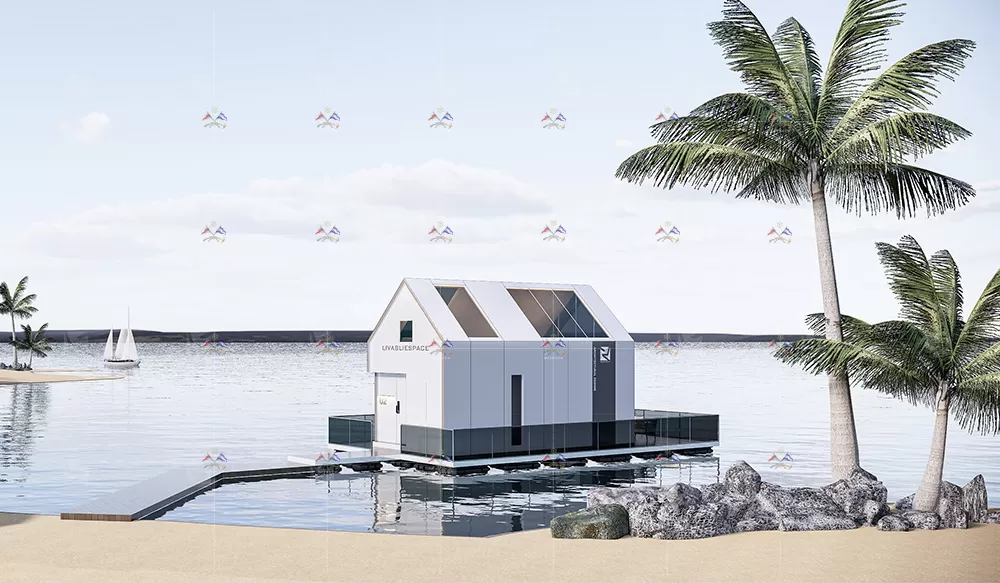
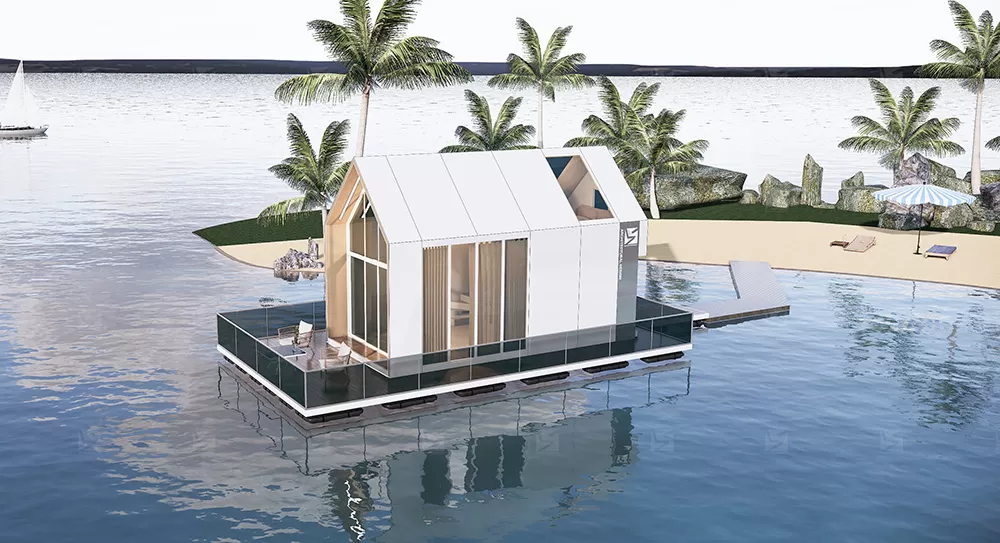
Waterfront tourism is shifting away from heavy land-based footprints. Developers and hospitality funds now recognize the financial speed of off-site construction. A prefabricated floating hotel delivers luxury accommodation without consuming land quotas, offering high nightly yields and unmatched guest appeal.
Yet, high-end guest rooms mean nothing if the marine foundation fails. If you choose the wrong pontoon or mooring system, your floating asset will suffer structural distortion, chronic roll that makes guests seasick, or catastrophic breakaways during severe storms.
At DeFever, we view the pontoon and mooring assembly as the invisible foundation of your hospitality business. This guide analyzes marine substructures from engineering, regulatory, and financial perspectives to help you procure the right systems.
Need an initial review for your water parcel? Contact our engineering team today for a technical consultation.
1. Site Condition Assessment: The Non-Negotiable First Step
Procurement must never begin with pontoon brochures. It begins with hydrodynamic surveys. A floating platform does not resist forces like a land foundation; it dissipates dynamic kinetic energy from wind, waves, and currents.
Hydrologic and Meteorological Variables
You must gather verified historical data for your specific site, targeting 50-year or 100-year return events:
Tidal Range and Water Fluctuations: Determine absolute minimum and maximum water levels. A 6-meter tide requires a fundamentally different mooring footprint than a stable freshwater lake.
Significant Wave Height (Hs) and Wave Period (Tp): Short-period chop rattles structures, while long-period ocean swells create immense cyclic bending moments on multi-module hotels.
Current Velocity: Currents exert continuous lateral drag against submerged pontoons. Surface velocity combined with depth-stratified flow dictates anchor sizing.
Wind Speeds and Windage: Two-story prefabricated guest suites present massive wind profiles, turning the accommodation blocks into sail surfaces during tropical squalls.
Geotechnical and Bathymetric Surveys
Bathymetric surveys create an accurate contour map of the seabed or lake bottom. Sub-bottom profiling reveals whether the substrate is loose silt, dense sand, or solid granite bedrock. You cannot select an anchoring mechanism without knowing what the marine floor can hold.
2. Pontoon Selection: Structural Stability and Material Trade-offs
The pontoon must support both static loads (the deadweight of the prefabricated hotel suites, furniture, and MEP systems) and dynamic loads (guests, wind pressure, and wave action). It must also guarantee adequate freeboard to keep entrances dry under peak live loading.
Four primary materials dominate commercial marine construction. Each presents distinct tradeoffs in capital expense (CAPEX), operating cost (OPEX), and lifespan.
| Material Type | Design Lifespan | Structural Mass | Corrosion Resistance | Primary Use Case |
|---|---|---|---|---|
| Heavy-Duty Marine Concrete | 50+ Years | Very High | Exceptional in saltwater | Multi-story boutique suites, public lobbies, open-water resorts |
| Marine-Grade Steel | 25–35 Years | High | Requires active cathodic protection | Heavy bespoke platforms, deep-water installations |
| Structural Aluminum Frame + HDPE Pods | 20–30 Years | Low to Medium | High (marine-grade 6061/5083) | Single-story eco-lodges, calm bays, lakes, and inland waterways |
| Modular Rotomolded Polyethylene (HDPE) | 10–15 Years | Low | Inert to saltwater | Access walkways, light auxiliary docks, floating pool decks |
Heavy-Duty Marine Concrete Pontoons
Reinforced marine concrete is the global standard for luxury overwater hospitality. Its massive self-weight produces low natural frequencies, dampening wave movements so guests rarely feel motion underfoot.
High-performance concrete mixes resist saltwater degradation and chloride intrusion. Closed-cell expanded polystyrene (EPS) cores provide unsinkable reserve buoyancy even if the exterior shell sustains impact. The drawback lies in logistics: heavy concrete pontoons demand specialized launch sites and heavy-lift cranes.
Steel Pontoons
Steel offers massive structural strength and accommodates complex, long-span modular builds. It allows integrated basement-style technical rooms below the waterline for holding tanks, batteries, and desalination units.
However, steel requires vigilant maintenance. Without active cathodic protection (sacrificial anodes or impressed current systems) and durable epoxy coatings, saltwater corrosion will rapidly shorten the hull's operational life.
Aluminum Frames with HDPE Floats
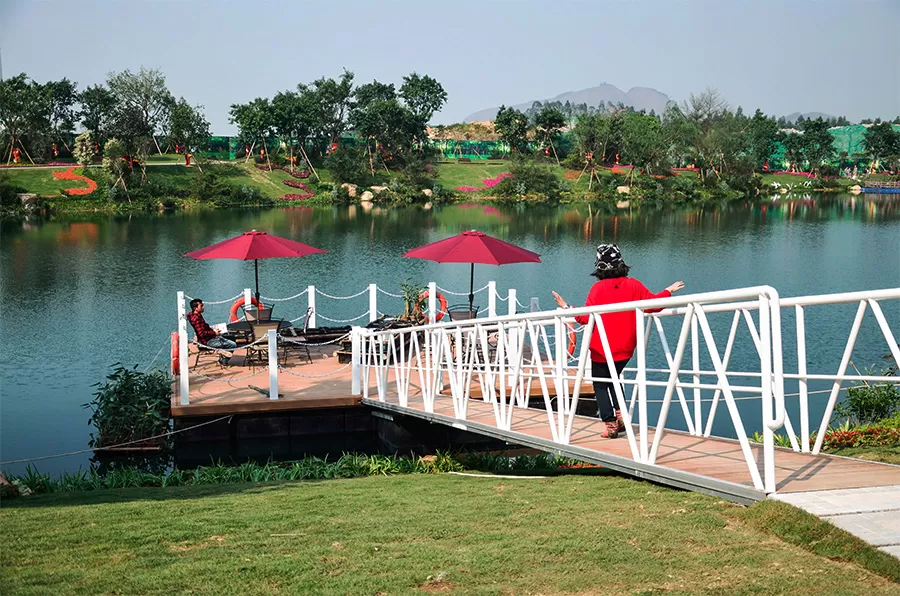
Marine-grade aluminum trusses paired with heavy-duty rotomolded or HDPE floats provide a balance of structural integrity and manageable weight. These systems simplify shipping to remote islands where commercial marine cranes are unavailable.
They perform well in protected lagoons and lakes. However, their light self-weight means they react rapidly to surface chop unless engineered with specialized wave attenuators.
Buoyancy Reserve and Metacentric Height
When engineering a prefabricated floating hotel, DeFever calculates a minimum reserve buoyancy of 30% to 50% beyond the total calculated wet load. We also evaluate the metacentric height (GM) to ensure that when all guests crowd onto one perimeter balcony, the angle of heel remains imperceptible.
3. Mooring Systems: Securing Your Investment Against Extreme Forces
If the pontoon provides buoyancy, the mooring system provides safety. The mooring apparatus must resist horizontal environmental forces while permitting necessary vertical travel as tides rise and fall.
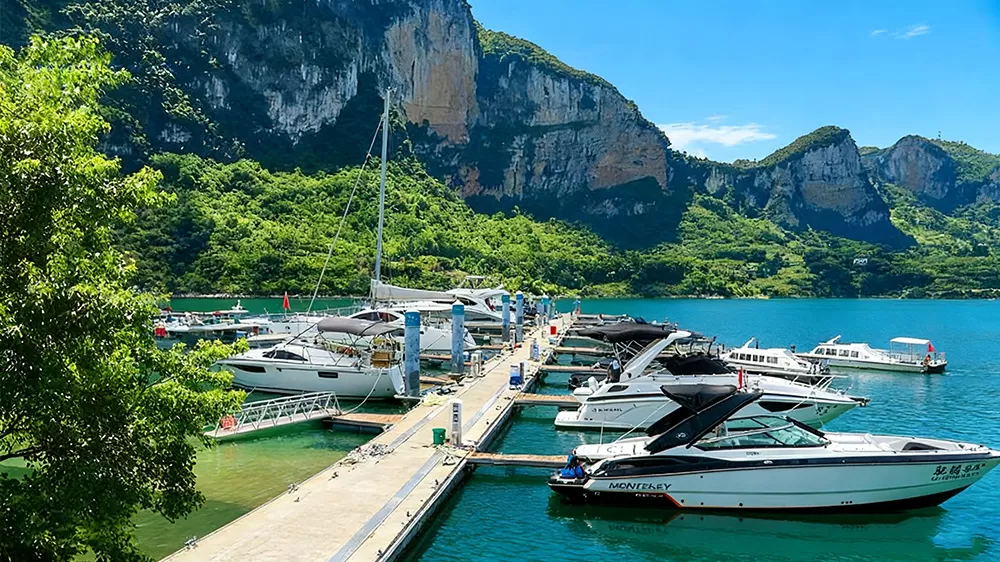
Pile and Guide Collar Systems (Dolphin Mooring)
Piles are steel or concrete tubular columns driven deep into the seabed. Heavy-duty internal or external guide collars link the floating hotel to the pile, fitted with wear-resistant elastomeric rollers.
Advantages: Piles deliver rigid horizontal positioning with virtually zero lateral sweep, making them perfect for tight marina spaces.
Drawbacks: Piling barges drive up CAPEX. They are impractical in water deeper than 15 meters or over impenetrable bedrock. Exposed piles also disrupt pristine natural views.
Elastic Tether Systems (Seaflex or Similar)
Elastic moorings use reinforced synthetic elastomeric hawsers anchored to seabed screws or concrete sinkers. As the tide rises or wind loads increase, the elastomers stretch predictably, absorbing energy through smooth elongation.
Guest Comfort: These systems eliminate the harsh metal-on-metal squeaks and clangs common with traditional chain systems, protecting the guest experience.
Eco-Friendly Credentials: Elastic moorings stay suspended above the seabed, preventing heavy chain drag from destroying sensitive seagrass beds or coral reefs. This simplifies environmental permitting.
Deadweight Anchors and Stud-Link Chains
This traditional maritime solution combines precast concrete anchor blocks (sinkers) dropped onto the floor with heavy marine-grade stud-link chains. The catenary curve of the chain provides the restoring force when waves displace the hotel.
Best Used: In deep water or exposed bays where driven piles are cost-prohibitive.
Disadvantages: Chains require a broad swing radius, limiting the layout density of your hotel keys. They also demand regular underwater diver inspections to check link wear and ground-tackle scour.
Redundancy and Typhoon Resilience
Catastrophic mooring failures happen when one critical link gives way and adjacent anchors experience progressive shock loading. Mooring geometry should provide a minimum safety factor of 2.0 to 2.5 under peak storm loading. Essential anchor tethers must feature built-in dual-line redundancy.
4. CAPEX vs. OPEX: Lifecycle Cost Analysis
Procurement teams often favor lightweight pontoons due to lower upfront manufacturing and freight costs. However, experienced resort operators evaluate the total cost of ownership across a 25-year asset cycle.
A lower-grade pontoon may save 15% during initial construction, but it incurs recurring financial penalties:
Repainting and Recoating: Steel platforms demand costly dry-docking or complex cofferdam deployments every 7 to 10 years to maintain their protective coatings.
Insurance Premiums: Marine underwriters scrutinize pontoon materials and mooring engineering. Robust concrete platforms paired with engineered elastic moorings command lower commercial property risk rates.
Operational Disruption: Unscheduled hull inspections and mooring repairs take keys out of service, costing operators thousands of dollars in lost room revenue.
Concrete pontoons deliver a lower total cost of ownership in saltwater resort environments. They resist water penetration, require zero rust maintenance, and offer an operational service life exceeding 50 years.
5. Utility and MEP Integration Across Floating Interfaces
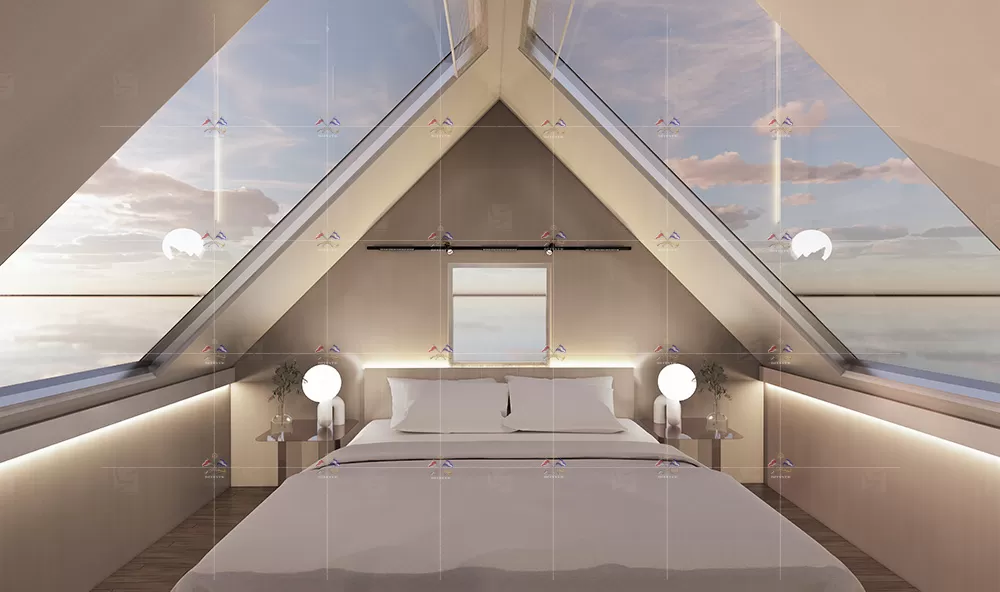
A prefabricated floating hotel must supply seamless luxury services: high-pressure showers, uninterrupted electricity, air conditioning, and silent wastewater discharge. Connecting these high-capacity utility lines from dry land to a continually shifting marine structure presents unique engineering challenges.
Dynamic Flex-Joints
Rigid pipes crack under cyclic tidal movement. You must route domestic fresh water, chilled water loops, and fire suppression mains through flexible, braided stainless-steel or heavy-wall marine rubber flex-hoses at every shore-to-dock and pontoon-to-pontoon hinge.
Vacuum and Pressurized Blackwater Networks
Gravity-fed drainage lines require substantial pitch, which floating pontoons cannot accommodate across extended lengths. Modern floating hotels deploy vacuum drainage networks or centralized marine lift stations.
Waste flows into sealed, odor-proof intermediate holding tanks hidden within pontoon service channels, where industrial macerator pumps propel blackwater ashore through high-density polyethylene (HDPE PE100) lines.
Internal Substructure Service Trays
Exposing utility runs to open sea air leads to rapid UV degradation and salt crusting. Advanced pontoons incorporate dry, cast-in-place service utility trenches beneath the walkable decking. These trenches keep electrical distribution, fiber optics, and water infrastructure dry, accessible, and hidden from guest view.
Frequently Asked Questions (FAQ)
Q1: Can a prefabricated floating hotel withstand severe typhoons or hurricanes?
A1: Yes, provided the structure is engineered to appropriate site criteria. Survival depends on hydro-structural engineering: calculating the combined windage of the prefabricated buildings, maximum wave run-up, and tidal storm surge. Platforms secured with heavy-duty concrete foundations, rated elastic moorings, or reinforced guide collars handle category 4 and 5 hurricane loads safely.
Q2: How do you prevent guests from experiencing seasickness inside the rooms?
A2: Motion mitigation begins with pontoon mass and configuration. Heavy concrete pontoons have large natural roll periods that resist high-frequency chop. Designers also link multiple individual pontoons using semi-rigid elastomeric hinge joints to create large, stable waterplanes. For exposed areas, submerged wave-damping skirts or outer breakwaters calm incoming swell energy before it reaches guest rooms.
Q3: What permits are required to deploy pontoons and mooring systems?
A3: Permitting varies by jurisdiction, but most countries regulate floating structures under marine, maritime safety, and environmental conservation portfolios rather than municipal land-building codes. You will typically need environmental clearance regarding seabed impact (protecting benthic habitats), navigation safety approvals from maritime coast guards, and structural certification from recognized marine classification societies.
Q4: How long do concrete pontoons last in high-salinity seawater?
A4: High-grade marine concrete pontoons possess a design lifespan of 50 years or more. They use dense, low-permeability concrete mixtures incorporating silica fume or slag, along with stainless steel, epoxy-coated rebar, or non-corrosive basalt fiber mesh. This prevents the chloride ions in seawater from reaching and corroding the internal reinforcement steel.
Q5: How is blackwater handled to ensure zero discharge into surrounding waters?
A5: Pristine water is your resort’s primary asset, so zero-discharge operations are mandatory. Floating hotels deploy centralized vacuum drainage or low-pressure sewer networks embedded inside the pontoon utility ducts. Wastewater gathers in fully sealed pontoon holding tanks and transfers to on-shore municipal sewers or a land-based membrane bioreactor (MBR) wastewater treatment plant.
Secure Your Floating Hospitality Vision with DeFever
Developing a prefabricated floating hotel requires an integrated approach spanning off-site architecture, hydrodynamic analysis, and marine installation. Overlooking the marine foundation risks the safety of your guests, your investment, and your operational license.
DeFever engineers and supplies end-to-end pontoon and mooring systems tailored to unique marine environments worldwide. We partner with resort developers, modular builders, and maritime operators to deliver resilient, luxurious, and fully certified floating properties.
Ready to evaluate your water asset?
Request a Feasibility Study: Submit your site bathymetry and wave data to our engineering department.
Download Pontoon Specs: Review our comprehensive marine-grade concrete and composite hull loading data.
Speak with our Engineers: Schedule a technical consultation to review your hospitality master plan.
Contact the DeFever technical team today to build your overwater resort on a reliable marine foundation.