2026-10-15
1. Introduction: The Engineering Imperative of Floating Bridges
When a conventional fixed bridge is not feasible—due to extreme water depth, unstable seabed conditions, environmental restrictions, or the need for a temporary crossing—engineers turn to a specialized solution: the floating bridge. These structures are not merely pontoons linked together; they are complex, dynamic systems that must safely carry pedestrian, vehicular, or even rail traffic while responding continuously to water level fluctuations, waves, wind, and currents. This article provides a deep technical dive into the design principles, material science, and operational realities of modern floating bridges, drawing on decades of global waterfront engineering experience.
2. Foundational Technology: How Floating Bridges Work
The core principle of a floating bridge is buoyancy. However, translating that principle into a safe, durable, and stable crossing requires sophisticated engineering across several disciplines.
2.1 The Buoyancy System: Pontoons and Floats
The primary load-bearing elements are the pontoons. Their design dictates the bridge's capacity, stability, and response to environmental forces.
Steel Pontoons: Dominant in heavy-duty, permanent, or military applications. Steel offers the highest strength-to-weight ratio, allowing for large, internally stiffened compartments. These compartments provide reserve buoyancy—if one is breached, the bridge remains afloat. Cathodic protection and marine-grade coatings are mandatory to mitigate corrosion in saltwater.
Reinforced Concrete Pontoons: Often specified for very large, permanent floating bridges (like those in the Pacific Northwest of the USA or Norway). Their immense mass provides inherent stability and dampens wave-induced motion. They are highly durable and require less long-term maintenance than steel in many environments, though they are more complex to construct and tow into place.
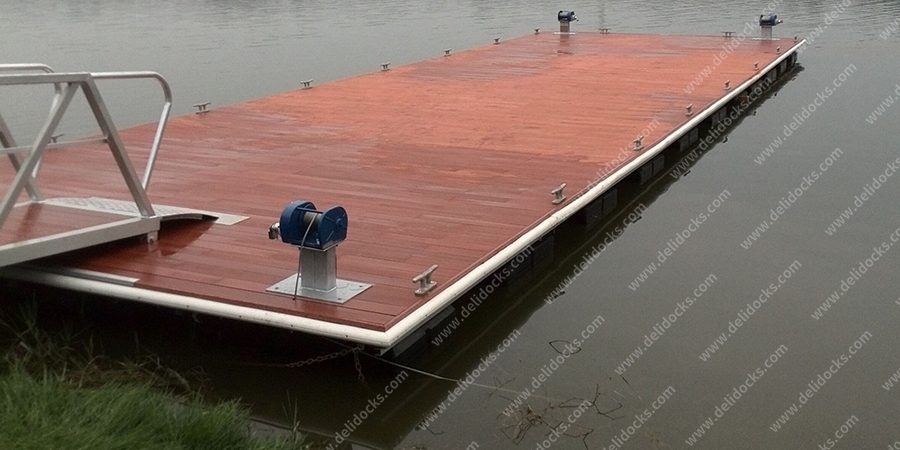
Polymer/Composite Pontoons: Used for lighter-duty applications such as pedestrian walkways, temporary work platforms, and recreational access bridges. They are corrosion-proof, lightweight, and modular, facilitating rapid installation and reconfiguration. However, their load-bearing capacity and long-term UV resistance are lower than steel or concrete.
2.2 Mooring and Restraint Systems
Unlike a fixed bridge, a floating bridge must be held in position against lateral forces (wind, current, waves) while being allowed to move vertically with the water level. This is achieved through several methods:
Pile-Guided Systems: The bridge is attached to vertical guide piles that allow it to slide up and down but restrain lateral movement. Common for approach spans and smaller bridges in protected waters.
Anchor and Chain Systems: Heavy anchors (concrete blocks, driven piles, or drag anchors) are connected to the pontoons via chains or cables. The catenary curve of the chain provides a restoring force—the more the bridge moves laterally, the more chain lifts off the bottom, increasing the tension pulling it back. This is the most common method for open-water crossings.
Tension Leg Systems: Vertical mooring lines (tendons) are anchored to the seabed under tension, holding the pontoons down against their excess buoyancy. This virtually eliminates heave, pitch, and roll, providing an exceptionally stable deck. Used for specialized applications like floating bridges in exposed locations or for vessel transfer.
2.3 Articulating Connections and Deck Design
The connections between pontoon segments and the transition spans to the shore are critical engineering elements. They must accommodate:
Rotational movements (pitch, roll, yaw) between adjacent pontoons.
Longitudinal and transverse displacements from thermal expansion and mooring forces.
Vertical movement from tidal changes and wave action.
This is achieved with articulated hinges and expansion joints, often using large steel pins and bearings. The roadway or walkway deck itself must be designed to be flexible yet durable, with a high-friction surface appropriate for the intended traffic (vehicles, pedestrians, or both).
3. Application-Specific Design and Analysis
The design of a floating bridge is profoundly influenced by its intended use and environmental context.
3.1 Vehicular Floating Bridges
These are major infrastructure projects designed to carry highway or even rail traffic. The engineering challenges are immense:
Hydrodynamic Analysis: Detailed modeling of wave spectra, current velocities, and potential seiches (standing waves) in enclosed basins. This data drives the design of the pontoon shape and mooring system to ensure acceptable motions (accelerations) for traffic safety and user comfort.
Live Load Distribution: Analysis of how heavy truck or train loads transfer through the articulated structure. Fatigue life of connections under repeated traffic cycles is a primary design criterion.
Extreme Event Resilience: Design must withstand 100-year or 500-year storm events, including storm surge and wave impact. Redundancy is key—if one pontoon is damaged, the structure must remain stable. DeFever, with its robust industrial supply chain, has the capacity to fabricate the massive steel pontoons and precision connection hardware required for such demanding projects.
3.2 Pedestrian and Light-Duty Floating Bridges
Common in parks, marinas, and ecotourism developments, these structures prioritize aesthetics, accessibility, and low environmental impact.
Modular Systems: Often constructed from aluminum or polymer-composite pontoons with hardwood or composite decking. Their modularity allows for curved layouts and adaptation to site constraints.
Accessibility: Ramped approaches must meet ADA (Americans with Disabilities Act) or equivalent standards, with gentle slopes that account for the full tidal range.
Integration: May include utility conduits for lighting, water, or data lines, requiring careful waterproofing and protection from mechanical damage.
3.3 Temporary and Military Floating Bridges
Designed for rapid deployment and retrieval, these are typically standardized, modular components that can be assembled quickly. The M3 Amphibious Rig and Improved Ribbon Bridge (IRB) are well-known examples. Speed of assembly, load capacity, and transportability are the driving design factors.
4. The B2B Perspective: Procurement, Installation, and Lifecycle
For project owners and contractors, selecting a floating bridge is a capital investment decision with long-term operational implications.
4.1 Critical Technical Specifications
When issuing an RFP or evaluating proposals, key technical data to request includes:
Buoyancy and Freeboard Calculations: Verified by a professional engineer, including safety factors.
Mooring System Design Basis: The environmental criteria (wind speed, current velocity, wave height) used for design.
Structural Analysis Reports: For all major load cases (dead, live, environmental, accidental).
Material Certifications: Mill certificates for steel, mix designs for concrete, and UV stability data for polymers.
Connection Hardware Specifications: Material grade, load ratings, and corrosion protection details.
4.2 Installation Logistics
Floating bridge installation is a specialized marine operation. Key phases include:
Site Preparation: Seabed survey, installation of mooring anchors/piles, and preparation of abutments on both shores.
Prefabrication and Transport: Pontoons are typically fabricated off-site (often in a controlled shipyard environment) and then towed or barged to the location. DeFever’s experience in managing global logistics ensures that even large, complex components arrive on schedule and within budget.
Assembly and Connection: Pontoons are positioned and connected sequentially, starting from one shore. This requires precise marine maneuvering and alignment.
Mooring Hook-up and Testing: Chains or cables are connected to pre-installed anchors, tensioned, and tested. Load-out tests may be performed with ballast or heavy vehicles to verify performance.
4.3 Maintenance and Total Cost of Ownership
The long-term cost of a floating bridge is heavily influenced by the chosen materials and design.
Steel Pontoons: Require regular inspection and maintenance of coatings and sacrificial anodes. Costly dry-docking for major repairs may be needed every 20-30 years.
Concrete Pontoons: Minimal maintenance on the hull itself, but connections and moorings still require regular inspection. They are often less expensive to maintain over a 75-100 year design life.
Connections and Deck: These are the highest-maintenance items. Hinge pins need lubrication and inspection for wear. Expansion joints require periodic replacement. The deck surface must be maintained for skid resistance and to prevent water ingress to the structure below.
5. Industry Challenges and Engineering Solutions
Decades of global floating bridge projects have revealed persistent challenges that demand innovative solutions.
Challenge: Extreme Wave and Current Loading. Solution: Adoption of advanced hydrodynamic modeling (computational fluid dynamics) and model testing in wave basins. Use of tuned mass dampers or hydrodynamic shapes that minimize wave response.
Challenge: Corrosion in the Splash Zone. The area just above and below the waterline is the most vulnerable. Solution: Applying advanced coating systems (epoxy/polyurethane), specifying corrosion-resistant alloys (duplex stainless steel) for critical components, and implementing rigorous inspection protocols.
Challenge: Vandalism and Fire Risk. Solution: Designing pontoons with multiple watertight compartments. Using non-combustible or fire-retardant materials where possible. Implementing security lighting and access control.
Challenge: Environmental Permitting. Concerns about water circulation, shading of benthic habitats, and fish passage. Solution: Designing pontoons to allow light penetration (e.g., grated deck sections, strategic gaps). Using clean, non-toxic materials. Minimizing dredging and seabed disturbance during installation.
6. Conclusion: A Specialized Domain Requiring Proven Expertise
The successful delivery of a floating bridge—whether a modest pedestrian walkway or a major vehicular crossing—demands a rare combination of naval architecture, structural engineering, geotechnical knowledge, and marine construction expertise. It is not a domain for generic contractors. Engaging a partner with a proven track record, deep technical resources, and a commitment to quality across the entire supply chain is essential for mitigating risk and ensuring a structure that performs safely and durably for its intended lifespan.
Frequently Asked Questions (FAQ) About Floating Bridges
Q1: What is the maximum length possible for a floating bridge?
A1: There is no fixed theoretical maximum length, as it depends on water conditions and technology. The current record-holder is Washington State's SR 520 floating bridge in the USA, with a total floating length of approximately 2,350 meters (7,710 feet). Proposals for much longer crossings, such as across fjords in Norway (up to 5 km), are in advanced planning stages, utilizing tension-leg or curved designs to manage environmental forces.
Q2: How is a floating bridge protected against sinking if a pontoon is damaged?
A2: This is addressed through the principle of reserve buoyancy. Critical pontoons, especially on major bridges, are divided internally into multiple watertight compartments by bulkheads. If one compartment is breached and floods, the remaining intact compartments provide enough buoyancy to keep the entire pontoon and the bridge deck afloat and stable. Design codes mandate specific levels of reserve buoyancy based on the bridge's importance and traffic.
Q3: Can a floating bridge be used in areas that freeze in winter?
A3: Yes, but it requires special design considerations. Ice loading can be a major force. Solutions include: 1) Designing pontoon shapes that allow ice to ride up or break without damaging the structure. 2) Using "bubbler" systems that circulate warmer water to prevent ice formation directly around the pontoons. 3) In extreme cases, designing the bridge to be removable before freeze-up. The presence of ice significantly complicates both design and operation.
Q4: How does a floating bridge handle very large ships passing nearby?
A4: Large vessels generate significant drawdown and wake surges. Bridges in navigable waters are designed to withstand these loads. Additionally, navigation channels are typically located away from the main floating structure, which is often in shallower water. If a channel must pass through a floating bridge, a movable span (like a drawbridge or a retractable/pontoon section) must be incorporated, which adds significant complexity and cost.
Q5: What is the typical cost comparison between a floating bridge and a fixed bridge?
A5: This is highly site-specific. A floating bridge is generally considered when a fixed bridge would be prohibitively expensive or technically impossible—for example, in water depths exceeding 60-80 meters, where fixed piers become extremely costly. While the floating structure itself is expensive, it avoids the massive costs of deep-water foundations. The total project cost must include long-term maintenance (especially for moorings and connections), which can be higher for a floating bridge than a conventional one.
Q6: What kind of permits are required for a private floating bridge?
A6: Permitting is often complex and varies by jurisdiction (federal, state/provincial, local). It typically involves: 1) Waterway navigation permits (from authorities like the US Coast Guard or local port authority). 2) Environmental permits assessing impacts on wetlands, fish habitats, and water quality. 3) Shoreline development permits from local municipalities. 4) Building permits for the structure itself. Engaging a permitting specialist early is highly recommended, as this process can take 1-3 years or more.