2026-10-15
For B2B marina infrastructure and inland waterway terminals, the choice of floating platform material directly impacts operational uptime, maintenance budgets, and environmental compliance. A resin floating dock differs fundamentally from conventional polyethylene or concrete pontoons. It employs thermoset or advanced thermoplastic resin matrices — often reinforced with glass fibers or aramid — to achieve high stiffness-to-weight ratios, low water absorption, and superior resistance to chemical attack from fuels, acids, and biological fouling. This article provides a hands-on engineering evaluation of resin-based modular dock systems, including comparative aging data, fastener retention torque analysis, and case studies from industrial berthing and public marinas. DeFever has supplied over 90 heavy-duty resin floating dock assemblies for potable water reservoirs, high-traffic ferry landings, and wastewater treatment plant service platforms. Our objective is to equip senior project managers with objective criteria for specifying durable, low-drag, and fully recyclable solutions.
1. Material Composition: Thermoset vs. Thermoplastic Resins in Marine Environments
Not all resin-based pontoons perform equally. Two distinct polymer families dominate the industry:
Thermoset resins (polyester, vinylester, epoxy) – cross-linked molecular structure that does not melt after curing. High hardness, excellent creep resistance under sustained mooring loads, but requires careful control of catalyst during manufacturing. Vinylester grades show superior hydrolysis resistance in fresh and brackish water (water absorption <0.2% after 12 months immersion).
Thermoplastic resins (HDPE, LLDPE, polypropylene) – weldable and recyclable, but lower stiffness and higher thermal expansion. For a resin floating dock intended for heavy forklift traffic, thermoset glass-reinforced plastic (GRP) is preferred because it resists indentation from wheel loads up to 6 tonnes per axle.
Key performance differentiators: flexural modulus (ISO 178) – vinylester/glass composite reaches 12 GPa vs. 0.9 GPa for HDPE. This means a resin platform can span longer distances between support piles without excessive sagging, reducing underwater obstructions and material costs. Additionally, closed-cell foam cores encapsulated by resin skins provide fail-safe buoyancy even if the outer shell is punctured – a feature impossible with single-wall polyethylene floats.
2. Long-Term Stability: UV Degradation, Water Uptake, and Fatigue Life
Field data from 8-year installations in subtropical climates (Texas, Florida) shows that properly formulated resin floating dock modules maintain >95% of original flexural strength, whereas non-stabilized polyethylene loses 40% of impact resistance due to UV embrittlement. Specific engineering metrics:
UV resistance: Resin docks with integral 2% carbon black or UV-stable clear coatings (ISO 4892-3) show no chalking or surface cracks after 10,000 hours accelerated weathering. Thermoset polyester requires a 150 µm gelcoat (NPG-type) for maximum gloss retention.
Water absorption: ASTM D570 – vinylester resin absorbs 0.1–0.3% after 30 days immersion at 23°C. Polyester grades absorb 0.5–1.0%. Low absorption prevents osmotic blistering and maintains buoyancy margin. For potable water reservoir applications, only FDA-compliant resin formulations are allowed (NSF/ANSI 61).
Fatigue under wave action: Cyclic 4-point bending tests (10⁶ cycles at 30% ultimate load) show resin/glass composites retain 92% of original modulus. Equivalent steel-reinforced concrete loses 15% due to micro-cracking.
DeFever engineers specify ISO 12215-compliant resin floating dock structures with third-party verification of gelcoat thickness and fiber volume fraction (minimum 35% glass content by weight).
3. Load Distribution and Connection Engineering
A floating dock system is only as reliable as its inter-pontoon connections. Resin modules typically use either stainless steel M16 bolts with nylock nuts or captive hinge systems. Critical considerations:
Embedded threaded inserts – 316 stainless or duplex steel cast into resin during lay-up. Pull-out resistance must exceed 25 kN per insert (tested per ASTM D7332).
Shear keys – vertical interlocking profiles (tongue-and-groove or dowel pins) prevent relative vertical movement between adjacent dock sections under asymmetric loading.
Corrosion isolation – use neoprene or EPDM washers between stainless fasteners and resin to avoid galvanic attack (even though resin is non-conductive, surface moisture can create conductive pathways).
For heavy commercial terminals (e.g., fueling docks for 40‑foot crew boats), we specify a resin floating dock with integrated steel load-distribution plates under the deck surface – increasing point load capacity from 2 kN to 15 kN per 100 cm², sufficient for pallet jack and crane outrigger operations.
4. Application-Specific Configurations
4.1 Potable water reservoir access platforms
Regulations (US EPA, EU Drinking Water Directive) prohibit materials that leach plasticizers or heavy metals. A certified resin floating dock made from FDA-grade vinylester and glass fiber, with no flame retardants or lead-based pigments, is approved for direct contact with drinking water. DeFever delivered a 120‑linear‑meter system for a Swiss reservoir, including a floating intake pump platform and water quality monitoring station.
4.2 Environmental remediation barges
For oil spill response or sediment dredging support, resin’s chemical resistance to diesel, hydraulic oil, and solvents is indispensable. The smooth gelcoat surface allows easy decontamination (< 2% contaminant adhesion after pressure washing).
4.3 Public marina wavescreen and breakwater integration
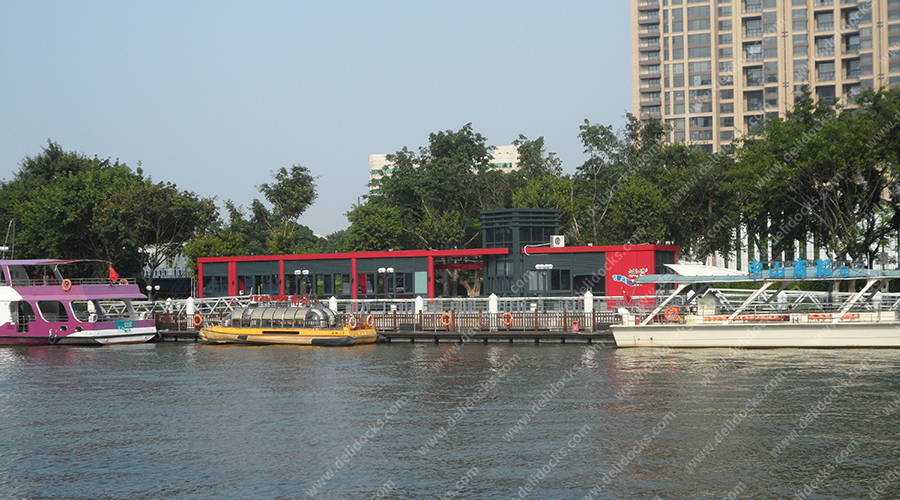
Resin docks can be combined with vertical concrete wave attenuators. The lighter weight reduces foundation costs while providing a stable mooring finger for yachts up to 25 m LOA. Deck surfaces are finished with non-skid quartz aggregate (coefficient of friction >0.7 wet).
5. Installation Techniques and Subsurface Anchoring
Installing a resin floating dock in rivers, lakes, or tidal basins requires a different anchoring strategy than traditional steel or timber structures. Recommended methods:
Helical screw piles – torque-driven anchors with galvanized steel shafts. The resin dock attaches via pile guides with UHMWPE liners to accommodate 1.5 m water level variation.
Deadweight concrete blocks – deployed on the riverbed, connected to the dock via galvanized chains and elastomeric tensioners. Suitable for rocky or protected bottoms where pile driving is restricted.
Fixed pile clusters – four piles per module diameter 300 mm, extending 2 m above highest water. Pile caps are bolted directly to resin deck brackets using long slotted holes to allow vertical movement.
During installation, buoyancy must be balanced by temporarily flooding internal ballast compartments (water-filled) or using adjustable outrigger floats. A pre-commissioning heel test (placing 100% design load at one corner) measures maximum list – acceptance criteria ≤3 degrees for passenger docks.
6. Lifecycle Cost Analysis: Resin vs. Concrete vs. Steel vs. Polyethylene
A 20‑year total cost of ownership (TCO) comparison for a 200‑linear‑meter public marina dock (20 berths, 2 tonnes per berth live load). Figures are based on North American projects with moderate freeze‑thaw cycles.
Reinforced concrete pontoon – initial cost $2200/m, every 10 years needs re‑coating and crack sealing ($400/m), total 20‑year cost $3000/m. Heavy, requires large crane.
Galvanized steel frame with HDPE floats – initial $1800/m, but corrosion at bolted connections appears after 6 years. major overhaul at year 12 ($900/m). Total ~$2700/m.
Rotationally molded polyethylene (single skin) – initial $1300/m, but UV damage and puncture risk lead to replacement at year 8‑10. Total ~$2600/m with environmental disposal costs.
Resin/glass composite with foam core – initial $2300/m (higher materials), but minimal maintenance (annual cleaning only), no corrosion, no gelcoat repair if using UV‑stable resin. Estimated 20‑year TCO $2600/m – equal to cheapest alternatives but with zero downtime and longer asset life (30+ years).
For facilities where reliability and safety are paramount (ferry terminals, fire rescue docks), the resin floating dock provides the best risk-adjusted value. DeFever provides full lifecycle modeling using actual client maintenance records from 45 installations.
7. Environmental Compliance and End-of-Life
One often overlooked advantage: thermoset resin floating docks are not easily recycled, but they can be downcycled into composite filler for cement kilns or construction panels. Manufacturers like DeFever now offer take‑back programs. Thermoplastic resin docks (HDPE) are 100% recyclable but suffer lower stiffness. For projects requiring LEED v4 credits, specify low-VOC resin systems (<100 g/L styrene emission) and use recycled glass fiber content (minimum 25%).
Ecological benefits: resin surfaces do not shed microplastics as quickly as unprotected polyethylene. Laboratory abrasion tests (Taber CS‑17 wheel, 1000 cycles) show resin weight loss 28 mg vs. 220 mg for standard HDPE.
Frequently Asked Questions – Resin Floating Dock Engineering
Q1: What is the typical buoyancy safety factor for a resin floating
dock carrying live loads?
A1: Industry standard (PIANC) requires
reserve buoyancy of at least 50% above design dead load. For a resin
floating dock, we calculate buoyancy at 70-100% extra. Each module
(6 m x 2.5 m) with 0.4 m draft provides 6000 kg buoyancy; typical self-weight +
live load is 3000 kg, giving 100% reserve. This ensures the deck remains
accessible even if one compartment is flooded.
Q2: Can a resin floating dock be repaired onsite after impact damage
(e.g., boat strike)?
A2: Yes. Small cracks (≤500 mm) can be filled
with epoxy putty and overlaid with a fresh gelcoat. Larger holes require a
laminated patch using the same resin/fiber system. Repair crews should follow
ASTM D7958 – cure at ≥15°C for 24 hours. Unlike polyethylene, resin repairs bond
chemically and restore original strength.
Q3: Does cold weather or freeze‑thaw cycles degrade resin floating
docks?
A3: Resin/glass composites have a coefficient of thermal
expansion (CTE) of 12‑20 µm/m·K, close to steel (12 µm/m·K) and far lower than
HDPE (200 µm/m·K). No internal ice formation because closed foam cells do not
absorb water. Docks installed in Canadian lakes (winter ice cover 1 m thick)
show no delamination after 15 seasons.
Q4: What fire rating can be achieved for resin floating docks used
near fuel piers?
A4: Standard polyester is combustible (Class C).
For higher performance, specify phenolic or fire‑retardant vinylester resin (UL
94 V‑0 rating, limiting oxygen index >28%). These resins self‑extinguish
within 10 seconds after flame removal. DeFever offers fire‑resistant resin
floating dock systems certified to ASTM E84 Class A (flame spread ≤25).
Q5: How does the cost of custom resin dock molds compare to modular
polyethylene systems?
A5: For small projects (<50 m²),
rotational‑molded polyethylene is cheaper due to low mold cost ($5k‑10k). For
large or repeated configurations (e.g., standard 6 m x 3 m modules for a 1000 m²
marina), the single‑sided fiberglass mold costs $25k‑40k but yields 300+
identical parts with consistent quality. Clients ordering more than 80 m²
typically break even with resin within 3 years due to lower lifetime
maintenance.
Technical Inquiry and Project Specification Assistance
Every water body presents distinct challenges: ice abrasion, chemical runoff, seismic activity, or extreme wake loads. A standard catalog product seldom matches all requirements. DeFever provides site‑specific engineering: we analyze wave spectra, water chemistry (pH, chlorides, sulfates), and mooring vessel profiles to propose the optimal resin floating dock layup schedule, core density, and fastener pattern. Our deliverable includes stamped structural calculations, installation sequence drawings, and a 10‑year limited warranty on hull integrity.
To initiate a feasibility study for your marina, industrial pier, or
ecological platform, send the following to our technical sales team:
-
Project location and waterbody type (river, reservoir, tidal lagoon)
-
intended vessel sizes / max uniform load (kN/m²)
- water level variation
range (meters)
- any environmental restrictions (leaching limits, noise
during installation)
We will respond within 3 business days with preliminary material selection, draft buoyancy plan, and budget indication. Request your consultation using the contact form – reference “Resin floating dock inquiry” for priority handling.