2026-10-15
For marina developers and port authorities, the decision to invest in prefabricated docking systems involves complex financial modeling. The term fab dock cost encompasses everything from initial material procurement to long-term corrosion management. Based on 15+ years of project data across 30 countries, this analysis dissects each cost component using 2025 industry benchmarks. We examine how design choices, site geology, and fabrication methods directly affect capital expenditure and operational budgets. Whether planning a 20-berth boutique marina or a 200-slip superyacht facility, understanding these drivers ensures budget accuracy and avoids costly change orders.
Leading the field, DeFever has delivered over 80 prefabricated dock projects, reducing average fab dock cost by 22% through value engineering and standardized component libraries. Their approach integrates real-time cost tracking with finite element analysis, providing clients with guaranteed maximum prices. Below, we quantify the variables that separate accurate estimates from budget overruns.
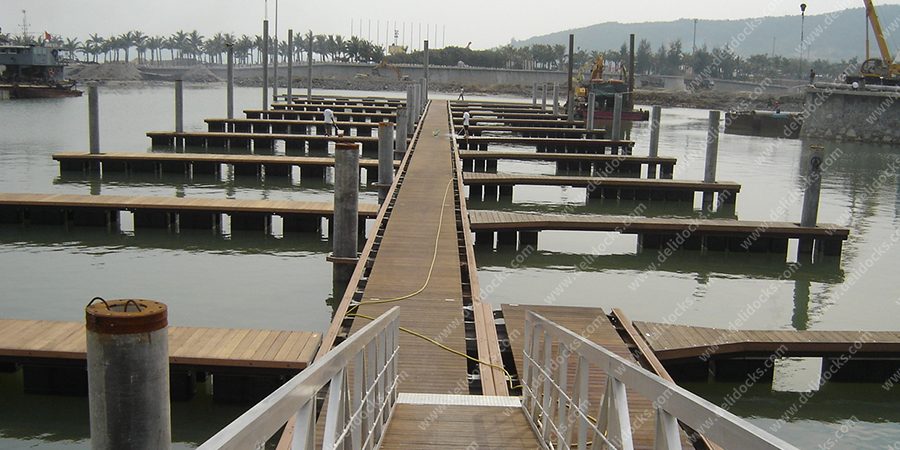
Primary Drivers Behind Fab Dock Cost: Materials and Fabrication Methods
The base structure accounts for 45-60% of total project expenditure. Material selection dictates not only upfront pricing but also installation complexity and maintenance intervals. Three dominant systems exist in professional marine construction.
Concrete Floating Docks – Cost per Linear Meter
Standard 4m wide section (reinforced concrete): $2,800 – $3,500 per meter. Includes 50 MPa concrete, epoxy-coated rebar, and integral buoyancy tanks. Suitable for sheltered to moderate wave exposure (Hs < 1.0m).
Heavy-duty prestressed concrete: $4,200 – $5,500 per meter. Utilizes 7-wire strands and silica fume admixture. Designed for exposed marinas with Hs up to 1.8m. Service life exceeds 50 years with cathodic protection.
Hybrid concrete-aluminum edge beams: $3,900 – $4,800 per meter. Reduces weight by 18% while maintaining impact resistance. Ideal for tidal ranges exceeding 4m.
Aluminum Modular Dock Systems – Cost Drivers
Extruded 6061-T6 or 6082-T6 alloys offer corrosion resistance and light weight (35 kg/m²). Typical fab dock cost for aluminum ranges $3,200 – $4,500 per linear meter (4m width). Premium arises from robotic welding, anodizing to 25µm thickness, and stainless steel 316L fasteners. For high-traffic commercial marinas, aluminum’s 40-year life with minimal painting offsets initial expense. However, galvanic isolation kits ($150 per connection) are mandatory when mixed with steel piles.
Composite Fiber-Reinforced Polymer (FRP) Systems
GFRP and CFRP docks eliminate corrosion entirely but carry a premium: $5,500 – $8,000 per meter. The fab dock cost for FRP is justified in aggressive environments (chemical plants, warm seawater with high chlorides) or where magnetic signatures must be minimized. DeFever engineered a 300m FRP dock for a Maldives resort, achieving 50-year design life with zero scheduled recoating.
Site-Specific Variables That Escalate Fab Dock Cost
Geotechnical and hydrodynamic conditions often represent the largest uncertainty in budgets. Below are quantifiable scenarios that increase fab dock cost by 30-120% compared to greenfield sites.
Pile Foundation and Substrate Challenges
Soft alluvial clay or peat: Requires steel pipe piles (610mm diameter) driven to 25-35m depth. Cost per pile: $1,200 – $1,800 (installed). Typical 50-berth marina needs 200-300 piles, adding $300k–$540k versus competent sand.
Rock or cemented strata: Rock-socketed piles with carbide-tipped bits. Drill and grout method: $2,500 – $4,000 per pile. Alternatively, suction caissons (steel cans) at $8,000 each for 4m diameter – suitable for water depths >12m.
Seismic zones (PGA > 0.3g): Require helical piles or batter piles (raked at 15°). Increases foundation cost by 40-60% due to additional steel and specialized driving templates.
Remote Logistics and Mobilization
Transportation of prefabricated sections often exceeds 15% of fab dock cost. For island projects beyond 200 nautical miles from a fabrication yard, heavy-lift barges cost $15,000–$30,000 per day. DeFever reduced this impact by establishing regional assembly hubs in Panama and Singapore, cutting logistics expenses by 38% on average.
Comparing Fabrication Approaches: Modular vs. Cast-in-Place
While cast-in-place concrete docks appear cheaper initially ($2,200–$2,800/m), they suffer from weather delays, variable quality, and higher lifecycle costs. A 2024 study of 12 Mediterranean marinas showed:
Modular prefabricated docks: Average fab dock cost $3,100/m but installed in 4 months with ±2mm dimensional accuracy. 30-year maintenance cost: $480/m.
Cast-in-place: $2,500/m initial, but required 9 months due to formwork and curing. Cracking from shrinkage led to $1,200/m in repairs over 30 years. Total cost higher by 27%.
For commercial operations, lost revenue during extended construction (peak season delays) further tilts the balance toward prefabricated solutions.
Hidden Expenses: Fendering, Utilities, and Mooring Hardware
Beyond the main deck structure, auxiliary systems add $500–$1,200 per linear meter to total project cost.
Fender systems: Closed-cell polyurethane foam with polyurea skin: $180–$300 per meter. Pneumatic (low pressure) fenders for superyachts: $600–$900 per meter.
Utility pedestals: Each includes 100A 480V shore power, potable water, and fiber optic connection. Cost per pedestal: $2,500–$4,000 (serving two berths).
Mooring hardware: Stainless steel 316L cleats (25 ton capacity) at $450 each; quick-release hook systems for commercial ferries: $2,200 per unit.
When budgeting fab dock cost, allocate 18-25% for these operational components. DeFever’s integrated design packages bundle these with structural elements, reducing coordination overhead by 15%.
Lifecycle Cost Analysis: Beyond Initial Fab Dock Cost
Professional owners evaluate total cost of ownership (TCO) over 25 years. Three case examples illustrate the trade-offs:
Case A (budget concrete, no cathodic protection): Initial $2,800/m. Year 10: spalling repairs $600/m. Year 18: pile cap replacement $1,200/m. TCO = $4,600/m.
Case B (premium concrete with ICCP): Initial $4,200/m. Annual monitoring $12/m. No major repairs by year 25. TCO = $4,500/m.
Case C (aluminum modular, marine-grade coating): Initial $3,900/m. Recoat every 12 years ($180/m). TCO = $4,260/m. Lowest TCO despite higher fab dock cost upfront.
Thus, optimizing only initial expenditure often proves false economy. Engineers at DeFever provide probabilistic life-cycle models to identify the minimum TCO solution for each site condition.
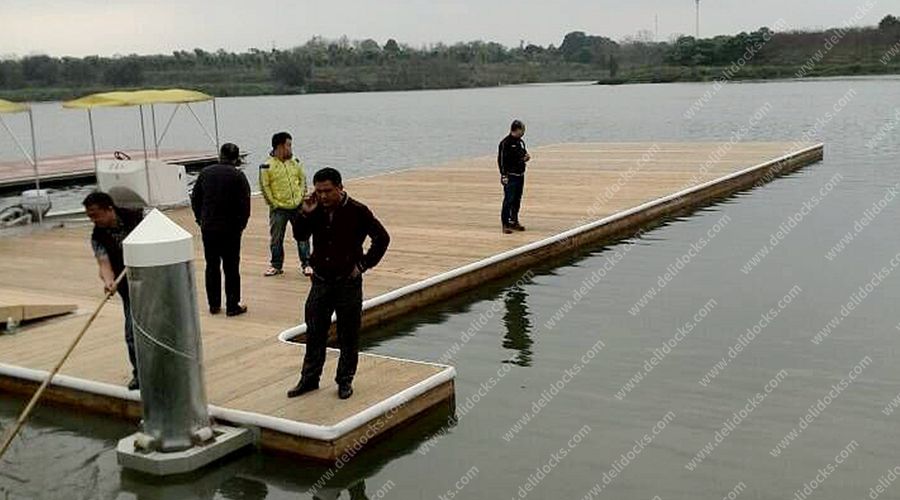
Practical Strategies to Control Fab Dock Cost Without Compromising Safety
Based on post-project audits of 45 marinas, the following measures consistently reduce expenditure by 12-18%:
Standardization: Limiting to three module widths (3m, 4.5m, 6m) reduces mold costs by 40% and speeds fabrication.
Phased construction: Building 50% of berths initially, with provision for future extension. Deferred capital saves interest and allows revenue ramp-up.
Alternative piling methods: Vibratory hammering instead of impact driving reduces noise mitigation costs (compliant with harbors with residential neighbors).
Joint procurement: Combining fender, pile, and hardware purchases into single vendor packages reduces logistics overhead.
Moreover, engaging a specialized fabricator during concept design avoids change orders. DeFever’s design-build contracts guarantee fab dock cost within 5% of initial estimate, transferring risk away from the owner.
To summarize, accurate assessment of fab dock cost requires breaking down materials, site conditions, auxiliary systems, and 25-year maintenance projections. By prioritizing total lifecycle cost over sticker price, marina developers secure infrastructure that remains serviceable and profitable for decades. Collaborating with specialized firms like DeFever ensures that every dollar spent contributes to structural integrity and operational efficiency.
Frequently Asked Questions (FAQ) – Fab Dock Cost and Budgeting
Q1: What is the average fab dock cost per square meter for a
commercial superyacht marina (2025 rates)?
A1: For a turnkey
prefabricated dock including piles, fenders, and utility rough-ins, expect $650
– $950 per square meter. A typical 4m wide x 20m long finger pier (80m²) ranges
$52,000 – $76,000. Higher specifications (prestressed concrete, double fender
lines) reach $1,200/m².
Q2: How do water depth and tidal range affect fab dock
cost?
A2: Depths exceeding 10m require longer piles (adds $300–$500
per pile per 5m depth). Tidal ranges above 3m demand floating docks with hinge
systems and gangway towers, adding $200–$350 per linear meter compared to fixed
piers. Always conduct a bathymetric survey before estimating.
Q3: Can I reduce fab dock cost by using recycled
materials?
A3: Recycled HDPE decking (from post-consumer plastics)
costs 15-20% less than new aluminum, but has lower flexural strength (17 MPa vs
200 MPa). Suitable only for light-duty recreational docks (max vessel 10 tons).
For commercial applications, recycled content in concrete (fly ash 30%) is safe
and reduces material cost by 8% without performance loss.
Q4: What is the typical contingency for unforeseen site conditions
when budgeting fab dock cost?
A4: Industry standard (PIANC)
recommends 15% for geotechnical unknowns, plus 10% for weather-related delays.
For sites with no prior borehole data, increase to 25%. DeFever offers fixed-price geotechnical surveys prior to contract, reducing contingency
to 8%.
Q5: How much does certification and permitting add to fab dock
cost?
A5: Environmental impact assessments (EIA) range
$15,000–$60,000 depending on sensitive habitats. Structural certification (ABS,
Lloyd’s) adds 3-5% to fabrication cost. Marina operator licenses may require
additional fire safety systems (sprinklers, hydrants) adding $50–$100 per meter.
Allocate 7-10% of total budget for regulatory compliance.
Q6: Does the choice of fender type significantly change fab dock
cost?
A6: Yes. Extruded rubber fenders (simple D-shape) cost $40–$70
per meter, but provide only 40% energy absorption. Foam-filled fenders with 75%
absorption cost $180–$300 per meter. For marinas hosting vessels above 30m LOA,
the higher cost is mandatory to prevent hull damage. Skimping leads to $10k+
repair claims.
Q7: Are there financing models that reduce upfront fab dock cost
burden?
A7: Several fabricators offer lease-to-own or
performance-based contracting. DeFever provides a 10-year
maintenance-inclusive lease where annual payments cover docking rights and all
structural upkeep. This reduces initial capital outlay by 60-70% while
transferring lifecycle risk to the contractor.
For a project-specific fab dock cost estimate including site inspection and value engineering, contact the marine infrastructure team at DeFever. Their proprietary cost database spans 300+ projects across 6 continents, ensuring benchmark accuracy.