2026-10-15
Stand-up paddleboarding (SUP) has grown into a mainstream water activity, driving demand for dedicated launch and retrieval infrastructure. Unlike conventional boat docks, a paddleboard floating dock must address low freeboard, minimal wave-induced motion, non-slip surfaces for bare feet, and easy reboarding from the water. This article presents a technical framework for marina operators, resort developers, and municipal waterfront planners. It covers buoyancy calculations, deck material selection, hinge connection details, and environmental load resistance. DeFever integrates these specifications into its commercial dock systems, ensuring safe and durable SUP access points.
1. Freeboard Height and Edge Profile for SUP Board Handling
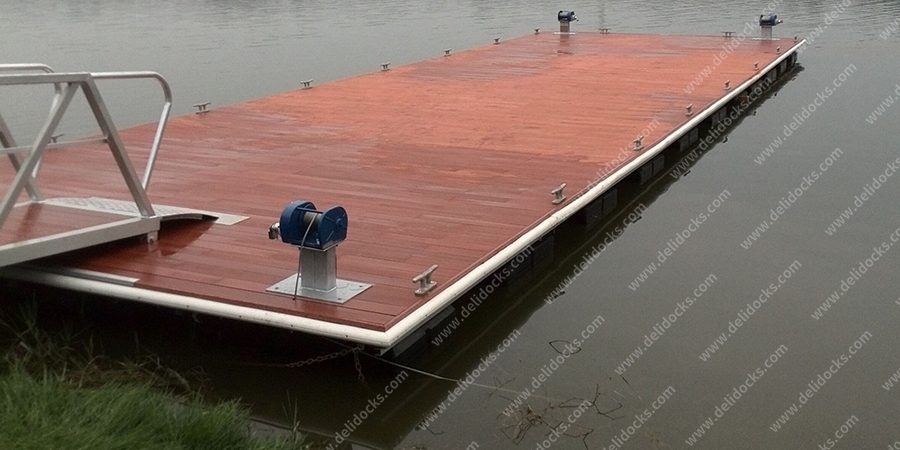
The primary usability requirement for any paddleboard floating dock is a low freeboard – the vertical distance from water surface to deck top. For SUP access:
Optimal freeboard: 150mm to 200mm (6 to 8 inches). This allows paddlers to slide the board onto the dock without lifting, and to kneel on the dock while pulling the board.
Maximum freeboard: 250mm (10 inches). Beyond this, users strain to retrieve boards, increasing fall risk.
Edge profile: Rounded or beveled PVC extrusions covering the deck edge. Sharp aluminum edges cut board rails and injure bare feet.
Board ramp integration: Some docks include a 450mm-wide, 10° sloping section that extends 300mm below water, allowing paddlers to glide the board partly onto the dock before dismounting.
Achieving low freeboard requires sufficient buoyancy relative to deck weight. Each linear meter of dock must displace at least 180 kg to support two adults plus SUP boards with 150mm freeboard.
2. Flotation Core Materials: Closed-Cell Foam vs. Air-Filled Chambers
Two main flotation technologies exist for commercial paddleboard floating dock systems. Each has quantifiable trade-offs:
Expanded polystyrene (EPS) foam encapsulated in rotationally molded polyethylene: Density 32 kg/m³, compressive strength 150 kPa. Provides neutral buoyancy even if outer shell is punctured. Service life 20+ years in freshwater, 12 years in saltwater (UV degradation of shell).
Aluminum or galvanized steel pontoons with air chambers: Lower draft, higher load capacity. But a single puncture floods the chamber, causing tilt. Requires sealed compartments with automatic bilge pumps. More suitable for heavy-duty guest docks than paddleboard-specific areas.
Composite modular blocks (Recycled plastic encased EPS): Each block 0.5m x 0.5m x 0.4m high, providing 80 kg buoyancy. Connectable via through-bolts. Allows customizable dock shapes. Preferred for paddleboard launch zones because low height keeps freeboard under 200mm.
For saltwater installations, specify closed-cell foam with a UV-stabilized HDPE shell (thickness ≥ 6mm) to prevent marine borer damage. DeFever uses cross-linked polyethylene foam (XLPE) that resists water absorption even if cut – absorption rate < 1% after 30 days immersion.
3. Deck Surface Requirements for Barefoot Traffic
SUP dock users often walk barefoot. The deck surface must provide slip resistance when wet, without abrasive textures that cause abrasions. Test criteria:
Static coefficient of friction (COF) per ASTM F1679: ≥ 0.6 when wet (leather test). Wood or painted surfaces often measure 0.3-0.4.
Surface texture: Diamond grating or pebble-textured HDPE (Ra = 50-70μm). Avoid open-grid decking – board fins get caught.
Temperature resistance: Deck surface temperature under direct sun (ambient 35°C) should not exceed 55°C. Light-colored HDPE (tan, gray, sand) stays 15°C cooler than dark colors or aluminum.
Anti-slip inserts: For aluminum decks, apply 3M Safety-Walk tape or factory-bonded polyurethane grit (mesh size 30/50). Replace every 24 months.
A dedicated paddleboard floating dock should also include a 600mm-wide transition zone with a soft, closed-cell foam mat for kneeling. This reduces knee strain when helping children or inexperienced paddlers.
4. Wave Damping and Motion Response
Excessive vertical acceleration causes instability when stepping from a SUP board onto the dock. Engineering targets for a paddleboard floating dock in typical marina wake conditions (wave height 0.2-0.4m, period 2-3 seconds):
Heave response amplitude operator (RAO): ≤ 1.2 at the dominant wave period. Achieved by increasing dock mass (adding concrete ballast) or using wave attenuators.
Natural period of heave > 3.5 seconds: Prevents resonance with short-period boat wakes. Docks with lightweight foam-only construction have natural periods of 1.5-2 seconds, causing uncomfortable bobbing.
Added mass solution: Install ballast voids within the dock structure that can be filled with water or concrete. A 6m x 2.4m dock should have 500-800 kg of ballast to lower the heave natural frequency.
For exposed locations (open lakes, coastal bays), flank the paddleboard launch area with a floating wave attenuator (damping panels with 50% porosity) placed 3-5 meters upwind.
5. Anchoring and Mooring for Water Level Fluctuation
Unlike fixed piers, a paddleboard floating dock must accommodate changing water levels (reservoirs, tidal zones). Three anchoring methods:
Guide piles: Two or four steel pipes (114mm diameter, driven into bed) with slip rings attached to the dock. Allows vertical movement of ±2m. Requires annual greasing of rings.
Hinge gangway with pile anchor: Single pile at the shoreward corner, connected by a hinged walkway. Simpler but restricts width.
Spud pole system: Removable 2-inch schedule 40 pipes inserted through dock corners into receiving sleeves. Manual adjustment for seasonal water changes. Suitable for reservoirs with predictable drawdown cycles.
Specify that the anchoring system limits horizontal dock drift to ≤ 150mm under wind loads of 30 knots. Overly flexible anchor chains (longer than 3m) allow docks to swing sideways, making SUP launching hazardous.
6. Reboarding Aids for Fallen Paddlers
A safety requirement often overlooked: a paddleboard floating dock must facilitate self-rescue from the water. Include:
Boarding ladder: Retractable or fixed, with 300mm step spacing, anti-slip rungs, and a bottom step submerged at least 400mm. Ladder width 400mm. Mount on the side facing the deepest water.
Grab bar: Stainless steel (316 grade) handrail mounted 900mm above deck, providing leverage to pull oneself up.
Low-friction edging: A 150mm wide PVC rub rail that allows wet hands to grip without sharp edges.
Test the reboarding configuration with a person wearing a PFD (lifejacket). The dock must not tilt more than 10° when a 100 kg person pulls on the ladder.
7. Water Quality and Environmental Compatibility
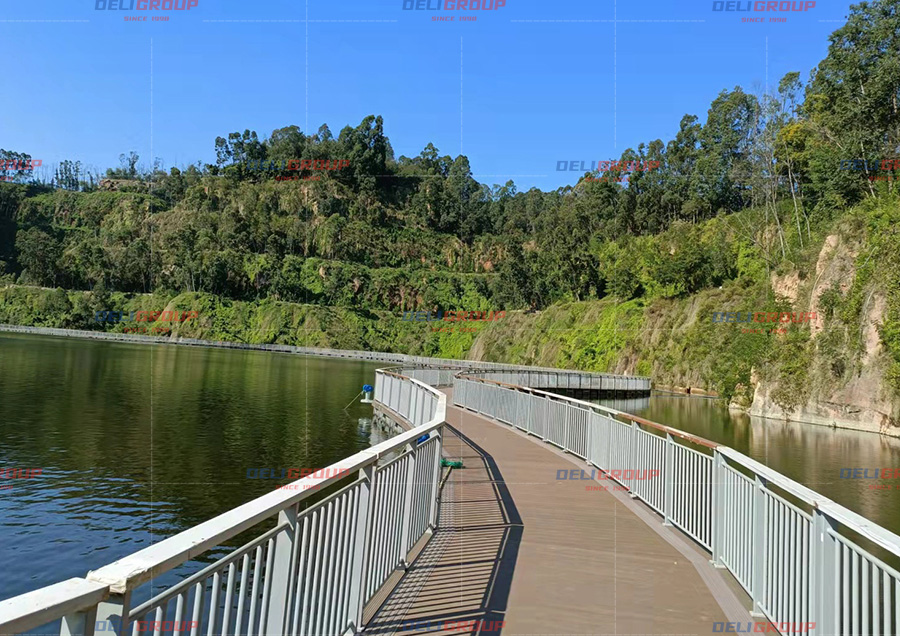
Marina projects require dock materials that minimize environmental impact. For a paddleboard floating dock in sensitive areas (fish habitats, swimming zones):
No pressure-treated wood: Leaches copper, chromium, or arsenic into water. Use HDPE plastic lumber or untreated cedar with sacrificial anodes (if saltwater).
Non-toxic antifouling: If the wetted surfaces require antifouling, use silicone-based coatings (e.g., Intersleek) not copper-based paints.
Permeability: Gaps between deck planks should be ≤ 6mm to prevent fin entanglement but allow light to reach submerged vegetation. Avoid solid surfaces that shade out eelgrass.
Shading factor: For docks over critical habitat, calculate the shading footprint. A 6m x 3m dock can block 18m² of light; mitigate by using a central open atrium (1m x 1m cutout).
DeFever offers an eco-float range made from 100% recycled HDPE with UV inhibitors, meeting US EPA's WaterSense criteria for low environmental impact.
8. Modular Connectivity for Multi-Board Storage Layout
Commercial operations (SUP rental concessions, paddleboard yoga classes) need dock layouts that separate launching, retrieving, and storage zones. Design a paddleboard floating dock system as interconnected modules:
Launch lane: 2.4m wide, 6m long, with low freeboard and a gently sloping underwater ramp (made of perforated HDPE) to guide boards into water.
Retrieval platform: 3m x 3m square with side rails and a boarding ladder. Deck height 180mm.
Dry storage racks: Overhead stainless steel framework (2-tier) with padded cradles. Each rack holds 6-8 boards vertically.
Paddle holders: U-shaped clips mounted at waist height, spaced 400mm apart, to prevent paddles from rolling into water.
Connect modules using M12 stainless steel bolts with vibration-damping rubber washers. Avoid welded connections – they prevent reconfiguration.
9. UV Degradation and Material Selection for Longevity
Outdoor exposure drastically affects dock life. Test data for common materials in a paddleboard floating dock under Florida sun (UV index 10+) after 5 years:
Untreated HDPE (black or natural): Surface chalking depth 0.2-0.5mm, but no structural loss. Acceptable.
Aluminum (6061-T6) with anodized finish (class 20): Minimal degradation but gets hot. Powder coating (80μm polyester) lasts 8-10 years before fading.
Composite wood (HDPE + wood fiber): Color fades by 40% in 2 years. Wood fibers absorb moisture, leading to freeze-thaw cracking in northern climates.
Marine-grade plywood sealed with epoxy: Delaminates within 2 years. Not suitable for floating docks.
Recommendation: Use UV-stabilized HDPE (additive package including 2.5-3% carbon black or titanium dioxide) for all deck and float components. Life expectancy exceeds 25 years when anchored away from direct sand abrasion.
10. Load Design: Personnel, Board Weight, and Crowding
Structural design must account for dynamic and static loads according to ASCE 7-22 and marina standards (PIANC). For a paddleboard floating dock:
Live load (uniformly distributed): 4.8 kN/m² (100 psf) – equivalent to eight 75 kg persons densely packed on a 2.4m x 3.6m area.
Concentrated load: 1.5 kN (150 kg) applied over a 250mm x 250mm area without permanent deflection.
Impact load from board: A SUP board weighing 15 kg hitting the dock edge at 2 m/s generates ~300 N impact force. Edge member must resist without cracking.
Safety factor: 2.0 against flotation capacity (i.e., dock must remain afloat even if 50% of air volume flooded).
Ask the dock supplier for a stamped engineering calculation showing that under fully loaded conditions (maximum number of persons plus boards), the freeboard stays above 50mm. Less than 50mm means the deck submerges, causing tripping hazard.
11. Installation Considerations for Variable Shoreline Conditions
Site factors impact dock performance. Before ordering a paddleboard floating dock, evaluate:
Seabed composition: Soft mud requires helical piles (screw anchors) with 2-3m penetration. Rocky bottoms need deadweight anchors (concrete blocks, 1000-2000 kg each).
Water depth range: Minimum depth at lowest water must be 0.5m below bottom of dock to prevent grounding. For tidal ranges >1.5m, use pile guides.
Ice conditions: In freeze-thaw zones, remove dock each winter or use ice-eater aerators. EPS foam can be crushed by ice expansion.
Access from shore: A gangway with slope ≤ 1:6 (for wheelchair access) or temporary steps. The pivot point should be at least 1m inland to avoid sediment disturbance.
DeFever provides a pre-installation site inspection checklist (soil test, bathymetry survey, prevailing wind recording) to match dock design to local conditions.
12. Compliance with ADA Accessibility (For Public Facilities)
If the paddleboard floating dock serves a public marina, it may need to comply with the Americans with Disabilities Act (ADA) or local equivalent. Requirements:
Accessible route: Gangway width ≥ 1.2m with 1:12 slope maximum (8.33%).
Edge protection: Curbs or raised edges at least 50mm high along open sides to prevent wheelchair roll-off.
Transfer system: A 300mm high platform (compared to deck) that allows a person to transfer from a wheelchair to a paddleboard seating position.
Handrails: 865mm to 965mm height, continuous, with a 300mm extension beyond the end of the gangway.
Most commercial SUP docks are not explicitly ADA-compliant due to the low freeboard requirement conflicting with wheelchair access. If compliance is mandatory, design a separate transfer dock adjacent to the main paddleboard launch.
Frequently Asked Questions (FAQ) – Paddleboard Floating Dock
Q1: What is the recommended size for a paddleboard floating dock
serving a public SUP launch area?
A1: For a single
launch lane, minimum dock dimensions are 2.4m wide x 4.5m long. This provides
enough space for two persons to prepare boards and a third to retrieve. For high
traffic (over 20 launches per hour), expand to 3.6m x 6m with two separate
launch lanes separated by a central divider. DeFever offers modular extensions that bolt onto existing dock sections.
Q2: How do I prevent algae and slime buildup on a paddleboard
floating dock without harsh chemicals?
A2: Specify
a deck surface with microban additive (embedded antimicrobial) or use a pressure
washer (1500 psi) every 30 days. For underwater flotation surfaces, install a
thin copper sheet (0.5mm) on the bottom edges – copper naturally inhibits
biofouling. Do not use copper-based paints as they leach into water. An
alternative is a weekly rinse with a 10% vinegar solution, safe for the
environment.
Q3: Can a paddleboard floating dock be installed on a lake with
fluctuating water levels up to 3 meters?
A3: Yes,
using a pile-guided system. Drive two 100mm diameter steel pipes vertically into
the lakebed, passing through guide rings attached to the dock. The rings slide
up and down as water level changes. For 3m fluctuation, pipe length should
extend 4m above maximum water level. Ensure the guide rings have nylon bushings
to reduce friction and noise.
Q4: What safety hardware is mandatory on a commercial paddleboard
dock?
A4: Required items per most local
regulations: (1) A Type IV throwable flotation device (ring buoy or cushion)
mounted within 2m of the dock entrance, (2) A reaching pole (4m long) with a
hook, (3) Signage showing maximum capacity (persons and boards), (4) Anti-slip
warning signs at the gangway, (5) Lighting if used after sunset – minimum 50 lux
at deck level. Also, a first aid kit stored in a waterproof box is strongly
recommended.
Q5: How often should a paddleboard floating dock be
inspected?
A5: Perform a visual inspection at the
start of each operating season and after any major storm (>50 knot winds or
0.5m wave event). Check for: loose bolts (torque check to 40 Nm for M12
fasteners), cracked polyethylene shells, missing chafe guards, and corrosion on
metal components (especially welds and chain links). Replace any shackle with
visible red rust (more than 5% surface area). For foam-filled docks, probe for
soft spots – signs of hull breach and water absorption.
Q6: Is a paddleboard floating dock suitable for saltwater
marinas?
A6: Absolutely, but material selection is
critical. Use 316 stainless steel for all bolts, hinges, and ladders (304 grade
pits in salt air). Avoid aluminum unless anodized and fitted with sacrificial
zinc anodes (replace annually). HDPE and EPS foam are naturally
saltwater-resistant. However, marine borers (shipworms) can penetrate damaged
polyethylene shells; specify a closed-cell foam that does not provide habitat.
Rinse the dock with freshwater at the end of each season.
Q7: Can I install a paddleboard floating dock by myself without
professional marine contractors?
A7: For small
modular sections (each less than 100 kg), a team of three people can assemble
docks using hand tools. However, anchoring (driving piles or placing concrete
blocks) often requires specialized equipment like a vibratory hammer or crane.
Also, electrical work for lighting must be done by a licensed electrician. For
public or commercial installations, hire a marine contractor to ensure
compliance with local building codes and insurance policies. DeFever offers installation oversight services for
large projects.
Ready to Engineer Your SUP Launch Facility?
Selecting a paddleboard floating dock requires balancing user safety, environmental conditions, and long-term durability. DeFever provides custom-engineered solutions based on your water depth, wave exposure, and expected traffic. Submit your site data (waterbody type, maximum wave height, target freeboard, and number of simultaneous users) to receive a structural layout and buoyancy calculation report.
Start your inquiry now:
Email: deli@delidocks.com
Request form: https://www.dfyachts.com/contact
Specification sheet available for download – response within two business days.