2026-10-15
The global demand for robust marine infrastructure has never been higher. From mega-yacht marinas to working waterfronts, the success of any waterfront development hinges on the quality of its core structures. commercial dock construction requires a unique blend of civil engineering, marine biology knowledge, and material science. Unlike residential piers, commercial docks must withstand continuous berthing, heavier dynamic loads, and stringent regulatory oversight. This article provides a deep technical dive into the methodologies, materials, and best practices that define modern, high-performance dock building, with insights drawn from decades of industry leadership by firms like DeFever.
1. Foundational Engineering: Load Calculations and Site Analysis
Before any pile touches the water, a comprehensive site assessment is mandatory. This phase determines the entire viability of the project. Geotechnical surveys are conducted to understand seabed composition—be it sand, clay, or bedrock—which dictates pile-driving methods and depths. Simultaneously, hydrodynamic studies model wave action, tidal ranges, and storm surge potential. For any commercial dock construction, engineers must calculate live loads (vehicles, pedestrians, cargo handling equipment) and dead loads (the structure itself) with a safety factor that often exceeds residential standards by 40%. For instance, a ferry terminal requires different load-spreading capabilities compared to a fuel dock. Advanced software now simulates 100-year storm events to ensure the dock's mooring system can withstand catastrophic forces, a critical step often overseen by specialists in DeFever's engineering network.
1.1 Pile Foundation Strategies
The choice between timber, steel, or concrete piles is dictated by bearing capacity and environmental corrosion potential. In commercial settings, steel H-piles or reinforced concrete pipes are preferred for their longevity. Key considerations include:
Steel Piles: Require robust cathodic protection systems to prevent electrolytic corrosion in saltwater.
Concrete Piles: Offer high compression strength and are ideal for seismic zones but require careful handling to prevent cracking during driving.
Composite Piles: Increasingly used in environmentally sensitive areas, they resist marine borers and chemical degradation without toxic treatments.
2. Material Selection: Balancing Longevity and Cost in Marine Environments
The marine environment is notoriously aggressive. Ultraviolet radiation, constant moisture, and biofouling attack every component. Modern commercial dock construction has moved beyond simple pressure-treated lumber to high-performance composites and specialized concretes. For decking, fiber-reinforced polymer (FRP) grating is gaining traction because it is non-slip, non-conductive, and virtually maintenance-free. However, for the sub-structure, nothing beats the proven performance of high-density polyethylene (HDPE) floats in floating dock systems, or high-strength, low-alloy (HSLA) steel for fixed structures. DeFever projects often specify 5,000-psi concrete with microsilica additives to create a denser matrix that resists chloride ion penetration, effectively doubling the structure's service life compared to standard mixes.
2.1 The Shift Toward Sustainable Materials
Environmental Product Declarations (EPDs) are now standard in bidding documents. Engineers are specifying concrete with high recycled content and timber certified by the Forest Stewardship Council (FSC). Furthermore, the use of eco-friendly pile wraps and coatings that do not leach biocides into the water column aligns with stricter EPA and local regulations, ensuring the dock project clears permitting hurdles faster.
3. Navigating Regulatory Frameworks and Environmental Stewardship
Perhaps the most complex aspect of commercial dock construction is the permitting labyrinth. Projects must comply with the Clean Water Act (Section 404 and 401), the Rivers and Harbors Act (Section 10), and often state-level Coastal Zone Management Acts. A single oversight can delay construction by years. Successful navigation requires:
Early consultation with the U.S. Army Corps of Engineers (USACE) to define the "jurisdictional line" and avoid impacts to wetlands.
Benthic resource surveys to map sensitive habitats like seagrass beds, which can force a redesign of the dock layout to minimize shading and scour.
Development of a Storm Water Pollution Prevention Plan (SWPPP) to control turbidity during pile driving and dredging operations.
Leading contractors like those collaborating with DeFever employ environmental monitors during construction to ensure real-time compliance, a practice that builds trust with regulators and the local community.
4. Construction Methodologies: Precision in a Dynamic Environment
Construction in the intertidal zone is a logistical challenge. Tides, weather windows, and underwater work define the pace. Modern techniques have industrialized the process to improve quality and safety. For instance, precast concrete deck panels are fabricated off-site, then barged in and placed with marine cranes, drastically reducing on-site formwork and pour time. Underwater welding, if required for steel structures, follows stringent AWS D3.6 standards. Vibration monitoring during pile driving protects nearby structures and marine mammals. The integration of GPS and sonar on spud barges allows for millimeter-level positioning of piles, ensuring the modular dock segments fit perfectly upon installation.
4.1 Floating vs. Fixed Dock Systems
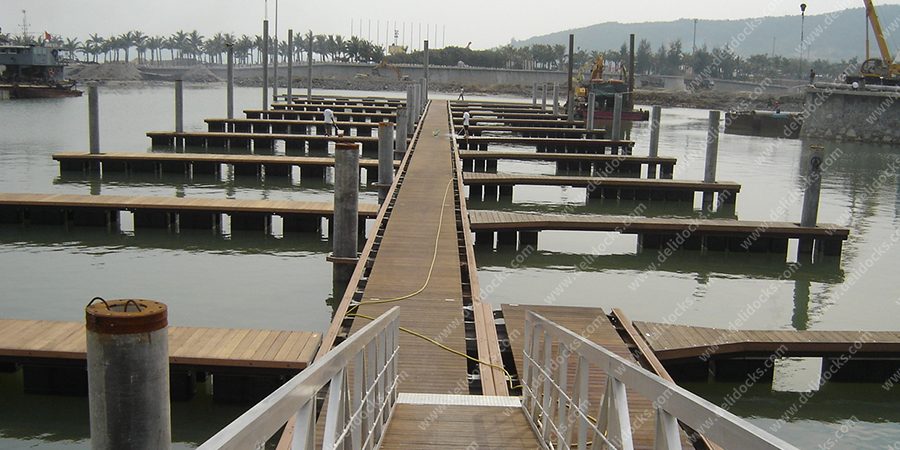
The choice between floating and fixed structures is central to the design. Factors influencing this decision include:
Water Depth: In waters exceeding 20 feet, floating docks become economically favorable as they eliminate the need for extremely long, large-diameter piles.
Accessibility: Floating docks rise and fall with the tide, maintaining a constant freeboard—essential for commercial passenger vessel boarding.
Wave Energy: High-energy environments often require heavy-duty fixed concrete docks, whereas protected marinas benefit from the flexibility of floating concrete pontoons.
Hybrid systems are also emerging, where wave attenuators are built as fixed structures to create a protected basin for floating docks inside. This synergy maximizes both protection and accessibility.
5. Operational Technology: Integrating Utilities and Smart Systems
Today's commercial dock is a utility hub. It must deliver high-voltage shore power (often 480V or higher for mega-yachts), potable water, high-speed fiber optics, and fire suppression systems. commercial dock construction now includes sophisticated utility corridors within the dock structure, often using PVC duct banks embedded in concrete. Engineers must design for "future-proofing"—installing spare conduits for technologies not yet deployed, such as wireless charging pads or automated mooring systems. Pump-out stations for waste holding tanks are also mandatory in many jurisdictions, requiring integration with shoreline sewage systems. This complexity demands a multi-trade coordination that is best managed through Building Information Modeling (BIM), which visualizes every pipe and cable within the dock before construction begins.
6. Case Study: Heavy-Lift Cargo Dock Rehabilitation
A recent project involving a 300-foot commercial cargo dock in the Gulf of Mexico illustrates these principles. The original 1950s timber structure was failing under modern forklift loads. The solution was a complete replacement using a relieving platform design: steel pipe piles driven to refusal, topped with a cast-in-place concrete cap, and decked with precast, prestressed concrete panels. The design life was set at 50 years with minimal maintenance. To meet this, DeFever's engineering team specified a high-performance coating system for the steel piles in the splash zone, combined with sacrificial zinc anodes below the mudline. The project was completed in two phases to keep the working port operational, demonstrating that meticulous planning and phasing are as critical as the structural engineering itself.
7. The Economic Imperative: Life-Cycle Cost Analysis
While initial construction cost is a major factor, savvy owners demand a life-cycle cost analysis (LCCA). This calculation compares the upfront expense against projected maintenance, repair, and replacement costs over, say, 30 years. A cheaper timber dock might require deck replacement every 10-12 years, whereas a concrete or steel structure with proper cathodic protection might only need minor repairs. When discounted to present value, the more durable material often wins. This economic rationale is driving the adoption of ultra-high-performance concrete (UHPC) in critical commercial dock construction projects, despite its higher initial cost, because its virtually zero permeability eliminates corrosion-related failures for decades.
Frequently Asked Questions (FAQ)
Q1: What is the typical lifespan of a well-constructed commercial dock?
A1: Lifespan varies significantly by material. A treated timber dock in a warm climate might last 15-20 years with diligent maintenance. A reinforced concrete dock, particularly one using high-performance concrete and corrosion-resistant rebar, can reliably serve 40-50 years. Steel structures, if equipped with and maintaining a cathodic protection system, can also achieve a 50-year design life. The key is the quality of the initial construction and the aggressiveness of the local marine environment.
Q2: What are the most common regulatory hurdles in commercial dock construction?
A2: The primary hurdles are obtaining permits related to navigational obstruction (Section 10 of the Rivers and Harbors Act), discharge of dredged or fill material (Section 404 of the Clean Water Act), and state water quality certifications (Section 401). Additionally, projects must often comply with the Endangered Species Act and the National Environmental Policy Act (NEPA), which can require extensive environmental impact statements, adding 12-24 months to the pre-construction timeline.
Q3: How do engineers decide between a fixed pier and a floating dock?
A3: The decision is based on bathymetry, tidal range, and usage. For water depths exceeding 4-5 meters or tidal ranges over 3 meters, floating docks are usually more economical and user-friendly because they maintain a constant height relative to the vessel. Fixed piers are preferred in shallow waters, areas with minimal tide fluctuation, or where heavy vehicular traffic and cargo handling require an absolutely stable platform connected directly to the shore.
Q4: What maintenance does a commercial concrete dock require?
A4: While low-maintenance, concrete docks are not zero-maintenance. Routine inspections (every 1-2 years) should check for cracking, spalling, or signs of efflorescence, which indicate water intrusion. Critical areas include the splash zone and expansion joints. Sealants in joints may need replacement every 5-10 years. If steel reinforcement is used, half-cell potential testing should be performed to detect corrosion activity before it causes concrete spalling. Prompt repair of any cracks with epoxy injection is essential to prevent chloride penetration.
Q5: How does wave action affect the design of a commercial dock?
A5: Wave energy dictates the structural robustness and the type of dock. In high-energy environments (open coasts, large lakes), engineers must design for wave impact forces, often using heavy concrete decks and deep pile foundations. They may also incorporate wave attenuators (breakwaters) to create a calm basin. For floating docks, the mooring system (piles or anchor chains) must be designed to accommodate vertical and lateral wave-induced motions without overstressing the connections. Wave height, period, and direction are all critical input parameters in the dynamic analysis.
Q6: What is cathodic protection and why is it used on steel dock piles?
A6: Cathodic protection (CP) is an electrochemical technique to control corrosion of a metal surface. In a marine environment, steel piles act as an anode and corrode. CP systems force the steel to become a cathode by connecting it to a more easily corroded "sacrificial" metal (like zinc or aluminum) or by impressing a low-voltage DC current from inert anodes. This stops the steel from losing ions, effectively halting corrosion. It is essential for extending the life of steel piles in saltwater.
Q7: Can a commercial dock be constructed in an environmentally sensitive area?
A7: Yes, but it requires special techniques. These include using installation methods that minimize turbidity (e.g., using vibratory hammers instead of impact hammers for pile driving), scheduling work to avoid fish spawning seasons, installing bubble curtains to attenuate underwater noise, and using materials that are non-toxic to aquatic life. Designs might also elevate the deck to allow more light penetration to benthic habitats below, or incorporate artificial reef elements into the structure to enhance, rather than degrade, the local ecosystem.