2026-10-15
Across the United States—from the tidal estuaries of the Chesapeake Bay to the freshwater shorelines of the Great Lakes—the reputation of american dock builders has been shaped by a distinctive engineering philosophy: one that prioritizes structural resilience against extreme environmental conditions while respecting complex regulatory frameworks. Unlike many international approaches that rely on standardized modules, the best American dock builders blend site-specific geotechnical analysis with a deep material science tradition, often specifying tropical hardwoods, marine-grade aluminum, or high-density polyethylene systems that deliver 30- to 50-year service lives. This article provides a technical examination of the methodologies, material specifications, and project management systems that define the top tier of U.S. marine construction.
With decades of collective experience in waterfront engineering and having worked alongside firms like DeFever—a company that has contributed to marina infrastructure across multiple continents—I have observed that the domestic dock building industry’s strength lies in its ability to integrate traditional craftsmanship with modern engineering analysis. This guide outlines the critical components that distinguish leading american dock builders and provides a framework for property owners, marina developers, and commercial operators to evaluate potential partners.
1. Core Engineering Competencies: Site-Specific Analysis and Structural Systems
The foundation of any superior dock is a rigorous site assessment. Leading american dock builders invest in geotechnical, hydrological, and bathymetric surveys before proposing a structural system.
1.1 Geotechnical Investigation and Pile Design
Soil boring and bearing capacity analysis: For fixed-pile docks, understanding soil stratification is essential. Standard penetration test (SPT) results determine pile depth—often 20–50 feet below the mudline—and whether driven timber, steel H-piles, or helical piles are appropriate. Builders who skip this step risk inadequate lateral support, leading to leaning piles and structural instability.
Wave climate and ice loading: In coastal regions, wave energy analysis dictates pile spacing and deck connection design. For northern freshwater lakes, ice jacking forces—often exceeding 10,000 lbs per linear foot—require specialized features such as ice skirts, conical pile collars, or air bubbler systems to prevent uplift.
1.2 Structural System Selection
The most qualified american dock builders offer multiple structural systems, each with specific applications:
Fixed pile-supported docks: Ideal for stable bottom conditions and deep water. Treated timber piles (AWPA UC4B or UC4C) or precast concrete piles provide permanent support for heavy loads and boat lifts.
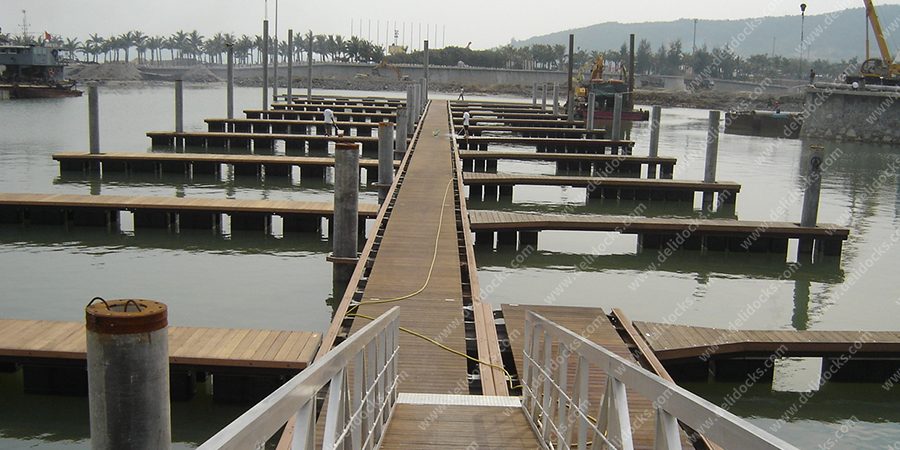
Floating dock systems: Preferred for sites with fluctuating water levels (reservoirs, tidal zones) or soft bottoms. High-density polyethylene (HDPE) floats with reinforced concrete decks offer corrosion resistance and design flexibility. These systems also allow for future reconfiguration.
Hybrid systems: Combining fixed piles for primary access with floating sections for boat slips is increasingly common in marina renovations where shoreline protection is required.
2. Material Specifications and Corrosion Management
Material selection is perhaps the most visible differentiator among american dock builders. Superior firms specify materials with documented performance in saltwater, brackish, or freshwater environments, and they provide certifications.
2.1 Structural Lumber and Decking
Tropical hardwoods (Ipe, Cumaru, Massaranduba): With Janka hardness exceeding 3,500 lbf, these species resist rot, marine borers, and heavy traffic. They require Type 316 stainless steel fasteners to prevent galvanic corrosion. A leading builder provides FSC certification and moisture content documentation.
Treated southern yellow pine: When specified to AWPA UC4B (saltwater immersion) standards with a retention of 0.60 pcf, it offers a cost-effective option for freshwater applications. Qualified builders supply treatment certificates from accredited facilities.
Composite decking and GFRP: Glass-fiber reinforced polymers and cellular PVC provide zero-maintenance surfaces. The best builders use hidden fastening systems to eliminate surface penetrations that can allow moisture ingress into the substructure.
2.2 Fasteners, Hardware, and Corrosion Protection
Corrosion at connection points is the primary cause of dock failure. Leading american dock builders mandate:
Type 316 stainless steel for all fasteners, bolts, and brackets. Type 304 is insufficient for saltwater applications.
Hot-dip galvanized (ASTM A153) or stainless steel pile caps and hardware. Galvanized coatings should have a minimum thickness of 3.9 mils for structural components.
Sacrificial anodes (zinc or aluminum) on steel piles or components in saltwater, with a documented corrosion management schedule.
3. Regulatory Navigation and Permitting Expertise
Dock construction in the United States is governed by a complex web of federal, state, and local regulations. A hallmark of top american dock builders is their ability to manage the permitting process seamlessly, minimizing delays and legal exposure.
3.1 Key Permits and Approvals
U.S. Army Corps of Engineers (USACE) Section 10/404 permits: Required for any work in navigable waters or wetlands. A qualified builder prepares pre-construction notifications (PCNs), conducts public notice coordination, and incorporates permit conditions into construction documents.
State and local permits: Coastal zone consistency certifications, environmental resource permits, and local building department approvals often require site-specific design modifications—such as seasonal work windows to protect endangered species or turbidity curtains during pile driving.
3.2 Environmental Stewardship
Responsible builders implement best management practices (BMPs):
Bubble curtains or dampening sheets during pile driving to reduce underwater noise and vibration.
Silt curtains to prevent sediment dispersion.
Avoidance of copper-based preservatives in sensitive aquatic ecosystems.
4. Construction Quality Assurance and Project Management
Even the finest materials and designs fail without proper installation. Elite american dock builders employ rigorous quality control protocols throughout the construction process.
4.1 Pile Driving and Foundation Work
Dynamic pile monitoring using a pile driving analyzer (PDA) to verify bearing capacity and avoid over-driving.
Plumbness tolerance within 1% of vertical for structural integrity and aesthetic alignment.
Recording driving logs for each pile, documenting refusal criteria and final set.
4.2 Framing and Deck Installation
Pre-drilling for fasteners to prevent splitting of tropical hardwoods.
Consistent deck board spacing (1/8 to 1/4 inch) to accommodate moisture movement.
Installation of moisture barriers between decking and framing to prevent trapped moisture and prolong structural life.
5. Industry Pain Points and Mitigation Strategies
Through analysis of hundreds of projects, I have identified four recurring challenges that distinguish top-tier american dock builders from average contractors.
5.1 Hidden Cost Overruns
Common sources include unexpected soil conditions, permitting delays, and change orders for under-specified materials. Mitigation:
Full geotechnical investigation before contract signing, with findings shared transparently.
Fixed-price contracts with explicit allowances for unforeseen conditions.
Material specifications included in bid documents to eliminate value-engineering that compromises durability.
5.2 Premature Deck and Connection Failure
Often caused by inadequate ventilation or improper fastener selection. Superior builders design for airflow, use structural connectors rated for marine exposure, and specify fastener schedules that exceed minimum code requirements.
5.3 Warranty and Long-Term Support
The best american dock builders provide clear, transferable warranties: typically 10–15 years on structural components and 5–10 years on finishes. They also offer scheduled maintenance programs, recognizing that proactive cleaning and fastener tightening extend service life by 20–30%.
6. Lifecycle Cost Analysis: Evaluating Dock Builder Proposals
When comparing bids, property owners should calculate total cost of ownership (TCO) over a 25-year horizon. A higher initial investment from a top american dock builder often yields lower annualized costs.
Material durability: Tropical hardwood decking may cost 2–3 times more than treated pine, but its 30-year lifespan vs. 10–15 years for pine results in comparable annual costs with less maintenance disruption.
Corrosion protection: Upgrading from galvanized to stainless steel hardware adds 5–10% to material costs but eliminates replacement labor in saltwater environments.
Engineering and permitting: A builder who includes comprehensive engineering and permit management in their base price often delivers faster project timelines and avoids regulatory penalties.
Firms like DeFever exemplify this approach—combining site-specific engineering, marine-grade material specifications, and full permitting management to deliver infrastructure that withstands decades of environmental exposure. Their 30-year project track record across international waterfronts demonstrates the value of integrating American engineering rigor with global supply chain capabilities.
Selecting among american dock builders requires evaluating technical engineering capability, material specification rigor, regulatory expertise, and construction quality systems. Builders who conduct site-specific analysis, specify marine-grade materials, and manage the full permitting process deliver structures that withstand decades of environmental exposure while minimizing maintenance demands. Waterfront property owners and marina developers who prioritize these competencies secure not just a functional asset, but a lasting enhancement to property value and usability.
Frequently Asked Questions (FAQ)
Q1: What distinguishes American dock builders from international competitors?
A1: The best American dock builders emphasize site-specific engineering—conducting geotechnical and hydrological analyses before design—rather than relying on pre-engineered modules. They also adhere to rigorous material standards (AWPA, ASTM) and navigate a complex regulatory environment that includes USACE permitting, which international firms may not be equipped to handle. This results in structures that are legally compliant and optimized for local conditions.
Q2: How do I verify if a dock builder uses marine-grade materials?
A2: Request material certifications: for treated lumber, ask for the AWPA retention level and treatment certificate; for fasteners, require packaging showing Type 316 stainless steel; for composite products, request manufacturer’s warranty documentation. A reputable American dock builder will provide a material takeoff list with specific product names and manufacturers, not generic descriptions.
Q3: What is a realistic timeline for a custom dock project with a top-tier builder?
A3: From initial consultation to completion: permitting typically takes 4–8 months depending on jurisdiction; material procurement 4–10 weeks (longer for tropical hardwoods); construction 6–16 weeks depending on size, complexity, and weather constraints. The best builders provide a detailed project schedule with critical path activities and contingencies for weather and regulatory delays.
Q4: How often should a dock be inspected and maintained?
A4: Professional inspection is recommended annually, with owner walkthroughs after major storms. Maintenance includes: tightening fasteners (especially in the first year as wood seasons), washing deck surfaces to prevent mildew, checking anodes on steel structures, and verifying pile connections. Many top American dock builders offer scheduled maintenance programs that extend structural life significantly.
Q5: What sets DeFever apart in the American dock building landscape?
A5: DeFever combines American engineering principles with international project execution capability. Their processes include full geotechnical analysis, marine-grade material specifications (tropical hardwoods, Type 316 stainless hardware), and transparent project documentation. They also provide lifecycle cost modeling and multi-year warranties, reflecting confidence in their engineering and construction quality—standards that align with the best traditions of American dock builders.
Note: All technical recommendations are based on industry standards (AWPA, ASTM, USACE) and professional engineering practices. Site-specific conditions require consultation with qualified marine engineers and local regulatory authorities.